

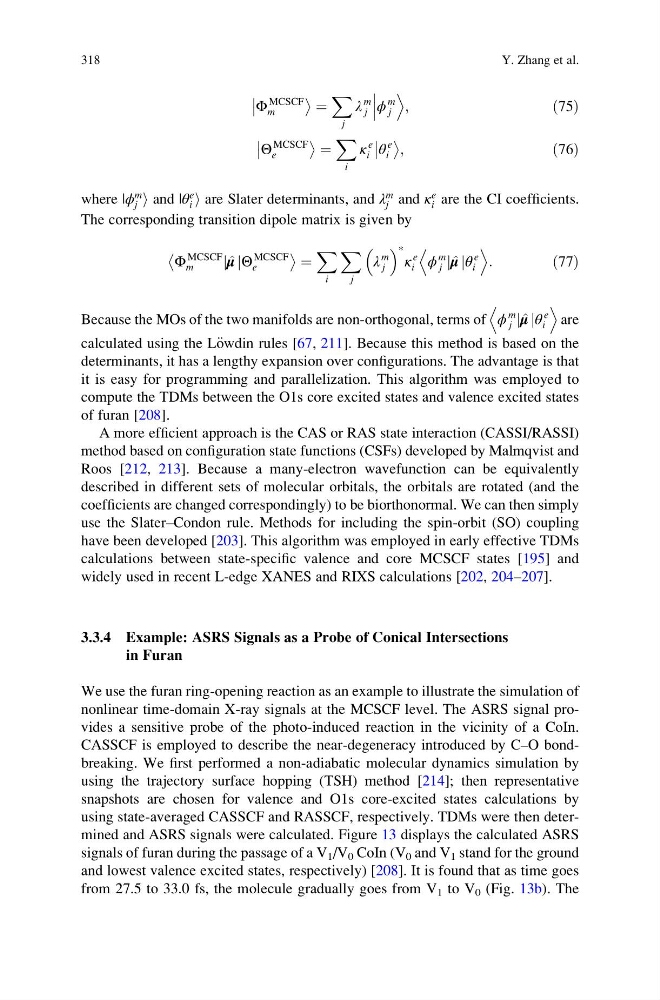
Φ
MCSCF
m
¼
X
j
λ
m
j ϕ
m
j
E
;
ð75Þ
Θ
MCSCF
e
¼
X
i
κ
e
i θ
e
i
;
ð76Þ
where |ϕ
m
j i and |θ
e
i i are Slater determinants, and λ
m
j and κ
e
i are the CI coefficients.
The corresponding transition dipole matrix is given by
Φ
MCSCF
m
^
μ
j jΘ
MCSCF
e
¼
X
i
X
j
λ
m
j
* κ
e
i ϕ
m
j ^
μ
j jθ
e
i
D
E
:
ð77Þ
Because the MOs of the two manifolds are non-orthogonal, terms of ϕ
m
j ^
μ
j jθ
e
i
D
E
are
calculated using the L€ owdin rules [67, 211]. Because this method is based on the
determinants, it has a lengthy expansion over configurations. The advantage is that
it is easy for programming and parallelization. This algorithm was employed to
compute the TDMs between the O1s core excited states and valence excited states
of furan [208].
A more efficient approach is the CAS or RAS state interaction (CASSI/RASSI)
method based on configuration state functions (CSFs) developed by Malmqvist and
Roos [212, 213]. Because a many-electron wavefunction can be equivalently
described in different sets of molecular orbitals, the orbitals are rotated (and the
coefficients are changed correspondingly) to be biorthonormal. We can then simply
use the Slater–Condon rule. Methods for including the spin-orbit (SO) coupling
have been developed [203]. This algorithm was employed in early effective TDMs
calculations between state-specific valence and core MCSCF states [195] and
widely used in recent L-edge XANES and RIXS calculations [202, 204–207].
3.3.4 Example: ASRS Signals as a Probe of Conical Intersections
in Furan
We use the furan ring-opening reaction as an example to illustrate the simulation of
nonlinear time-domain X-ray signals at the MCSCF level. The ASRS signal provides a sensitive probe of the photo-induced reaction in the vicinity of a CoIn.
CASSCF is employed to describe the near-degeneracy introduced by C–O bondbreaking. We first performed a non-adiabatic molecular dynamics simulation by
using the trajectory surface hopping (TSH) method [214]; then representative
snapshots are chosen for valence and O1s core-excited states calculations by
using state-averaged CASSCF and RASSCF, respectively. TDMs were then determined and ASRS signals were calculated. Figure 13 displays the calculated ASRS
signals of furan during the passage of a V 1 /V 0 CoIn (V 0 and V 1 stand for the ground
and lowest valence excited states, respectively) [208]. It is found that as time goes
from 27.5 to 33.0 fs, the molecule gradually goes from V 1 to V 0 (Fig. 13b). The
318
Y. Zhang et al.
MCSCF
m
¼
X
j
λ
m
j ϕ
m
j
E
;
ð75Þ
Θ
MCSCF
e
¼
X
i
κ
e
i θ
e
i
;
ð76Þ
where |ϕ
m
j i and |θ
e
i i are Slater determinants, and λ
m
j and κ
e
i are the CI coefficients.
The corresponding transition dipole matrix is given by
Φ
MCSCF
m
^
μ
j jΘ
MCSCF
e
¼
X
i
X
j
λ
m
j
* κ
e
i ϕ
m
j ^
μ
j jθ
e
i
D
E
:
ð77Þ
Because the MOs of the two manifolds are non-orthogonal, terms of ϕ
m
j ^
μ
j jθ
e
i
D
E
are
calculated using the L€ owdin rules [67, 211]. Because this method is based on the
determinants, it has a lengthy expansion over configurations. The advantage is that
it is easy for programming and parallelization. This algorithm was employed to
compute the TDMs between the O1s core excited states and valence excited states
of furan [208].
A more efficient approach is the CAS or RAS state interaction (CASSI/RASSI)
method based on configuration state functions (CSFs) developed by Malmqvist and
Roos [212, 213]. Because a many-electron wavefunction can be equivalently
described in different sets of molecular orbitals, the orbitals are rotated (and the
coefficients are changed correspondingly) to be biorthonormal. We can then simply
use the Slater–Condon rule. Methods for including the spin-orbit (SO) coupling
have been developed [203]. This algorithm was employed in early effective TDMs
calculations between state-specific valence and core MCSCF states [195] and
widely used in recent L-edge XANES and RIXS calculations [202, 204–207].
3.3.4 Example: ASRS Signals as a Probe of Conical Intersections
in Furan
We use the furan ring-opening reaction as an example to illustrate the simulation of
nonlinear time-domain X-ray signals at the MCSCF level. The ASRS signal provides a sensitive probe of the photo-induced reaction in the vicinity of a CoIn.
CASSCF is employed to describe the near-degeneracy introduced by C–O bondbreaking. We first performed a non-adiabatic molecular dynamics simulation by
using the trajectory surface hopping (TSH) method [214]; then representative
snapshots are chosen for valence and O1s core-excited states calculations by
using state-averaged CASSCF and RASSCF, respectively. TDMs were then determined and ASRS signals were calculated. Figure 13 displays the calculated ASRS
signals of furan during the passage of a V 1 /V 0 CoIn (V 0 and V 1 stand for the ground
and lowest valence excited states, respectively) [208]. It is found that as time goes
from 27.5 to 33.0 fs, the molecule gradually goes from V 1 to V 0 (Fig. 13b). The
318
Y. Zhang et al.