

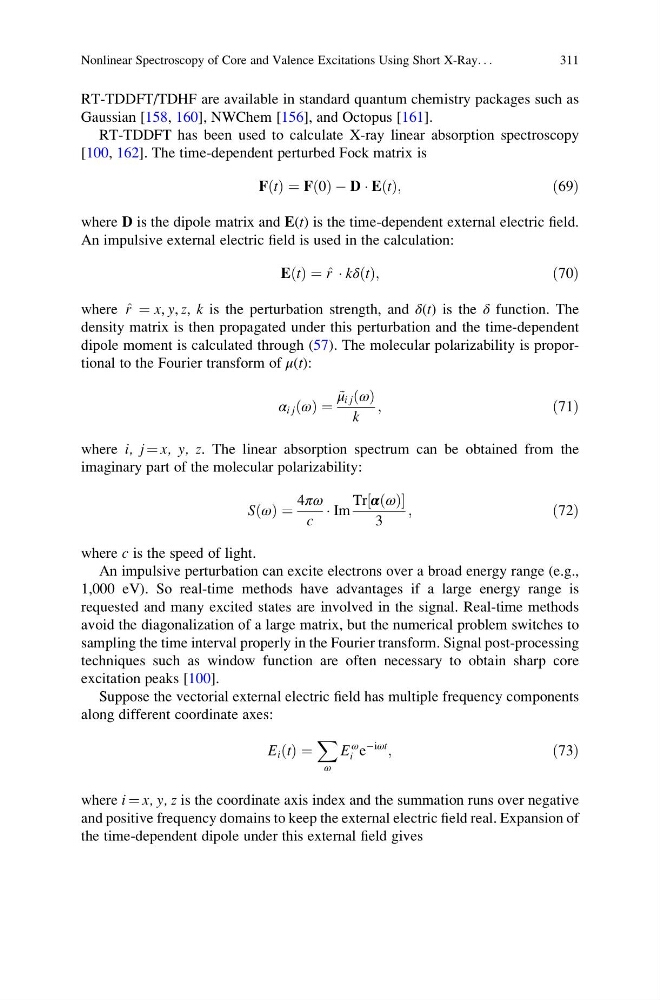
RT-TDDFT/TDHF are available in standard quantum chemistry packages such as
Gaussian [158, 160], NWChem [156], and Octopus [161].
RT-TDDFT has been used to calculate X-ray linear absorption spectroscopy
[100, 162]. The time-dependent perturbed Fock matrix is
F t
ð Þ ¼ F 0
ð Þ À D Á E t
ð Þ;
ð69Þ
where D is the dipole matrix and E(t) is the time-dependent external electric field.
An impulsive external electric field is used in the calculation:
E t
ð Þ ¼ ^
r Á kδ t
ð Þ;
ð70Þ
where ^
r ¼ x, y, z, k is the perturbation strength, and δ(t) is the δ function. The
density matrix is then propagated under this perturbation and the time-dependent
dipole moment is calculated through (57). The molecular polarizability is proportional to the Fourier transform of μ(t):
α i j ω
ð Þ ¼
~
μ i j ω
ð Þ
k
;
ð71Þ
where i, j ¼ x, y, z. The linear absorption spectrum can be obtained from the
imaginary part of the molecular polarizability:
S ω
ð Þ ¼
4πω
c
Á Im
Tr α ω
ð Þ
½
3
;
ð72Þ
where c is the speed of light.
An impulsive perturbation can excite electrons over a broad energy range (e.g.,
1,000 eV). So real-time methods have advantages if a large energy range is
requested and many excited states are involved in the signal. Real-time methods
avoid the diagonalization of a large matrix, but the numerical problem switches to
sampling the time interval properly in the Fourier transform. Signal post-processing
techniques such as window function are often necessary to obtain sharp core
excitation peaks [100].
Suppose the vectorial external electric field has multiple frequency components
along different coordinate axes:
E i t
ð Þ ¼
X
ω
E
ω
i e
Àiωt
;
ð73Þ
where i ¼ x, y, z is the coordinate axis index and the summation runs over negative
and positive frequency domains to keep the external electric field real. Expansion of
the time-dependent dipole under this external field gives
Nonlinear Spectroscopy of Core and Valence Excitations Using Short X-Ray. . .
311
Gaussian [158, 160], NWChem [156], and Octopus [161].
RT-TDDFT has been used to calculate X-ray linear absorption spectroscopy
[100, 162]. The time-dependent perturbed Fock matrix is
F t
ð Þ ¼ F 0
ð Þ À D Á E t
ð Þ;
ð69Þ
where D is the dipole matrix and E(t) is the time-dependent external electric field.
An impulsive external electric field is used in the calculation:
E t
ð Þ ¼ ^
r Á kδ t
ð Þ;
ð70Þ
where ^
r ¼ x, y, z, k is the perturbation strength, and δ(t) is the δ function. The
density matrix is then propagated under this perturbation and the time-dependent
dipole moment is calculated through (57). The molecular polarizability is proportional to the Fourier transform of μ(t):
α i j ω
ð Þ ¼
~
μ i j ω
ð Þ
k
;
ð71Þ
where i, j ¼ x, y, z. The linear absorption spectrum can be obtained from the
imaginary part of the molecular polarizability:
S ω
ð Þ ¼
4πω
c
Á Im
Tr α ω
ð Þ
½
3
;
ð72Þ
where c is the speed of light.
An impulsive perturbation can excite electrons over a broad energy range (e.g.,
1,000 eV). So real-time methods have advantages if a large energy range is
requested and many excited states are involved in the signal. Real-time methods
avoid the diagonalization of a large matrix, but the numerical problem switches to
sampling the time interval properly in the Fourier transform. Signal post-processing
techniques such as window function are often necessary to obtain sharp core
excitation peaks [100].
Suppose the vectorial external electric field has multiple frequency components
along different coordinate axes:
E i t
ð Þ ¼
X
ω
E
ω
i e
Àiωt
;
ð73Þ
where i ¼ x, y, z is the coordinate axis index and the summation runs over negative
and positive frequency domains to keep the external electric field real. Expansion of
the time-dependent dipole under this external field gives
Nonlinear Spectroscopy of Core and Valence Excitations Using Short X-Ray. . .
311