

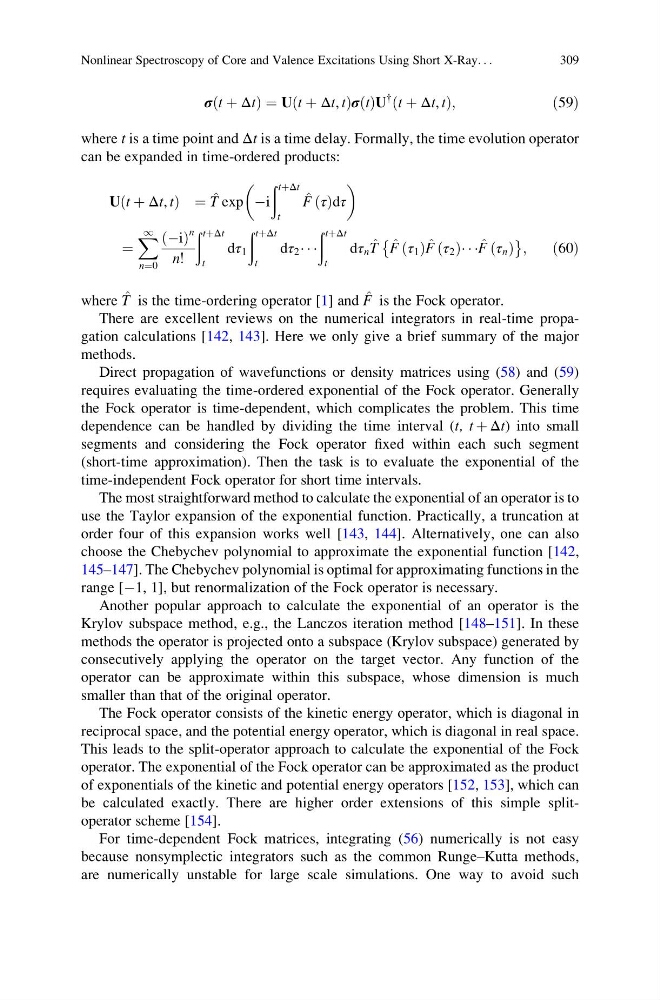
σ t þ Δt
ð
Þ¼U t þ Δt, t
ð
Þ σ t
ð ÞU
{ t þ Δt, t
ð
Þ ;
ð59Þ
where t is a time point and Δt is a time delay. Formally, the time evolution operator
can be expanded in time-ordered products:
U t þ Δt, t
ð
Þ ¼ ^
T exp Ài
ð tþΔt
t
^
F τ
ð Þdτ
¼
X 1
n¼0
Ài
ð Þ
n
n!
ð tþΔt
t
dτ 1
ð tþΔt
t
dτ 2 Á Á Á
ð tþΔt
t
dτ n ^
T ^
F τ 1
ð Þ ^
F τ 2
ð ÞÁÁÁ ^
F τ n
ð Þ
È
É ;
ð60Þ
where ^
T is the time-ordering operator [1] and ^
F is the Fock operator.
There are excellent reviews on the numerical integrators in real-time propagation calculations [142, 143]. Here we only give a brief summary of the major
methods.
Direct propagation of wavefunctions or density matrices using (58) and (59)
requires evaluating the time-ordered exponential of the Fock operator. Generally
the Fock operator is time-dependent, which complicates the problem. This time
dependence can be handled by dividing the time interval (t, t þ Δt) into small
segments and considering the Fock operator fixed within each such segment
(short-time approximation). Then the task is to evaluate the exponential of the
time-independent Fock operator for short time intervals.
The most straightforward method to calculate the exponential of an operator is to
use the Taylor expansion of the exponential function. Practically, a truncation at
order four of this expansion works well [143, 144]. Alternatively, one can also
choose the Chebychev polynomial to approximate the exponential function [142,
145–147]. The Chebychev polynomial is optimal for approximating functions in the
range [À1, 1], but renormalization of the Fock operator is necessary.
Another popular approach to calculate the exponential of an operator is the
Krylov subspace method, e.g., the Lanczos iteration method [148–151]. In these
methods the operator is projected onto a subspace (Krylov subspace) generated by
consecutively applying the operator on the target vector. Any function of the
operator can be approximate within this subspace, whose dimension is much
smaller than that of the original operator.
The Fock operator consists of the kinetic energy operator, which is diagonal in
reciprocal space, and the potential energy operator, which is diagonal in real space.
This leads to the split-operator approach to calculate the exponential of the Fock
operator. The exponential of the Fock operator can be approximated as the product
of exponentials of the kinetic and potential energy operators [152, 153], which can
be calculated exactly. There are higher order extensions of this simple splitoperator scheme [154].
For time-dependent Fock matrices, integrating (56) numerically is not easy
because nonsymplectic integrators such as the common Runge–Kutta methods,
are numerically unstable for large scale simulations. One way to avoid such
Nonlinear Spectroscopy of Core and Valence Excitations Using Short X-Ray. . .
309
ð
Þ¼U t þ Δt, t
ð
Þ σ t
ð ÞU
{ t þ Δt, t
ð
Þ ;
ð59Þ
where t is a time point and Δt is a time delay. Formally, the time evolution operator
can be expanded in time-ordered products:
U t þ Δt, t
ð
Þ ¼ ^
T exp Ài
ð tþΔt
t
^
F τ
ð Þdτ
¼
X 1
n¼0
Ài
ð Þ
n
n!
ð tþΔt
t
dτ 1
ð tþΔt
t
dτ 2 Á Á Á
ð tþΔt
t
dτ n ^
T ^
F τ 1
ð Þ ^
F τ 2
ð ÞÁÁÁ ^
F τ n
ð Þ
È
É ;
ð60Þ
where ^
T is the time-ordering operator [1] and ^
F is the Fock operator.
There are excellent reviews on the numerical integrators in real-time propagation calculations [142, 143]. Here we only give a brief summary of the major
methods.
Direct propagation of wavefunctions or density matrices using (58) and (59)
requires evaluating the time-ordered exponential of the Fock operator. Generally
the Fock operator is time-dependent, which complicates the problem. This time
dependence can be handled by dividing the time interval (t, t þ Δt) into small
segments and considering the Fock operator fixed within each such segment
(short-time approximation). Then the task is to evaluate the exponential of the
time-independent Fock operator for short time intervals.
The most straightforward method to calculate the exponential of an operator is to
use the Taylor expansion of the exponential function. Practically, a truncation at
order four of this expansion works well [143, 144]. Alternatively, one can also
choose the Chebychev polynomial to approximate the exponential function [142,
145–147]. The Chebychev polynomial is optimal for approximating functions in the
range [À1, 1], but renormalization of the Fock operator is necessary.
Another popular approach to calculate the exponential of an operator is the
Krylov subspace method, e.g., the Lanczos iteration method [148–151]. In these
methods the operator is projected onto a subspace (Krylov subspace) generated by
consecutively applying the operator on the target vector. Any function of the
operator can be approximate within this subspace, whose dimension is much
smaller than that of the original operator.
The Fock operator consists of the kinetic energy operator, which is diagonal in
reciprocal space, and the potential energy operator, which is diagonal in real space.
This leads to the split-operator approach to calculate the exponential of the Fock
operator. The exponential of the Fock operator can be approximated as the product
of exponentials of the kinetic and potential energy operators [152, 153], which can
be calculated exactly. There are higher order extensions of this simple splitoperator scheme [154].
For time-dependent Fock matrices, integrating (56) numerically is not easy
because nonsymplectic integrators such as the common Runge–Kutta methods,
are numerically unstable for large scale simulations. One way to avoid such
Nonlinear Spectroscopy of Core and Valence Excitations Using Short X-Ray. . .
309