

response. High order functional derivatives of the exchange-correlation energy
functional are necessary [111, 121]. Because many excited states and orbitals,
including virtual orbitals, are involved, high order perturbation methods are
unsuitable for simulations of large systems because of their unfavorable computational scaling.
3.2.4 Real-Time Propagation Methods
In the frequency domain, each relevant excited state must be explicitly calculated
when the SOS expressions of nonlinear X-ray spectroscopy signals are employed.
The calculation becomes very expensive when many excited states contribute to the
signals. In recent attosecond laser spectroscopy experiments [128–140], the orbital
relaxation as well as the nonadiabatic dynamics with significant geometry changes
involve many excited states. Real-time methods are then preferable.
In real-time time-dependent density functional theory (RT-TDDFT), rather than
solving for eigenstates, the wave function or the one-electron reduced density
matrix
1 is directly propagated in the time domain. Spectroscopic signals can be
extracted from Fourier transform of time-dependent system properties such as the
polarization of the molecule driven by the external electric field. The entire
spectrum can be obtained at once and direct calculation of specific excited states
is avoided.
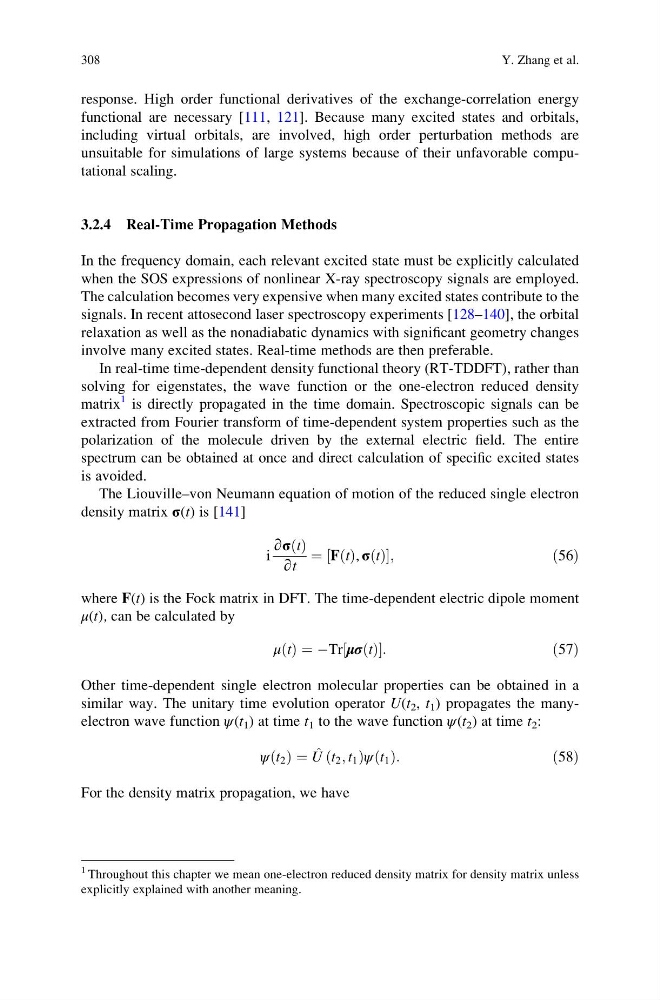
The Liouville–von Neumann equation of motion of the reduced single electron
density matrix σ(t) is [141]
i
∂σ t
ð Þ
∂t
¼ F t
ð Þ, σ t
ð Þ
½
;
ð56Þ
where F(t) is the Fock matrix in DFT. The time-dependent electric dipole moment
μ(t), can be calculated by
μ t
ð Þ ¼ ÀTr μσ t
ð Þ
½
:
ð57Þ
Other time-dependent single electron molecular properties can be obtained in a
similar way. The unitary time evolution operator U(t 2 , t 1 ) propagates the manyelectron wave function ψ(t 1 ) at time t 1 to the wave function ψ(t 2 ) at time t 2 :
ψ t 2
ð Þ ¼ ^
U t 2 ; t 1
ð
Þψ t 1
ð Þ:
ð58Þ
For the density matrix propagation, we have
1 Throughout this chapter we mean one-electron reduced density matrix for density matrix unless
explicitly explained with another meaning.
308
Y. Zhang et al.
functional are necessary [111, 121]. Because many excited states and orbitals,
including virtual orbitals, are involved, high order perturbation methods are
unsuitable for simulations of large systems because of their unfavorable computational scaling.
3.2.4 Real-Time Propagation Methods
In the frequency domain, each relevant excited state must be explicitly calculated
when the SOS expressions of nonlinear X-ray spectroscopy signals are employed.
The calculation becomes very expensive when many excited states contribute to the
signals. In recent attosecond laser spectroscopy experiments [128–140], the orbital
relaxation as well as the nonadiabatic dynamics with significant geometry changes
involve many excited states. Real-time methods are then preferable.
In real-time time-dependent density functional theory (RT-TDDFT), rather than
solving for eigenstates, the wave function or the one-electron reduced density
matrix
1 is directly propagated in the time domain. Spectroscopic signals can be
extracted from Fourier transform of time-dependent system properties such as the
polarization of the molecule driven by the external electric field. The entire
spectrum can be obtained at once and direct calculation of specific excited states
is avoided.
The Liouville–von Neumann equation of motion of the reduced single electron
density matrix σ(t) is [141]
i
∂σ t
ð Þ
∂t
¼ F t
ð Þ, σ t
ð Þ
½
;
ð56Þ
where F(t) is the Fock matrix in DFT. The time-dependent electric dipole moment
μ(t), can be calculated by
μ t
ð Þ ¼ ÀTr μσ t
ð Þ
½
:
ð57Þ
Other time-dependent single electron molecular properties can be obtained in a
similar way. The unitary time evolution operator U(t 2 , t 1 ) propagates the manyelectron wave function ψ(t 1 ) at time t 1 to the wave function ψ(t 2 ) at time t 2 :
ψ t 2
ð Þ ¼ ^
U t 2 ; t 1
ð
Þψ t 1
ð Þ:
ð58Þ
For the density matrix propagation, we have
1 Throughout this chapter we mean one-electron reduced density matrix for density matrix unless
explicitly explained with another meaning.
308
Y. Zhang et al.