

3.2.3 Perturbation Methods for High Order Responses
Nonlinear optical response properties can be obtained by going beyond the first
order of perturbation in equations similar to (50). Response equation (Sternheimer
equation) of wave functions instead of density matrix can also been considered
[111]. Following the standard time-dependent perturbation theory, Orr and Ward
derived the sum-over-state (SOS) expressions of the nonlinear optical polarizations
four decades ago [112]. The SOS expressions are general and excited states from
any level of theory could be used. Much TDDFT work has been done along these
lines [91, 111, 113–121]. A weak time-dependent external electric field is introduced as a perturbation to the original Kohn–Sham system. Then the coupledperturbed TDDFT equations, which are similar to the coupled-perturbed KohnSham equations in DFT geometry optimization calculations, are solved at different
orders of the perturbation and nonlinear response properties are evaluated by
perturbed wave function or density matrix. Using the 2n þ 1 rule [122], third
order response properties can be obtained through the first perturbed wave function.
These approaches can also be used to calculate the nonlinear response to X-ray
pulses.
The complex polarization propagator (CPP) method for XANES simulation was
proposed by Norman and coworkers [123–125]. They first parameterized the orbital
rotation during time evolution, then started from an EOM of the state-transfer
operators with external perturbations and a phenomenological damping term.
With this damping term, decay of excited states can be considered in the
now-complex response functions and resonance divergences are eliminated. With
perturbation techniques, the EOM can be solved at different orders of perturbation
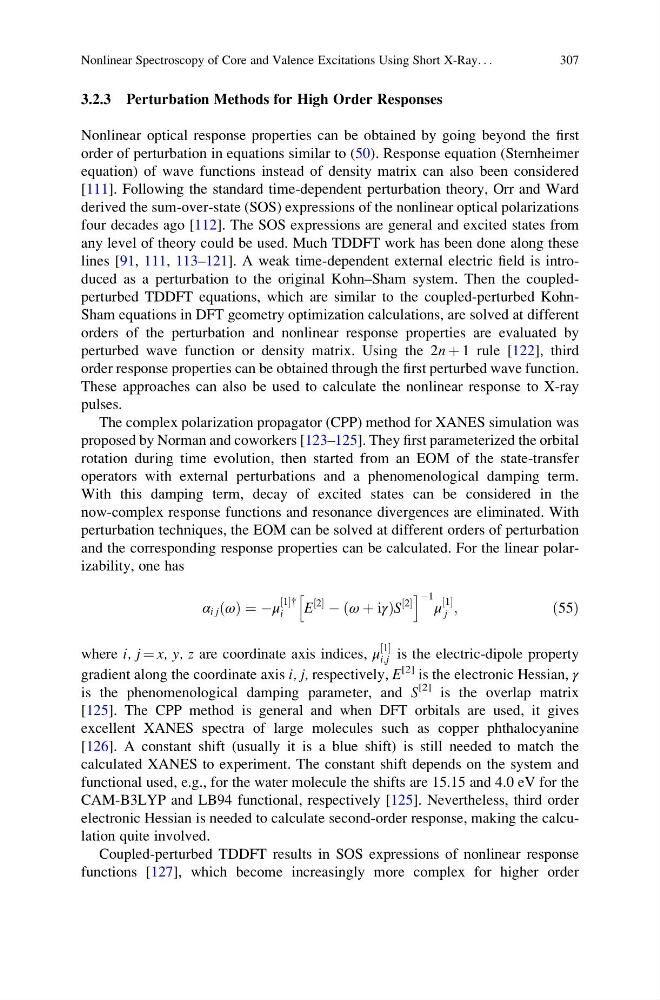
and the corresponding response properties can be calculated. For the linear polarizability, one has
α i j ω
ð Þ ¼ Àμ
1
½ {
i
E
2
½
À ω þ iγ
ð
ÞS
2
½
h
i À1 μ
1
½
j ;
ð55Þ
where i, j ¼ x, y, z are coordinate axis indices, μ
½1
i;j is the electric-dipole property
gradient along the coordinate axis i, j, respectively, E
[2] is the electronic Hessian, γ
is the phenomenological damping parameter, and S
[2] is the overlap matrix
[125]. The CPP method is general and when DFT orbitals are used, it gives
excellent XANES spectra of large molecules such as copper phthalocyanine
[126]. A constant shift (usually it is a blue shift) is still needed to match the
calculated XANES to experiment. The constant shift depends on the system and
functional used, e.g., for the water molecule the shifts are 15.15 and 4.0 eV for the
CAM-B3LYP and LB94 functional, respectively [125]. Nevertheless, third order
electronic Hessian is needed to calculate second-order response, making the calculation quite involved.
Coupled-perturbed TDDFT results in SOS expressions of nonlinear response
functions [127], which become increasingly more complex for higher order
Nonlinear Spectroscopy of Core and Valence Excitations Using Short X-Ray. . .
307
Nonlinear optical response properties can be obtained by going beyond the first
order of perturbation in equations similar to (50). Response equation (Sternheimer
equation) of wave functions instead of density matrix can also been considered
[111]. Following the standard time-dependent perturbation theory, Orr and Ward
derived the sum-over-state (SOS) expressions of the nonlinear optical polarizations
four decades ago [112]. The SOS expressions are general and excited states from
any level of theory could be used. Much TDDFT work has been done along these
lines [91, 111, 113–121]. A weak time-dependent external electric field is introduced as a perturbation to the original Kohn–Sham system. Then the coupledperturbed TDDFT equations, which are similar to the coupled-perturbed KohnSham equations in DFT geometry optimization calculations, are solved at different
orders of the perturbation and nonlinear response properties are evaluated by
perturbed wave function or density matrix. Using the 2n þ 1 rule [122], third
order response properties can be obtained through the first perturbed wave function.
These approaches can also be used to calculate the nonlinear response to X-ray
pulses.
The complex polarization propagator (CPP) method for XANES simulation was
proposed by Norman and coworkers [123–125]. They first parameterized the orbital
rotation during time evolution, then started from an EOM of the state-transfer
operators with external perturbations and a phenomenological damping term.
With this damping term, decay of excited states can be considered in the
now-complex response functions and resonance divergences are eliminated. With
perturbation techniques, the EOM can be solved at different orders of perturbation
and the corresponding response properties can be calculated. For the linear polarizability, one has
α i j ω
ð Þ ¼ Àμ
1
½ {
i
E
2
½
À ω þ iγ
ð
ÞS
2
½
h
i À1 μ
1
½
j ;
ð55Þ
where i, j ¼ x, y, z are coordinate axis indices, μ
½1
i;j is the electric-dipole property
gradient along the coordinate axis i, j, respectively, E
[2] is the electronic Hessian, γ
is the phenomenological damping parameter, and S
[2] is the overlap matrix
[125]. The CPP method is general and when DFT orbitals are used, it gives
excellent XANES spectra of large molecules such as copper phthalocyanine
[126]. A constant shift (usually it is a blue shift) is still needed to match the
calculated XANES to experiment. The constant shift depends on the system and
functional used, e.g., for the water molecule the shifts are 15.15 and 4.0 eV for the
CAM-B3LYP and LB94 functional, respectively [125]. Nevertheless, third order
electronic Hessian is needed to calculate second-order response, making the calculation quite involved.
Coupled-perturbed TDDFT results in SOS expressions of nonlinear response
functions [127], which become increasingly more complex for higher order
Nonlinear Spectroscopy of Core and Valence Excitations Using Short X-Ray. . .
307