

extension of DFT was not possible until Runge and Gross established the one-toone mapping of electron density and time-varying external potential [85]. There are
two categories for applying TDDFT to calculate excited state properties: the
response theory based on perturbation in the frequency domain and the direct
real-time propagation methods in the time domain. The frequency-domain formalism of TDDFT, which is based on linear response theory, became popular after
Casida proposed a density matrix response equation which is very similar to the
renowned random phase approximation (RPA) equation [86]. The Casida equation
can be derived by solving the equation of motion (EOM) of the single electron
reduced density matrix to the first order of external perturbation in the frequency
domain. Similar expressions have been obtained for TDHF in the collective electronic oscillator (CEO) method [87–89]. Nonlinear response functions of the
system can be calculated in CEO by applying high order perturbation theory [89].
Another way to obtain excited state properties is to solve the EOM of
single-electron reduced density matrix by direct propagation in the time domain.
Time-dependent properties of the system induced by the time-dependent external
perturbation can be calculated directly and Fourier transform can recover the
excited state information in the frequency domain.
In this section, we start with the linear-response formalism of Casida, and then
present a specific variant of linear-response TDDFT applied to core excited state
(restricted excitation window time-dependent density functional theory,
REW-TDDFT). Moreover, high order perturbation theory methods for nonlinear
response properties of the system are introduced and finally the real-time propagation methods are discussed. It should be noted that the response and real-time
propagation methods are very general and not restricted to DFT/TDDFT, but we
focus on the DFT/TDDFT formalisms of these methods in this chapter.
3.2.1 Linear Response Theory
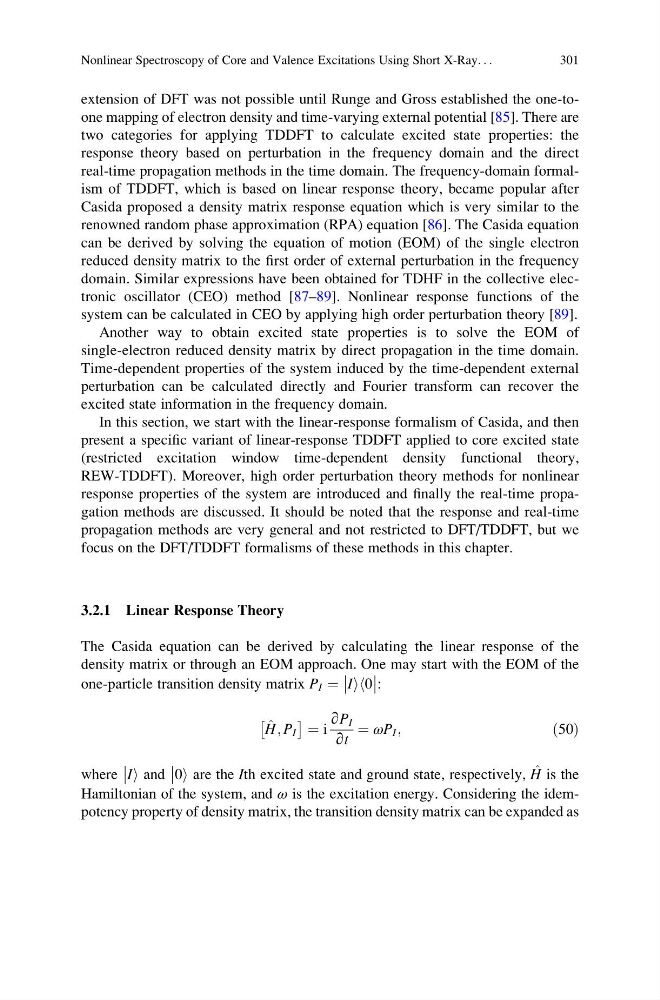
The Casida equation can be derived by calculating the linear response of the
density matrix or through an EOM approach. One may start with the EOM of the
one-particle transition density matrix P I ¼
Iih0
:
^
H; P I
Â
à ¼ i
∂P I
∂t
¼ ωP I ;
ð50Þ
where
Ii and
0i are the Ith excited state and ground state, respectively, ^
H is the
Hamiltonian of the system, and ω is the excitation energy. Considering the idempotency property of density matrix, the transition density matrix can be expanded as
Nonlinear Spectroscopy of Core and Valence Excitations Using Short X-Ray. . .
301
two categories for applying TDDFT to calculate excited state properties: the
response theory based on perturbation in the frequency domain and the direct
real-time propagation methods in the time domain. The frequency-domain formalism of TDDFT, which is based on linear response theory, became popular after
Casida proposed a density matrix response equation which is very similar to the
renowned random phase approximation (RPA) equation [86]. The Casida equation
can be derived by solving the equation of motion (EOM) of the single electron
reduced density matrix to the first order of external perturbation in the frequency
domain. Similar expressions have been obtained for TDHF in the collective electronic oscillator (CEO) method [87–89]. Nonlinear response functions of the
system can be calculated in CEO by applying high order perturbation theory [89].
Another way to obtain excited state properties is to solve the EOM of
single-electron reduced density matrix by direct propagation in the time domain.
Time-dependent properties of the system induced by the time-dependent external
perturbation can be calculated directly and Fourier transform can recover the
excited state information in the frequency domain.
In this section, we start with the linear-response formalism of Casida, and then
present a specific variant of linear-response TDDFT applied to core excited state
(restricted excitation window time-dependent density functional theory,
REW-TDDFT). Moreover, high order perturbation theory methods for nonlinear
response properties of the system are introduced and finally the real-time propagation methods are discussed. It should be noted that the response and real-time
propagation methods are very general and not restricted to DFT/TDDFT, but we
focus on the DFT/TDDFT formalisms of these methods in this chapter.
3.2.1 Linear Response Theory
The Casida equation can be derived by calculating the linear response of the
density matrix or through an EOM approach. One may start with the EOM of the
one-particle transition density matrix P I ¼
Iih0
:
^
H; P I
Â
à ¼ i
∂P I
∂t
¼ ωP I ;
ð50Þ
where
Ii and
0i are the Ith excited state and ground state, respectively, ^
H is the
Hamiltonian of the system, and ω is the excitation energy. Considering the idempotency property of density matrix, the transition density matrix can be expanded as
Nonlinear Spectroscopy of Core and Valence Excitations Using Short X-Ray. . .
301