

P I ¼
X
i, a
X ia ^
a
{ ^ i þ Y ia ^ i
{
^
a
À
Á ;
ð51Þ
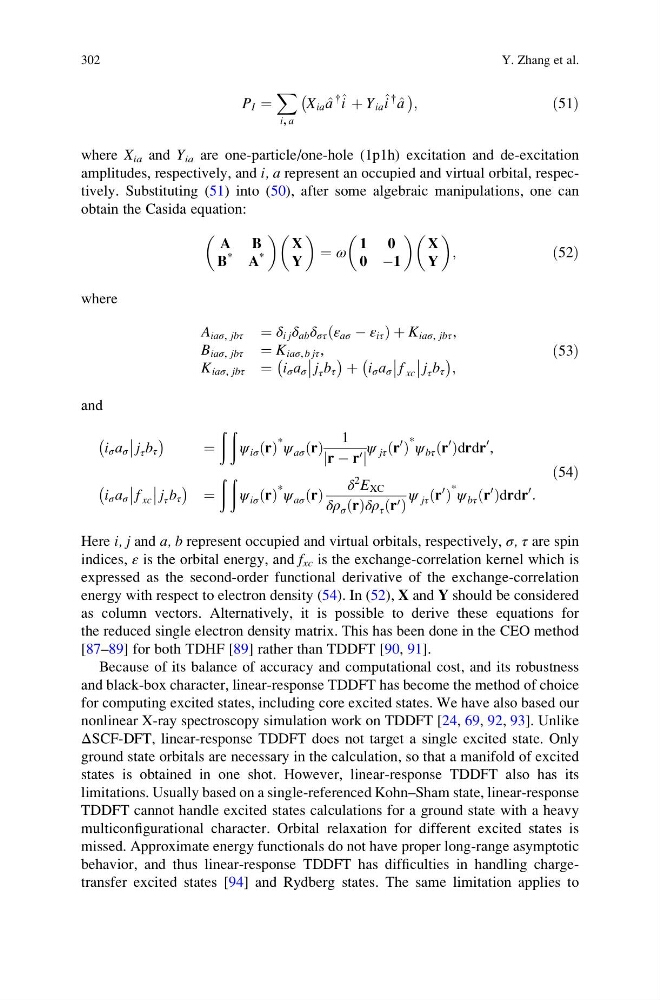
where X ia and Y ia are one-particle/one-hole (1p1h) excitation and de-excitation
amplitudes, respectively, and i, a represent an occupied and virtual orbital, respectively. Substituting (51) into (50), after some algebraic manipulations, one can
obtain the Casida equation:
A B
B
* A
*
X
Y
¼ ω
1 0
0 À1
X
Y
;
ð52Þ
where
A iaσ, jbτ ¼ δ i j δ ab δ στ ε aσ À ε iτ
ð
ÞþK iaσ, jbτ ,
B iaσ, jbτ ¼ K iaσ, b jτ ,
K iaσ, jbτ ¼ i σ a σ
j τ b τ
À
Á þ i σ a σ
f xc
j τ b τ
À
Á ;
ð53Þ
and
i σ a σ
j τ b τ
À
Á
¼
ð ð
ψ iσ r
ð Þ
* ψ aσ r
ð Þ
1
r À r 0
j
j
ψ jτ r
0
ð Þ
* ψ bτ r
0
ð Þdrdr
0 ,
i σ a σ
f xc
j τ b τ
À
Á ¼
ð ð
ψ iσ r
ð Þ
* ψ aσ r
ð Þ
δ
2 E XC
δρ σ r
ð Þδρ τ r 0
ð Þ
ψ jτ r
0
ð Þ
* ψ bτ r
0
ð Þdrdr
0
:
ð54Þ
Here i, j and a, b represent occupied and virtual orbitals, respectively, σ, τ are spin
indices, ε is the orbital energy, and f xc is the exchange-correlation kernel which is
expressed as the second-order functional derivative of the exchange-correlation
energy with respect to electron density (54). In (52), X and Y should be considered
as column vectors. Alternatively, it is possible to derive these equations for
the reduced single electron density matrix. This has been done in the CEO method
[87–89] for both TDHF [89] rather than TDDFT [90, 91].
Because of its balance of accuracy and computational cost, and its robustness
and black-box character, linear-response TDDFT has become the method of choice
for computing excited states, including core excited states. We have also based our
nonlinear X-ray spectroscopy simulation work on TDDFT [24, 69, 92, 93]. Unlike
ΔSCF-DFT, linear-response TDDFT does not target a single excited state. Only
ground state orbitals are necessary in the calculation, so that a manifold of excited
states is obtained in one shot. However, linear-response TDDFT also has its
limitations. Usually based on a single-referenced Kohn–Sham state, linear-response
TDDFT cannot handle excited states calculations for a ground state with a heavy
multiconfigurational character. Orbital relaxation for different excited states is
missed. Approximate energy functionals do not have proper long-range asymptotic
behavior, and thus linear-response TDDFT has difficulties in handling chargetransfer excited states [94] and Rydberg states. The same limitation applies to
302
Y. Zhang et al.
X
i, a
X ia ^
a
{ ^ i þ Y ia ^ i
{
^
a
À
Á ;
ð51Þ
where X ia and Y ia are one-particle/one-hole (1p1h) excitation and de-excitation
amplitudes, respectively, and i, a represent an occupied and virtual orbital, respectively. Substituting (51) into (50), after some algebraic manipulations, one can
obtain the Casida equation:
A B
B
* A
*
X
Y
¼ ω
1 0
0 À1
X
Y
;
ð52Þ
where
A iaσ, jbτ ¼ δ i j δ ab δ στ ε aσ À ε iτ
ð
ÞþK iaσ, jbτ ,
B iaσ, jbτ ¼ K iaσ, b jτ ,
K iaσ, jbτ ¼ i σ a σ
j τ b τ
À
Á þ i σ a σ
f xc
j τ b τ
À
Á ;
ð53Þ
and
i σ a σ
j τ b τ
À
Á
¼
ð ð
ψ iσ r
ð Þ
* ψ aσ r
ð Þ
1
r À r 0
j
j
ψ jτ r
0
ð Þ
* ψ bτ r
0
ð Þdrdr
0 ,
i σ a σ
f xc
j τ b τ
À
Á ¼
ð ð
ψ iσ r
ð Þ
* ψ aσ r
ð Þ
δ
2 E XC
δρ σ r
ð Þδρ τ r 0
ð Þ
ψ jτ r
0
ð Þ
* ψ bτ r
0
ð Þdrdr
0
:
ð54Þ
Here i, j and a, b represent occupied and virtual orbitals, respectively, σ, τ are spin
indices, ε is the orbital energy, and f xc is the exchange-correlation kernel which is
expressed as the second-order functional derivative of the exchange-correlation
energy with respect to electron density (54). In (52), X and Y should be considered
as column vectors. Alternatively, it is possible to derive these equations for
the reduced single electron density matrix. This has been done in the CEO method
[87–89] for both TDHF [89] rather than TDDFT [90, 91].
Because of its balance of accuracy and computational cost, and its robustness
and black-box character, linear-response TDDFT has become the method of choice
for computing excited states, including core excited states. We have also based our
nonlinear X-ray spectroscopy simulation work on TDDFT [24, 69, 92, 93]. Unlike
ΔSCF-DFT, linear-response TDDFT does not target a single excited state. Only
ground state orbitals are necessary in the calculation, so that a manifold of excited
states is obtained in one shot. However, linear-response TDDFT also has its
limitations. Usually based on a single-referenced Kohn–Sham state, linear-response
TDDFT cannot handle excited states calculations for a ground state with a heavy
multiconfigurational character. Orbital relaxation for different excited states is
missed. Approximate energy functionals do not have proper long-range asymptotic
behavior, and thus linear-response TDDFT has difficulties in handling chargetransfer excited states [94] and Rydberg states. The same limitation applies to
302
Y. Zhang et al.