

outgoing arrow at each end (Feynman and Goldstone) or in a symmetrized way as a
point with two incoming and two outgoing arrows (Abrikosov and Hugenholtz).
These differences affect how they are to be translated into algebraic expressions as
does the nature of the quantity being expanded (wave function, one-electron
Green’s function, self-energy, polarization propagator, etc.). Given this plethora
of types of diagrams and the difficulty of finding a clear explanation of how to read
polarization propagator diagrams, we have chosen to present rules for how our
diagrams should be translated into algebraic expressions. This is necessary because,
whereas the usual practice in the solid-state literature is to use time-unordered
diagrams with electron repulsions represented as wavy or dotted lines (i.e., Feynman diagrams), the usual practice in the quantum chemistry literature is using timeordered diagrams with electron repulsions represented as points (i.e., Hugenholtz
diagrams).
We limit ourselves to giving precise rules for the polarization propagator
(PP) because these rules are difficult to find in the literature. The PP expressed in
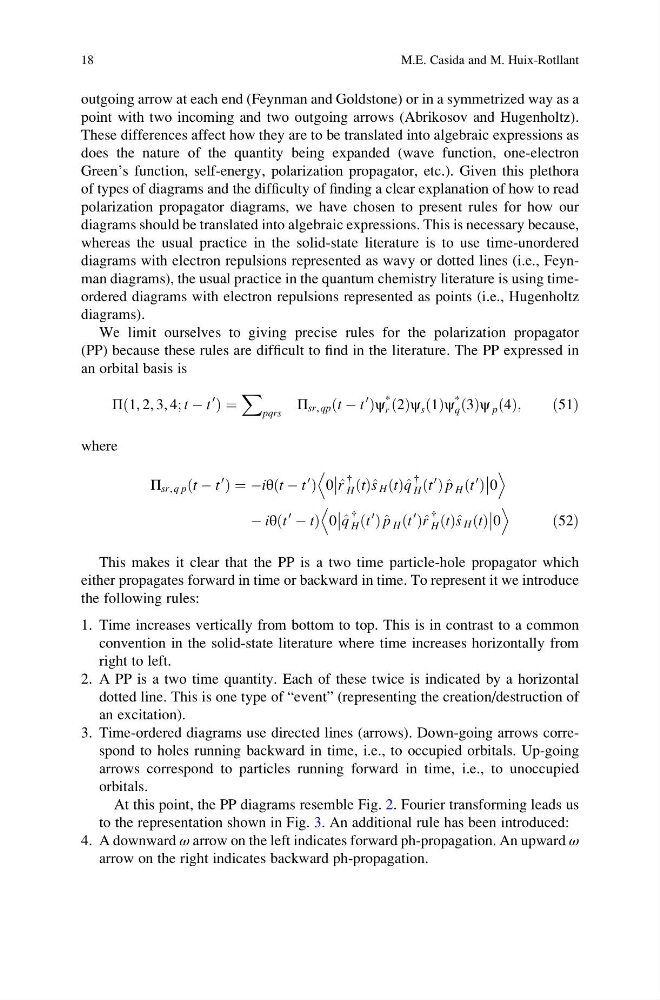
an orbital basis is
Π 1, 2, 3, 4; t À t
0
ð
Þ ¼
X
pqrs
Π sr, qp t À t
0
ð
Þψ
*
r 2
ð Þψ s 1
ð Þψ
*
q 3
ð Þψ p 4
ð Þ;
ð51Þ
where
Π sr, q p t À t
0
ð
Þ¼Àiθ t À t
0
ð
Þ 0
^
r
{
H t
ð Þ^ s H t
ð Þ^ q
{
H t
0
ð Þ^ p H t
0
ð Þ
0
D
E
À iθ t
0
À t
ð
Þ 0
^
q
{
H t
0
ð Þ^ p H t
0
ð Þ^ r
{
H t
ð Þ^ s H t
ð Þ
0
D
E
ð52Þ
This makes it clear that the PP is a two time particle-hole propagator which
either propagates forward in time or backward in time. To represent it we introduce
the following rules:
1. Time increases vertically from bottom to top. This is in contrast to a common
convention in the solid-state literature where time increases horizontally from
right to left.
2. A PP is a two time quantity. Each of these twice is indicated by a horizontal
dotted line. This is one type of “event” (representing the creation/destruction of
an excitation).
3. Time-ordered diagrams use directed lines (arrows). Down-going arrows correspond to holes running backward in time, i.e., to occupied orbitals. Up-going
arrows correspond to particles running forward in time, i.e., to unoccupied
orbitals.
At this point, the PP diagrams resemble Fig. 2. Fourier transforming leads us
to the representation shown in Fig. 3. An additional rule has been introduced:
4. A downward ω arrow on the left indicates forward ph-propagation. An upward ω
arrow on the right indicates backward ph-propagation.
18
M.E. Casida and M. Huix-Rotllant
point with two incoming and two outgoing arrows (Abrikosov and Hugenholtz).
These differences affect how they are to be translated into algebraic expressions as
does the nature of the quantity being expanded (wave function, one-electron
Green’s function, self-energy, polarization propagator, etc.). Given this plethora
of types of diagrams and the difficulty of finding a clear explanation of how to read
polarization propagator diagrams, we have chosen to present rules for how our
diagrams should be translated into algebraic expressions. This is necessary because,
whereas the usual practice in the solid-state literature is to use time-unordered
diagrams with electron repulsions represented as wavy or dotted lines (i.e., Feynman diagrams), the usual practice in the quantum chemistry literature is using timeordered diagrams with electron repulsions represented as points (i.e., Hugenholtz
diagrams).
We limit ourselves to giving precise rules for the polarization propagator
(PP) because these rules are difficult to find in the literature. The PP expressed in
an orbital basis is
Π 1, 2, 3, 4; t À t
0
ð
Þ ¼
X
pqrs
Π sr, qp t À t
0
ð
Þψ
*
r 2
ð Þψ s 1
ð Þψ
*
q 3
ð Þψ p 4
ð Þ;
ð51Þ
where
Π sr, q p t À t
0
ð
Þ¼Àiθ t À t
0
ð
Þ 0
^
r
{
H t
ð Þ^ s H t
ð Þ^ q
{
H t
0
ð Þ^ p H t
0
ð Þ
0
D
E
À iθ t
0
À t
ð
Þ 0
^
q
{
H t
0
ð Þ^ p H t
0
ð Þ^ r
{
H t
ð Þ^ s H t
ð Þ
0
D
E
ð52Þ
This makes it clear that the PP is a two time particle-hole propagator which
either propagates forward in time or backward in time. To represent it we introduce
the following rules:
1. Time increases vertically from bottom to top. This is in contrast to a common
convention in the solid-state literature where time increases horizontally from
right to left.
2. A PP is a two time quantity. Each of these twice is indicated by a horizontal
dotted line. This is one type of “event” (representing the creation/destruction of
an excitation).
3. Time-ordered diagrams use directed lines (arrows). Down-going arrows correspond to holes running backward in time, i.e., to occupied orbitals. Up-going
arrows correspond to particles running forward in time, i.e., to unoccupied
orbitals.
At this point, the PP diagrams resemble Fig. 2. Fourier transforming leads us
to the representation shown in Fig. 3. An additional rule has been introduced:
4. A downward ω arrow on the left indicates forward ph-propagation. An upward ω
arrow on the right indicates backward ph-propagation.
18
M.E. Casida and M. Huix-Rotllant