

than those of TDDFT (>10 eV). However, being an independent particle and hole
theory, STEX cannot account for core hole mixing in X-ray spectroscopy, whereas
REW-TDDFT can. The SCF calculation of a core ionized state is often tricky.
Convergence is not guaranteed. In addition, because the STEX equation (40) is not
solved self-consistently, the occupied and virtual STEX orbitals are not variational
for the total energy. Evaluating core excited state properties, e.g., electron density,
thus become complicated [70]. State-to-state transition dipole calculations are
expensive.
3.1.3 ΔSCF-DFT Method
A straightforward extension of DFT to excited states (including core excitations) is
achieved by employing non-Aufbau occupations of Kohn–Sham orbitals and running SCF calculations to obtain the target excited states as is done in ground state
calculations [71–74]. This is known as the ΔSCF-DFT (or simply the ΔSCF)
method. The biggest difficulty is the collapse to the lower energy states below the
excited state during the SCF iterations. Special care must be taken to keep the
electrons in the designated excited configuration. The maximum overlap method
(MOM) [62] is widely used to avoid SCF collapse. Here, the new occupied orbitals
in the current SCF cycle are chosen as the orbitals which have a maximum overlap
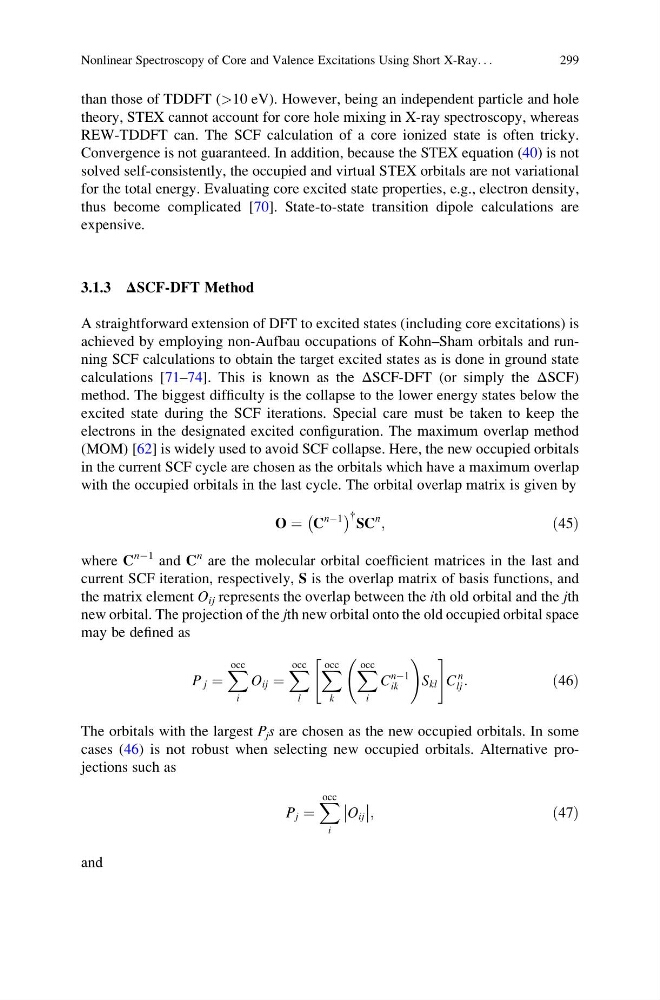
with the occupied orbitals in the last cycle. The orbital overlap matrix is given by
O ¼ C
nÀ1
À
Á { SC
n
;
ð45Þ
where C
nÀ1 and C
n are the molecular orbital coefficient matrices in the last and
current SCF iteration, respectively, S is the overlap matrix of basis functions, and
the matrix element O ij represents the overlap between the ith old orbital and the jth
new orbital. The projection of the jth new orbital onto the old occupied orbital space
may be defined as
P j ¼
X occ
i
O ij ¼
X occ
l
X occ
k
X occ
i
C
nÀ1
ik
!
S kl
"
#
C
n
lj :
ð46Þ
The orbitals with the largest P j s are chosen as the new occupied orbitals. In some
cases (46) is not robust when selecting new occupied orbitals. Alternative projections such as
P j ¼
X occ
i
O ij
;
ð47Þ
and
Nonlinear Spectroscopy of Core and Valence Excitations Using Short X-Ray. . .
299
theory, STEX cannot account for core hole mixing in X-ray spectroscopy, whereas
REW-TDDFT can. The SCF calculation of a core ionized state is often tricky.
Convergence is not guaranteed. In addition, because the STEX equation (40) is not
solved self-consistently, the occupied and virtual STEX orbitals are not variational
for the total energy. Evaluating core excited state properties, e.g., electron density,
thus become complicated [70]. State-to-state transition dipole calculations are
expensive.
3.1.3 ΔSCF-DFT Method
A straightforward extension of DFT to excited states (including core excitations) is
achieved by employing non-Aufbau occupations of Kohn–Sham orbitals and running SCF calculations to obtain the target excited states as is done in ground state
calculations [71–74]. This is known as the ΔSCF-DFT (or simply the ΔSCF)
method. The biggest difficulty is the collapse to the lower energy states below the
excited state during the SCF iterations. Special care must be taken to keep the
electrons in the designated excited configuration. The maximum overlap method
(MOM) [62] is widely used to avoid SCF collapse. Here, the new occupied orbitals
in the current SCF cycle are chosen as the orbitals which have a maximum overlap
with the occupied orbitals in the last cycle. The orbital overlap matrix is given by
O ¼ C
nÀ1
À
Á { SC
n
;
ð45Þ
where C
nÀ1 and C
n are the molecular orbital coefficient matrices in the last and
current SCF iteration, respectively, S is the overlap matrix of basis functions, and
the matrix element O ij represents the overlap between the ith old orbital and the jth
new orbital. The projection of the jth new orbital onto the old occupied orbital space
may be defined as
P j ¼
X occ
i
O ij ¼
X occ
l
X occ
k
X occ
i
C
nÀ1
ik
!
S kl
"
#
C
n
lj :
ð46Þ
The orbitals with the largest P j s are chosen as the new occupied orbitals. In some
cases (46) is not robust when selecting new occupied orbitals. Alternative projections such as
P j ¼
X occ
i
O ij
;
ð47Þ
and
Nonlinear Spectroscopy of Core and Valence Excitations Using Short X-Ray. . .
299