

~
τ pi sup t : E p t
0
ð Þ ¼ 0 8 t
0
< t
È
É
~
τ p f inf t : E p t
0
ð Þ ¼ 0 8 t
0
> t
È
É ;
ð22Þ
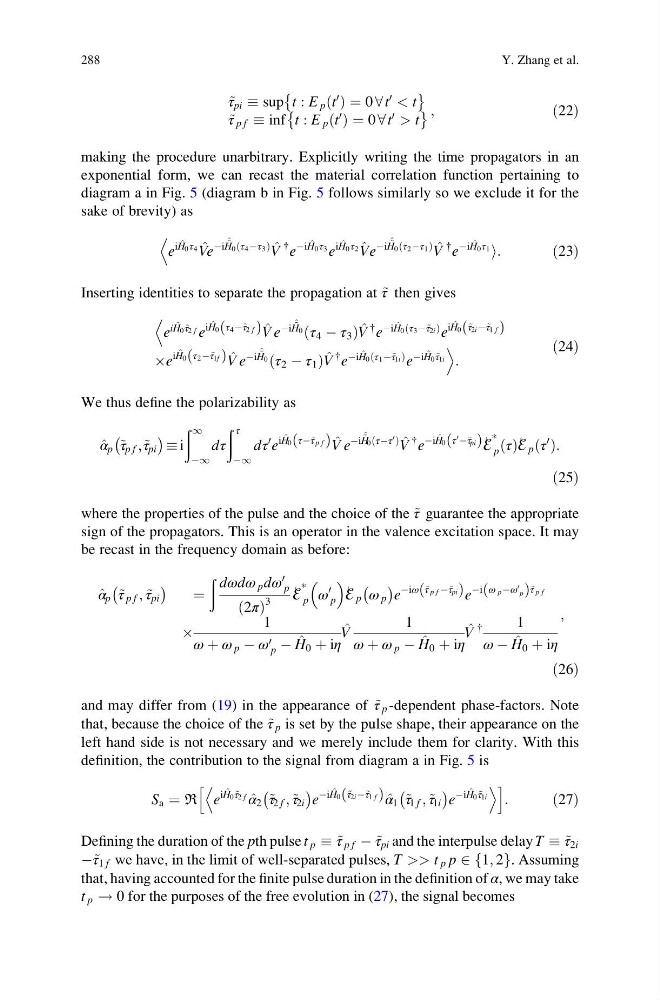
making the procedure unarbitrary. Explicitly writing the time propagators in an
exponential form, we can recast the material correlation function pertaining to
diagram a in Fig. 5 (diagram b in Fig. 5 follows similarly so we exclude it for the
sake of brevity) as
e
i ^
H 0 τ 4 ^
Ve
Ài ^ ~
H 0 τ 4 Àτ 3
ð
Þ ^
V
{ e
Ài ^
H 0 τ 3 e
i ^
H 0 τ 2 ^
Ve
Ài ^
~
H 0 τ 2 Àτ 1
ð
Þ ^
V
{ e
Ài ^
H 0 τ 1 i:
D
ð23Þ
Inserting identities to separate the propagation at ~
τ then gives
e
i ^
H 0 ~
τ 2 f e
i ^
H 0 τ 4 À~ τ 2 f
ð
Þ ^
V e
Ài ^
~
H 0 τ 4 À τ 3
ð
Þ ^
V
{ e
Ài ^
H 0 τ 3 À~ τ 2i
ð
Þ e
i ^
H 0 ~
τ 2i À~ τ 1 f
ð
Þ
D
Âe
i ^
H 0 τ 2 À~ τ 1f
ð
Þ ^
V e
Ài ^
~
H 0 τ 2 À τ 1
ð
Þ ^
V
{ e
Ài ^
H 0 τ 1 À~ τ 1i
ð
Þ e
Ài ^
H 0 ~
τ 1i
E
:
ð24Þ
We thus define the polarizability as
^
α p ~ τ p f ; ~
τ pi
À
Á i
ð 1
À1
dτ
ð τ
À1
dτ
0 e
i ^
H 0 τÀ~ τ p f
ð
Þ ^
V e
Ài ^
~
H 0 τÀτ
0
ð
Þ ^
V
{ e
Ài ^
H 0 τ
0 À~ τ pi
ð
Þ ℰ
*
p τ
ð Þℰ p τ
0
ð Þ:
ð25Þ
where the properties of the pulse and the choice of the ~
τ guarantee the appropriate
sign of the propagators. This is an operator in the valence excitation space. It may
be recast in the frequency domain as before:
^
α p ~
τ p f ; ~
τ pi
À
Á
¼
ð dωdω p dω
0
p
2π
ð Þ
3
ℰ
*
p ω
0
p
ℰ p ω p
À Á
e
Àiω ~
τ p f À~ τ pi
ð
Þ e
Ài ω p Àω
0
p
ð
Þ~ τ p f
Â
1
ω þ ω p À ω 0
p À ^
H 0 þ iη
^
V
1
ω þ ω p À ^
H 0 þ iη
^
V
{
1
ω À ^
H 0 þ iη
;
ð26Þ
and may differ from (19) in the appearance of ~
τ p -dependent phase-factors. Note
that, because the choice of the ~
τ p is set by the pulse shape, their appearance on the
left hand side is not necessary and we merely include them for clarity. With this
definition, the contribution to the signal from diagram a in Fig. 5 is
S a ¼ ℜ e
i ^
H 0 ~
τ 2 f ^
α 2 ~ τ 2 f ; ~ τ 2i
À
Á
e
Ài ^
H 0 ~
τ 2i À~ τ 1 f
ð
Þ ^
α 1 ~ τ 1 f ; ~ τ 1i
À
Á
e
Ài ^
H 0 ~
τ 1i
D
E
h
i
:
ð27Þ
Defining the duration of the pth pulse t p ~
τ p f À ~
τ pi and the interpulse delay T ~
τ 2i
À~ τ 1 f we have, in the limit of well-separated pulses, T >> t p p 2 1; 2
f g. Assuming
that, having accounted for the finite pulse duration in the definition of α, we may take
t p ! 0 for the purposes of the free evolution in (27), the signal becomes
288
Y. Zhang et al.
τ pi sup t : E p t
0
ð Þ ¼ 0 8 t
0
< t
È
É
~
τ p f inf t : E p t
0
ð Þ ¼ 0 8 t
0
> t
È
É ;
ð22Þ
making the procedure unarbitrary. Explicitly writing the time propagators in an
exponential form, we can recast the material correlation function pertaining to
diagram a in Fig. 5 (diagram b in Fig. 5 follows similarly so we exclude it for the
sake of brevity) as
e
i ^
H 0 τ 4 ^
Ve
Ài ^ ~
H 0 τ 4 Àτ 3
ð
Þ ^
V
{ e
Ài ^
H 0 τ 3 e
i ^
H 0 τ 2 ^
Ve
Ài ^
~
H 0 τ 2 Àτ 1
ð
Þ ^
V
{ e
Ài ^
H 0 τ 1 i:
D
ð23Þ
Inserting identities to separate the propagation at ~
τ then gives
e
i ^
H 0 ~
τ 2 f e
i ^
H 0 τ 4 À~ τ 2 f
ð
Þ ^
V e
Ài ^
~
H 0 τ 4 À τ 3
ð
Þ ^
V
{ e
Ài ^
H 0 τ 3 À~ τ 2i
ð
Þ e
i ^
H 0 ~
τ 2i À~ τ 1 f
ð
Þ
D
Âe
i ^
H 0 τ 2 À~ τ 1f
ð
Þ ^
V e
Ài ^
~
H 0 τ 2 À τ 1
ð
Þ ^
V
{ e
Ài ^
H 0 τ 1 À~ τ 1i
ð
Þ e
Ài ^
H 0 ~
τ 1i
E
:
ð24Þ
We thus define the polarizability as
^
α p ~ τ p f ; ~
τ pi
À
Á i
ð 1
À1
dτ
ð τ
À1
dτ
0 e
i ^
H 0 τÀ~ τ p f
ð
Þ ^
V e
Ài ^
~
H 0 τÀτ
0
ð
Þ ^
V
{ e
Ài ^
H 0 τ
0 À~ τ pi
ð
Þ ℰ
*
p τ
ð Þℰ p τ
0
ð Þ:
ð25Þ
where the properties of the pulse and the choice of the ~
τ guarantee the appropriate
sign of the propagators. This is an operator in the valence excitation space. It may
be recast in the frequency domain as before:
^
α p ~
τ p f ; ~
τ pi
À
Á
¼
ð dωdω p dω
0
p
2π
ð Þ
3
ℰ
*
p ω
0
p
ℰ p ω p
À Á
e
Àiω ~
τ p f À~ τ pi
ð
Þ e
Ài ω p Àω
0
p
ð
Þ~ τ p f
Â
1
ω þ ω p À ω 0
p À ^
H 0 þ iη
^
V
1
ω þ ω p À ^
H 0 þ iη
^
V
{
1
ω À ^
H 0 þ iη
;
ð26Þ
and may differ from (19) in the appearance of ~
τ p -dependent phase-factors. Note
that, because the choice of the ~
τ p is set by the pulse shape, their appearance on the
left hand side is not necessary and we merely include them for clarity. With this
definition, the contribution to the signal from diagram a in Fig. 5 is
S a ¼ ℜ e
i ^
H 0 ~
τ 2 f ^
α 2 ~ τ 2 f ; ~ τ 2i
À
Á
e
Ài ^
H 0 ~
τ 2i À~ τ 1 f
ð
Þ ^
α 1 ~ τ 1 f ; ~ τ 1i
À
Á
e
Ài ^
H 0 ~
τ 1i
D
E
h
i
:
ð27Þ
Defining the duration of the pth pulse t p ~
τ p f À ~
τ pi and the interpulse delay T ~
τ 2i
À~ τ 1 f we have, in the limit of well-separated pulses, T >> t p p 2 1; 2
f g. Assuming
that, having accounted for the finite pulse duration in the definition of α, we may take
t p ! 0 for the purposes of the free evolution in (27), the signal becomes
288
Y. Zhang et al.