

creates a valence excitation and tracks its motion along the potential energy surface
produced by the core hole [30].
2.4 Correlation Function Expressions for SXRS Signals
In the previous section, we defined ^ α p by combining two time-dependent dipole
interactions (excitation and de-excitation) as well as the pulse envelope (see (16)).
All time-dependence is then encoded into the polarizability ^
α p and the result (see
(17)) is compact but too complicated. Although perfectly suited to an expansion in
eigenstates, as shown in the previous section, this form of ^
α p suffers from some
drawbacks. Recalling the definition of operator time-dependence in the interaction
picture (see (7)), we see that there are three time propagation periods. This
definition for the polarizability therefore contains material propagation both for
interpulse and intrapulse time periods. Because these occur on two different timescales, a separation permits different treatments. In particular, it is then possible to
treat the intrapulse propagation perturbatively while preserving the full form of the
longer-time interpulse propagator.
That the two impinging fields are temporally well-separated guarantees that
there exist ~
τ 1i and ~
τ 1 f (~ τ 2i and ~
τ 2 f ), the initial and final times of the first (second)
pulse. The ~
τ pi and ~
τ p f are used to bound the possible interaction times with the pth
pulse. They are a formal tool used to separate the interpulse propagation from the
intrapulse propagation and can be unambiguously defined as
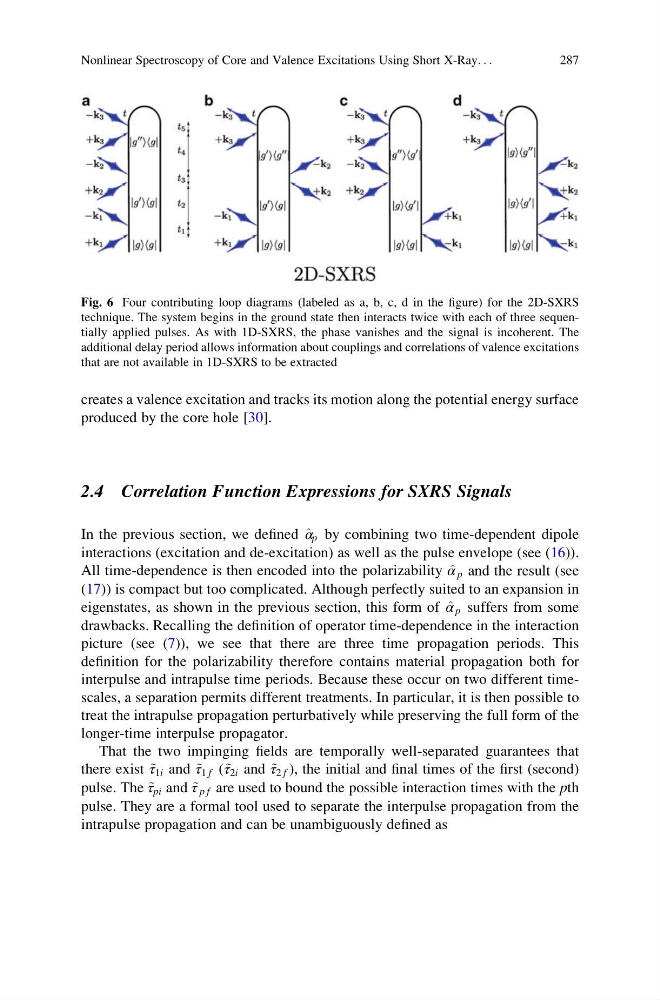
Fig. 6 Four contributing loop diagrams (labeled as a, b, c, d in the figure) for the 2D-SXRS
technique. The system begins in the ground state then interacts twice with each of three sequentially applied pulses. As with 1D-SXRS, the phase vanishes and the signal is incoherent. The
additional delay period allows information about couplings and correlations of valence excitations
that are not available in 1D-SXRS to be extracted
Nonlinear Spectroscopy of Core and Valence Excitations Using Short X-Ray. . .
287
produced by the core hole [30].
2.4 Correlation Function Expressions for SXRS Signals
In the previous section, we defined ^ α p by combining two time-dependent dipole
interactions (excitation and de-excitation) as well as the pulse envelope (see (16)).
All time-dependence is then encoded into the polarizability ^
α p and the result (see
(17)) is compact but too complicated. Although perfectly suited to an expansion in
eigenstates, as shown in the previous section, this form of ^
α p suffers from some
drawbacks. Recalling the definition of operator time-dependence in the interaction
picture (see (7)), we see that there are three time propagation periods. This
definition for the polarizability therefore contains material propagation both for
interpulse and intrapulse time periods. Because these occur on two different timescales, a separation permits different treatments. In particular, it is then possible to
treat the intrapulse propagation perturbatively while preserving the full form of the
longer-time interpulse propagator.
That the two impinging fields are temporally well-separated guarantees that
there exist ~
τ 1i and ~
τ 1 f (~ τ 2i and ~
τ 2 f ), the initial and final times of the first (second)
pulse. The ~
τ pi and ~
τ p f are used to bound the possible interaction times with the pth
pulse. They are a formal tool used to separate the interpulse propagation from the
intrapulse propagation and can be unambiguously defined as
Fig. 6 Four contributing loop diagrams (labeled as a, b, c, d in the figure) for the 2D-SXRS
technique. The system begins in the ground state then interacts twice with each of three sequentially applied pulses. As with 1D-SXRS, the phase vanishes and the signal is incoherent. The
additional delay period allows information about couplings and correlations of valence excitations
that are not available in 1D-SXRS to be extracted
Nonlinear Spectroscopy of Core and Valence Excitations Using Short X-Ray. . .
287