

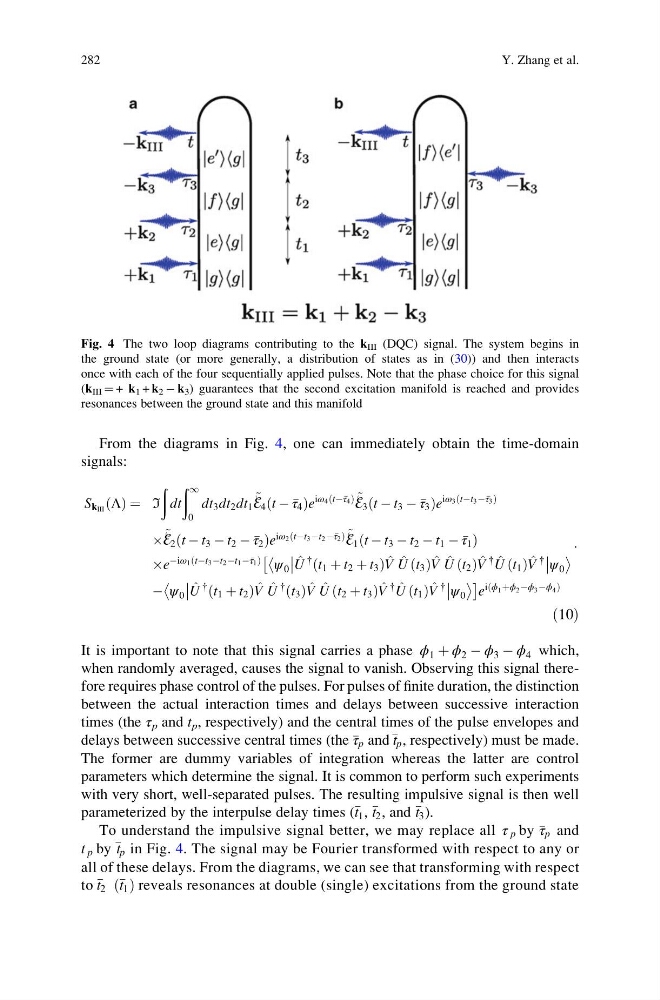
From the diagrams in Fig. 4, one can immediately obtain the time-domain
signals:
S k III Λ
ð Þ ¼ ℑ
ð
dt
ð 1
0
dt 3 dt 2 dt 1
~
ℰ 4 t À
τ 4
ð
Þe
iω 4 tÀ τ 4
ð
Þ~
ℰ 3 t À t 3 À
τ 3
ð
Þ e
iω 3 tÀt 3 À τ 3
ð
Þ
 ~
ℰ 2 t À t 3 À t 2 À
τ 2
ð
Þ e
iω 2 tÀt 3 Àt 2 À τ 2
ð
Þ ~
ℰ 1 t À t 3 À t 2 À t 1 À
τ 1
ð
Þ
Âe
Àiω1 tÀt3Àt2Àt1À τ1
ð
Þ
ψ 0 ^
U
{ t 1 þ t 2 þ t 3
ð
Þ ^
V ^
U t 3
ð Þ ^
V ^
U t 2
ð Þ ^
V
{ ^
U t 1
ð Þ ^
V
{
ψ 0
Â
À ψ 0 ^
U
{ t 1 þ t 2
ð
Þ ^
V ^
U
{ t 3
ð Þ ^
V ^
U t 2 þ t 3
ð
Þ ^
V
{ ^
U t 1
ð Þ ^
V
{
ψ 0
Ã
e
i ϕ 1 þϕ 2 Àϕ 3 Àϕ 4
ð
Þ
:
ð10Þ
It is important to note that this signal carries a phase ϕ 1 þ ϕ 2 À ϕ 3 À ϕ 4 which,
when randomly averaged, causes the signal to vanish. Observing this signal therefore requires phase control of the pulses. For pulses of finite duration, the distinction
between the actual interaction times and delays between successive interaction
times (the τ p and t p , respectively) and the central times of the pulse envelopes and
delays between successive central times (the τ p and t p , respectively) must be made.
The former are dummy variables of integration whereas the latter are control
parameters which determine the signal. It is common to perform such experiments
with very short, well-separated pulses. The resulting impulsive signal is then well
parameterized by the interpulse delay times ( t 1 , t 2 , and t 3 ).
To understand the impulsive signal better, we may replace all τ p by τ p and
t p by t p in Fig. 4. The signal may be Fourier transformed with respect to any or
all of these delays. From the diagrams, we can see that transforming with respect
to t 2 t 1
ð Þ reveals resonances at double (single) excitations from the ground state
Fig. 4 The two loop diagrams contributing to the k III (DQC) signal. The system begins in
the ground state (or more generally, a distribution of states as in (30)) and then interacts
once with each of the four sequentially applied pulses. Note that the phase choice for this signal
(k III ¼ + k 1 + k 2 À k 3 ) guarantees that the second excitation manifold is reached and provides
resonances between the ground state and this manifold
282
Y. Zhang et al.
signals:
S k III Λ
ð Þ ¼ ℑ
ð
dt
ð 1
0
dt 3 dt 2 dt 1
~
ℰ 4 t À
τ 4
ð
Þe
iω 4 tÀ τ 4
ð
Þ~
ℰ 3 t À t 3 À
τ 3
ð
Þ e
iω 3 tÀt 3 À τ 3
ð
Þ
 ~
ℰ 2 t À t 3 À t 2 À
τ 2
ð
Þ e
iω 2 tÀt 3 Àt 2 À τ 2
ð
Þ ~
ℰ 1 t À t 3 À t 2 À t 1 À
τ 1
ð
Þ
Âe
Àiω1 tÀt3Àt2Àt1À τ1
ð
Þ
ψ 0 ^
U
{ t 1 þ t 2 þ t 3
ð
Þ ^
V ^
U t 3
ð Þ ^
V ^
U t 2
ð Þ ^
V
{ ^
U t 1
ð Þ ^
V
{
ψ 0
Â
À ψ 0 ^
U
{ t 1 þ t 2
ð
Þ ^
V ^
U
{ t 3
ð Þ ^
V ^
U t 2 þ t 3
ð
Þ ^
V
{ ^
U t 1
ð Þ ^
V
{
ψ 0
Ã
e
i ϕ 1 þϕ 2 Àϕ 3 Àϕ 4
ð
Þ
:
ð10Þ
It is important to note that this signal carries a phase ϕ 1 þ ϕ 2 À ϕ 3 À ϕ 4 which,
when randomly averaged, causes the signal to vanish. Observing this signal therefore requires phase control of the pulses. For pulses of finite duration, the distinction
between the actual interaction times and delays between successive interaction
times (the τ p and t p , respectively) and the central times of the pulse envelopes and
delays between successive central times (the τ p and t p , respectively) must be made.
The former are dummy variables of integration whereas the latter are control
parameters which determine the signal. It is common to perform such experiments
with very short, well-separated pulses. The resulting impulsive signal is then well
parameterized by the interpulse delay times ( t 1 , t 2 , and t 3 ).
To understand the impulsive signal better, we may replace all τ p by τ p and
t p by t p in Fig. 4. The signal may be Fourier transformed with respect to any or
all of these delays. From the diagrams, we can see that transforming with respect
to t 2 t 1
ð Þ reveals resonances at double (single) excitations from the ground state
Fig. 4 The two loop diagrams contributing to the k III (DQC) signal. The system begins in
the ground state (or more generally, a distribution of states as in (30)) and then interacts
once with each of the four sequentially applied pulses. Note that the phase choice for this signal
(k III ¼ + k 1 + k 2 À k 3 ) guarantees that the second excitation manifold is reached and provides
resonances between the ground state and this manifold
282
Y. Zhang et al.