

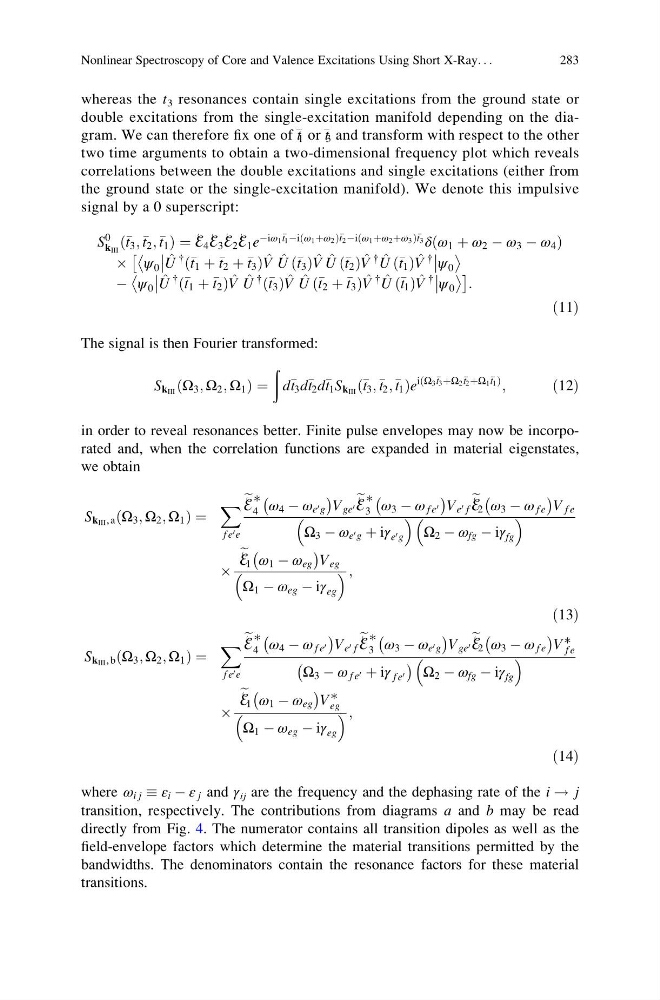
whereas the t 3 resonances contain single excitations from the ground state or
double excitations from the single-excitation manifold depending on the diagram. We can therefore fix one of t 1 or t 3 and transform with respect to the other
two time arguments to obtain a two-dimensional frequency plot which reveals
correlations between the double excitations and single excitations (either from
the ground state or the single-excitation manifold). We denote this impulsive
signal by a 0 superscript:
S
0
k III
t 3 ; t 2 ; t 1
ð
Þ¼ℰ 4 ℰ 3 ℰ 2 ℰ 1 e
Àiω 1 t 1 Ài ω 1 þω 2
ð
Þ
t 2 Ài ω 1 þω 2 þω 3
ð
Þ
t 3 δ ω 1 þ ω 2 À ω 3 À ω 4
ð
Þ
 ψ 0 ^
U
{ t 1 þ t 2 þ t 3
ð
Þ ^
V ^
U t 3
ð Þ ^
V ^
U t 2
ð Þ ^
V
{ ^
U t 1
ð Þ ^
V
{
ψ 0
Â
À ψ 0 ^
U
{ t 1 þ t 2
ð
Þ ^
V ^
U
{ t 3
ð Þ ^
V ^
U t 2 þ t 3
ð
Þ ^
V
{ ^
U t 1
ð Þ ^
V
{
ψ 0
à :
ð11Þ
The signal is then Fourier transformed:
S k III Ω 3 ; Ω 2 ; Ω 1
ð
Þ¼
ð
d t 3 d t 2 d t 1 S k III t 3 ; t 2 ; t 1
ð
Þe
i Ω 3 t 3 þΩ 2 t 2 þΩ 1 t 1
ð
Þ
;
ð12Þ
in order to reveal resonances better. Finite pulse envelopes may now be incorporated and, when the correlation functions are expanded in material eigenstates,
we obtain
S k III , a Ω 3 ; Ω 2 ; Ω 1
ð
Þ¼
X
f e 0 e
e
ℰ
∗
4 ω 4 À ω e 0 g
À
Á
V ge 0 e
ℰ
∗
3 ω 3 À ω f e 0
À
Á
V e 0 f
e
ℰ 2 ω 3 À ω f e
À
Á
V f e
Ω 3 À ω e 0 g þ iγ e 0 g
Ω 2 À ω fg À iγ fg
Â
e
ℰ 1 ω 1 À ω eg
À
Á
V eg
Ω 1 À ω eg À iγ eg
;
ð13Þ
S k III , b Ω 3 ; Ω 2 ; Ω 1
ð
Þ¼
X
f e 0 e
e
ℰ
∗
4 ω 4 À ω f e 0
À
Á
V e 0 f
e
ℰ
∗
3 ω 3 À ω e 0 g
À
Á
V ge 0 e
ℰ 2 ω 3 À ω f e
À
Á
V
∗
f e
Ω 3 À ω f e 0 þ iγ f e 0
À
Á Ω 2 À ω fg À iγ fg
Â
e
ℰ 1 ω 1 À ω eg
À
Á
V
∗
eg
Ω 1 À ω eg À iγ eg
;
ð14Þ
where ω i j ε i À ε j and γ ij are the frequency and the dephasing rate of the i ! j
transition, respectively. The contributions from diagrams a and b may be read
directly from Fig. 4. The numerator contains all transition dipoles as well as the
field-envelope factors which determine the material transitions permitted by the
bandwidths. The denominators contain the resonance factors for these material
transitions.
Nonlinear Spectroscopy of Core and Valence Excitations Using Short X-Ray. . .
283
double excitations from the single-excitation manifold depending on the diagram. We can therefore fix one of t 1 or t 3 and transform with respect to the other
two time arguments to obtain a two-dimensional frequency plot which reveals
correlations between the double excitations and single excitations (either from
the ground state or the single-excitation manifold). We denote this impulsive
signal by a 0 superscript:
S
0
k III
t 3 ; t 2 ; t 1
ð
Þ¼ℰ 4 ℰ 3 ℰ 2 ℰ 1 e
Àiω 1 t 1 Ài ω 1 þω 2
ð
Þ
t 2 Ài ω 1 þω 2 þω 3
ð
Þ
t 3 δ ω 1 þ ω 2 À ω 3 À ω 4
ð
Þ
 ψ 0 ^
U
{ t 1 þ t 2 þ t 3
ð
Þ ^
V ^
U t 3
ð Þ ^
V ^
U t 2
ð Þ ^
V
{ ^
U t 1
ð Þ ^
V
{
ψ 0
Â
À ψ 0 ^
U
{ t 1 þ t 2
ð
Þ ^
V ^
U
{ t 3
ð Þ ^
V ^
U t 2 þ t 3
ð
Þ ^
V
{ ^
U t 1
ð Þ ^
V
{
ψ 0
à :
ð11Þ
The signal is then Fourier transformed:
S k III Ω 3 ; Ω 2 ; Ω 1
ð
Þ¼
ð
d t 3 d t 2 d t 1 S k III t 3 ; t 2 ; t 1
ð
Þe
i Ω 3 t 3 þΩ 2 t 2 þΩ 1 t 1
ð
Þ
;
ð12Þ
in order to reveal resonances better. Finite pulse envelopes may now be incorporated and, when the correlation functions are expanded in material eigenstates,
we obtain
S k III , a Ω 3 ; Ω 2 ; Ω 1
ð
Þ¼
X
f e 0 e
e
ℰ
∗
4 ω 4 À ω e 0 g
À
Á
V ge 0 e
ℰ
∗
3 ω 3 À ω f e 0
À
Á
V e 0 f
e
ℰ 2 ω 3 À ω f e
À
Á
V f e
Ω 3 À ω e 0 g þ iγ e 0 g
Ω 2 À ω fg À iγ fg
Â
e
ℰ 1 ω 1 À ω eg
À
Á
V eg
Ω 1 À ω eg À iγ eg
;
ð13Þ
S k III , b Ω 3 ; Ω 2 ; Ω 1
ð
Þ¼
X
f e 0 e
e
ℰ
∗
4 ω 4 À ω f e 0
À
Á
V e 0 f
e
ℰ
∗
3 ω 3 À ω e 0 g
À
Á
V ge 0 e
ℰ 2 ω 3 À ω f e
À
Á
V
∗
f e
Ω 3 À ω f e 0 þ iγ f e 0
À
Á Ω 2 À ω fg À iγ fg
Â
e
ℰ 1 ω 1 À ω eg
À
Á
V
∗
eg
Ω 1 À ω eg À iγ eg
;
ð14Þ
where ω i j ε i À ε j and γ ij are the frequency and the dephasing rate of the i ! j
transition, respectively. The contributions from diagrams a and b may be read
directly from Fig. 4. The numerator contains all transition dipoles as well as the
field-envelope factors which determine the material transitions permitted by the
bandwidths. The denominators contain the resonance factors for these material
transitions.
Nonlinear Spectroscopy of Core and Valence Excitations Using Short X-Ray. . .
283