

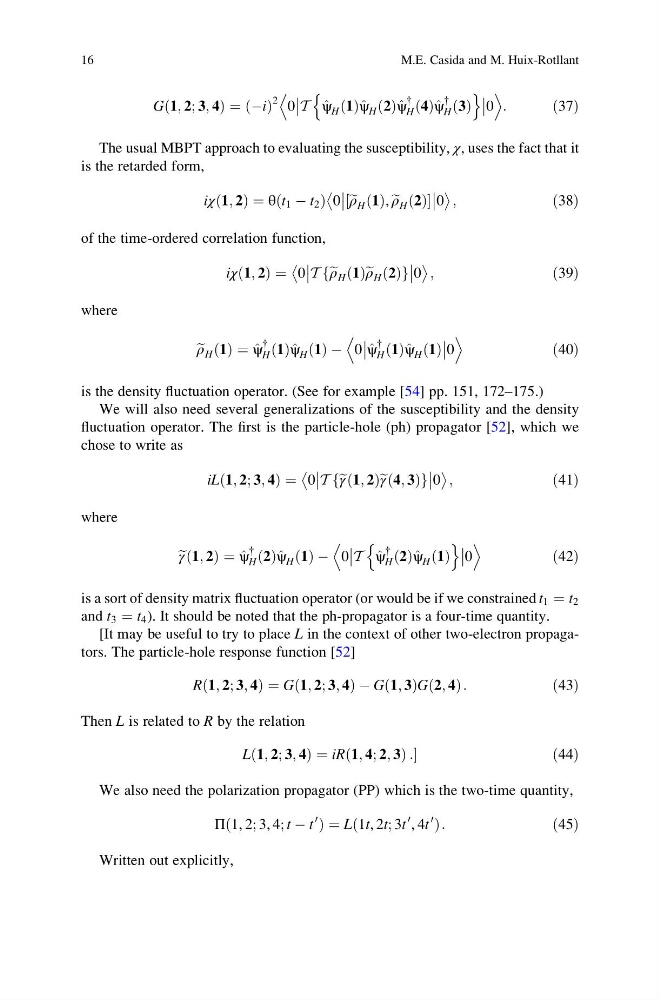
G 1; 2; 3; 4
ð
Þ¼ À i
ð Þ
2 0
T ^
ψ H 1
ð Þ^ ψ H 2
ð Þ^ ψ
{
H 4
ð Þ^ ψ
{
H 3
ð Þ
n
o
0
D
E
:
ð37Þ
The usual MBPT approach to evaluating the susceptibility, χ, uses the fact that it
is the retarded form,
iχ 1; 2
ð Þ ¼ θ t 1 À t 2
ð
Þ 0
e ρ H 1
ð Þ, e ρ H 2
ð Þ
½
0
;
ð38Þ
of the time-ordered correlation function,
iχ 1; 2
ð Þ ¼ 0
T e ρ H 1
ð Þe ρ H 2
ð Þ
f
g
0
;
ð39Þ
where
e ρ H 1
ð Þ ¼ ^
ψ
{
H 1
ð Þ^ ψ H 1
ð Þ À 0
^
ψ
{
H 1
ð Þ^ ψ H 1
ð Þ
0
D
E
ð40Þ
is the density fluctuation operator. (See for example [54] pp. 151, 172–175.)
We will also need several generalizations of the susceptibility and the density
fluctuation operator. The first is the particle-hole (ph) propagator [52], which we
chose to write as
iL 1; 2; 3; 4
ð
Þ¼ 0
T e γ 1; 2
ð Þe γ 4; 3
ð Þ
f
g
0
;
ð41Þ
where
e γ 1; 2
ð Þ ¼ ^
ψ
{
H 2
ð Þ^ ψ H 1
ð Þ À 0
T ^
ψ
{
H 2
ð Þ^ ψ H 1
ð Þ
n
o
0
D
E
ð42Þ
is a sort of density matrix fluctuation operator (or would be if we constrained t 1 ¼ t 2
and t 3 ¼ t 4 ). It should be noted that the ph-propagator is a four-time quantity.
[It may be useful to try to place L in the context of other two-electron propagators. The particle-hole response function [52]
R 1; 2; 3; 4
ð
Þ¼G 1; 2; 3; 4
ð
ÞÀG 1; 3
ð ÞG 2; 4
ð Þ:
ð43Þ
Then L is related to R by the relation
L 1; 2; 3; 4
ð
Þ¼iR 1; 4; 2; 3
ð
Þ:
ð 44Þ
We also need the polarization propagator (PP) which is the two-time quantity,
Π 1, 2; 3, 4; t À t
0
ð
Þ ¼ L 1t, 2t; 3t
0 , 4t
0
ð
Þ :
ð45Þ
Written out explicitly,
16
M.E. Casida and M. Huix-Rotllant
ð
Þ¼ À i
ð Þ
2 0
T ^
ψ H 1
ð Þ^ ψ H 2
ð Þ^ ψ
{
H 4
ð Þ^ ψ
{
H 3
ð Þ
n
o
0
D
E
:
ð37Þ
The usual MBPT approach to evaluating the susceptibility, χ, uses the fact that it
is the retarded form,
iχ 1; 2
ð Þ ¼ θ t 1 À t 2
ð
Þ 0
e ρ H 1
ð Þ, e ρ H 2
ð Þ
½
0
;
ð38Þ
of the time-ordered correlation function,
iχ 1; 2
ð Þ ¼ 0
T e ρ H 1
ð Þe ρ H 2
ð Þ
f
g
0
;
ð39Þ
where
e ρ H 1
ð Þ ¼ ^
ψ
{
H 1
ð Þ^ ψ H 1
ð Þ À 0
^
ψ
{
H 1
ð Þ^ ψ H 1
ð Þ
0
D
E
ð40Þ
is the density fluctuation operator. (See for example [54] pp. 151, 172–175.)
We will also need several generalizations of the susceptibility and the density
fluctuation operator. The first is the particle-hole (ph) propagator [52], which we
chose to write as
iL 1; 2; 3; 4
ð
Þ¼ 0
T e γ 1; 2
ð Þe γ 4; 3
ð Þ
f
g
0
;
ð41Þ
where
e γ 1; 2
ð Þ ¼ ^
ψ
{
H 2
ð Þ^ ψ H 1
ð Þ À 0
T ^
ψ
{
H 2
ð Þ^ ψ H 1
ð Þ
n
o
0
D
E
ð42Þ
is a sort of density matrix fluctuation operator (or would be if we constrained t 1 ¼ t 2
and t 3 ¼ t 4 ). It should be noted that the ph-propagator is a four-time quantity.
[It may be useful to try to place L in the context of other two-electron propagators. The particle-hole response function [52]
R 1; 2; 3; 4
ð
Þ¼G 1; 2; 3; 4
ð
ÞÀG 1; 3
ð ÞG 2; 4
ð Þ:
ð43Þ
Then L is related to R by the relation
L 1; 2; 3; 4
ð
Þ¼iR 1; 4; 2; 3
ð
Þ:
ð 44Þ
We also need the polarization propagator (PP) which is the two-time quantity,
Π 1, 2; 3, 4; t À t
0
ð
Þ ¼ L 1t, 2t; 3t
0 , 4t
0
ð
Þ :
ð45Þ
Written out explicitly,
16
M.E. Casida and M. Huix-Rotllant