

than one externally applied pulses or continuous wave (CW) laser field. To simulate
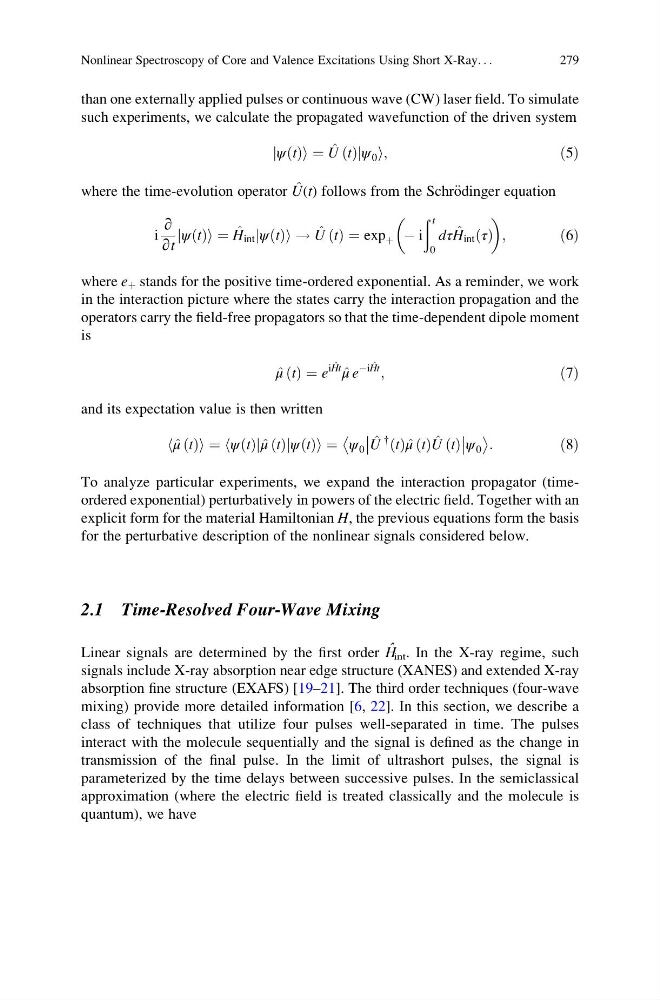
such experiments, we calculate the propagated wavefunction of the driven system
ψ t
ð Þ
j
i ¼ ^
U t
ð Þ ψ 0
j i;
ð5Þ
where the time-evolution operator ^
U(t) follows from the Schr€ odinger equation
i
∂
∂t
ψ t
ð Þ
j
i ¼ ^
H int ψ t
ð Þ
j
i ! ^
U t
ð Þ ¼ exp þ
À i
ð t
0
dτ ^
H int τ
ð Þ
;
ð6Þ
where e þ stands for the positive time-ordered exponential. As a reminder, we work
in the interaction picture where the states carry the interaction propagation and the
operators carry the field-free propagators so that the time-dependent dipole moment
is
^
μ t
ð Þ ¼ e
i ^
Ht
^
μ e
Ài ^
Ht
;
ð7Þ
and its expectation value is then written
^
μ t
ð Þ
h
i ¼ ψ t
ð Þ ^
μ t
ð Þ
j
jψ t
ð Þ
h
i ¼ ψ 0 ^
U
{ t
ð Þ^ μ t
ð Þ ^
U t
ð Þ
ψ 0
:
ð8Þ
To analyze particular experiments, we expand the interaction propagator (timeordered exponential) perturbatively in powers of the electric field. Together with an
explicit form for the material Hamiltonian H, the previous equations form the basis
for the perturbative description of the nonlinear signals considered below.
2.1 Time-Resolved Four-Wave Mixing
Linear signals are determined by the first order H ˆ
int . In the X-ray regime, such
signals include X-ray absorption near edge structure (XANES) and extended X-ray
absorption fine structure (EXAFS) [19–21]. The third order techniques (four-wave
mixing) provide more detailed information [6, 22]. In this section, we describe a
class of techniques that utilize four pulses well-separated in time. The pulses
interact with the molecule sequentially and the signal is defined as the change in
transmission of the final pulse. In the limit of ultrashort pulses, the signal is
parameterized by the time delays between successive pulses. In the semiclassical
approximation (where the electric field is treated classically and the molecule is
quantum), we have
Nonlinear Spectroscopy of Core and Valence Excitations Using Short X-Ray. . .
279
such experiments, we calculate the propagated wavefunction of the driven system
ψ t
ð Þ
j
i ¼ ^
U t
ð Þ ψ 0
j i;
ð5Þ
where the time-evolution operator ^
U(t) follows from the Schr€ odinger equation
i
∂
∂t
ψ t
ð Þ
j
i ¼ ^
H int ψ t
ð Þ
j
i ! ^
U t
ð Þ ¼ exp þ
À i
ð t
0
dτ ^
H int τ
ð Þ
;
ð6Þ
where e þ stands for the positive time-ordered exponential. As a reminder, we work
in the interaction picture where the states carry the interaction propagation and the
operators carry the field-free propagators so that the time-dependent dipole moment
is
^
μ t
ð Þ ¼ e
i ^
Ht
^
μ e
Ài ^
Ht
;
ð7Þ
and its expectation value is then written
^
μ t
ð Þ
h
i ¼ ψ t
ð Þ ^
μ t
ð Þ
j
jψ t
ð Þ
h
i ¼ ψ 0 ^
U
{ t
ð Þ^ μ t
ð Þ ^
U t
ð Þ
ψ 0
:
ð8Þ
To analyze particular experiments, we expand the interaction propagator (timeordered exponential) perturbatively in powers of the electric field. Together with an
explicit form for the material Hamiltonian H, the previous equations form the basis
for the perturbative description of the nonlinear signals considered below.
2.1 Time-Resolved Four-Wave Mixing
Linear signals are determined by the first order H ˆ
int . In the X-ray regime, such
signals include X-ray absorption near edge structure (XANES) and extended X-ray
absorption fine structure (EXAFS) [19–21]. The third order techniques (four-wave
mixing) provide more detailed information [6, 22]. In this section, we describe a
class of techniques that utilize four pulses well-separated in time. The pulses
interact with the molecule sequentially and the signal is defined as the change in
transmission of the final pulse. In the limit of ultrashort pulses, the signal is
parameterized by the time delays between successive pulses. In the semiclassical
approximation (where the electric field is treated classically and the molecule is
quantum), we have
Nonlinear Spectroscopy of Core and Valence Excitations Using Short X-Ray. . .
279