

2 Nonlinear X-Ray Spectroscopies
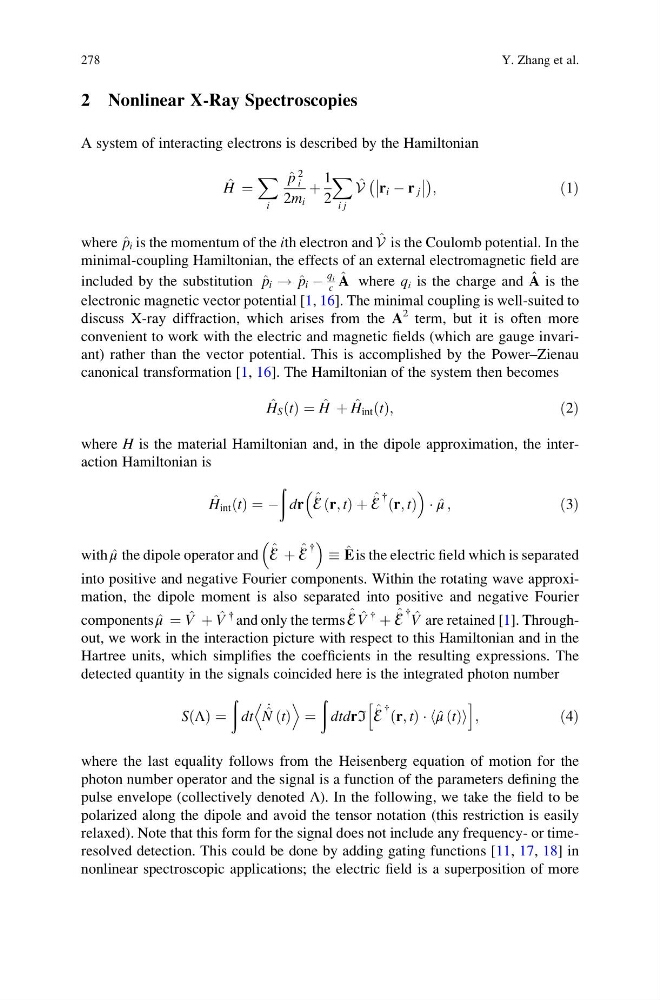
A system of interacting electrons is described by the Hamiltonian
^
H ¼
X
i
^
p
2
i
2m i
þ
1
2
X
i j
^
V r i À r j
À
Á ;
ð1Þ
where ^
p i is the momentum of the ith electron and ^
V is the Coulomb potential. In the
minimal-coupling Hamiltonian, the effects of an external electromagnetic field are
included by the substitution ^
p i ! ^
p i À
q i
c
^
A where q i is the charge and A ˆ is the
electronic magnetic vector potential [1, 16]. The minimal coupling is well-suited to
discuss X-ray diffraction, which arises from the A
2 term, but it is often more
convenient to work with the electric and magnetic fields (which are gauge invariant) rather than the vector potential. This is accomplished by the Power–Zienau
canonical transformation [1, 16]. The Hamiltonian of the system then becomes
^
H S t
ð Þ ¼ ^
H þ ^
H int t
ð Þ;
ð2Þ
where H is the material Hamiltonian and, in the dipole approximation, the interaction Hamiltonian is
^
H int t
ð Þ ¼ À
ð
dr ^
ℰ r; t
ð Þ þ ^
ℰ
{ r; t
ð Þ
Á ^
μ ;
ð3Þ
with ^
μ the dipole operator and ^
ℰ þ ^
ℰ
{
^
Eis the electric field which is separated
into positive and negative Fourier components. Within the rotating wave approximation, the dipole moment is also separated into positive and negative Fourier
components ^
μ ¼ ^
V þ ^
V
{ and only the terms ^
ℰ ^
V
{
þ ^
ℰ
{
^
V are retained [1]. Throughout, we work in the interaction picture with respect to this Hamiltonian and in the
Hartree units, which simplifies the coefficients in the resulting expressions. The
detected quantity in the signals coincided here is the integrated photon number
S Λ
ð Þ ¼
ð
dt _
^
N t
ð Þ
D
E
¼
ð
dtdrℑ ^
ℰ
{ r; t
ð Þ Á ^
μ t
ð Þ
h
i
h
i
;
ð4Þ
where the last equality follows from the Heisenberg equation of motion for the
photon number operator and the signal is a function of the parameters defining the
pulse envelope (collectively denoted Λ). In the following, we take the field to be
polarized along the dipole and avoid the tensor notation (this restriction is easily
relaxed). Note that this form for the signal does not include any frequency- or timeresolved detection. This could be done by adding gating functions [11, 17, 18] in
nonlinear spectroscopic applications; the electric field is a superposition of more
278
Y. Zhang et al.
A system of interacting electrons is described by the Hamiltonian
^
H ¼
X
i
^
p
2
i
2m i
þ
1
2
X
i j
^
V r i À r j
À
Á ;
ð1Þ
where ^
p i is the momentum of the ith electron and ^
V is the Coulomb potential. In the
minimal-coupling Hamiltonian, the effects of an external electromagnetic field are
included by the substitution ^
p i ! ^
p i À
q i
c
^
A where q i is the charge and A ˆ is the
electronic magnetic vector potential [1, 16]. The minimal coupling is well-suited to
discuss X-ray diffraction, which arises from the A
2 term, but it is often more
convenient to work with the electric and magnetic fields (which are gauge invariant) rather than the vector potential. This is accomplished by the Power–Zienau
canonical transformation [1, 16]. The Hamiltonian of the system then becomes
^
H S t
ð Þ ¼ ^
H þ ^
H int t
ð Þ;
ð2Þ
where H is the material Hamiltonian and, in the dipole approximation, the interaction Hamiltonian is
^
H int t
ð Þ ¼ À
ð
dr ^
ℰ r; t
ð Þ þ ^
ℰ
{ r; t
ð Þ
Á ^
μ ;
ð3Þ
with ^
μ the dipole operator and ^
ℰ þ ^
ℰ
{
^
Eis the electric field which is separated
into positive and negative Fourier components. Within the rotating wave approximation, the dipole moment is also separated into positive and negative Fourier
components ^
μ ¼ ^
V þ ^
V
{ and only the terms ^
ℰ ^
V
{
þ ^
ℰ
{
^
V are retained [1]. Throughout, we work in the interaction picture with respect to this Hamiltonian and in the
Hartree units, which simplifies the coefficients in the resulting expressions. The
detected quantity in the signals coincided here is the integrated photon number
S Λ
ð Þ ¼
ð
dt _
^
N t
ð Þ
D
E
¼
ð
dtdrℑ ^
ℰ
{ r; t
ð Þ Á ^
μ t
ð Þ
h
i
h
i
;
ð4Þ
where the last equality follows from the Heisenberg equation of motion for the
photon number operator and the signal is a function of the parameters defining the
pulse envelope (collectively denoted Λ). In the following, we take the field to be
polarized along the dipole and avoid the tensor notation (this restriction is easily
relaxed). Note that this form for the signal does not include any frequency- or timeresolved detection. This could be done by adding gating functions [11, 17, 18] in
nonlinear spectroscopic applications; the electric field is a superposition of more
278
Y. Zhang et al.