

P k
ð Þ ¼ 2
X N=2
i¼1
k
ψ i, B T
ð Þ
2 :
ð96Þ
The quality of this approximation is now limited by the error committed by
truncating the exchange and correlation potential contained in H ˆ KS (t) for r ! r s .
In atoms and molecules this adds to the error from truncating the tails of the
Coulomb potential and strongly depends on the dynamics induced by the external
field. It should be noted that for independent electrons in short-range potentials the
method is exact. The validity of this approximation in more general situations may
be assessed on the basis of the success in reproducing experiments. The example
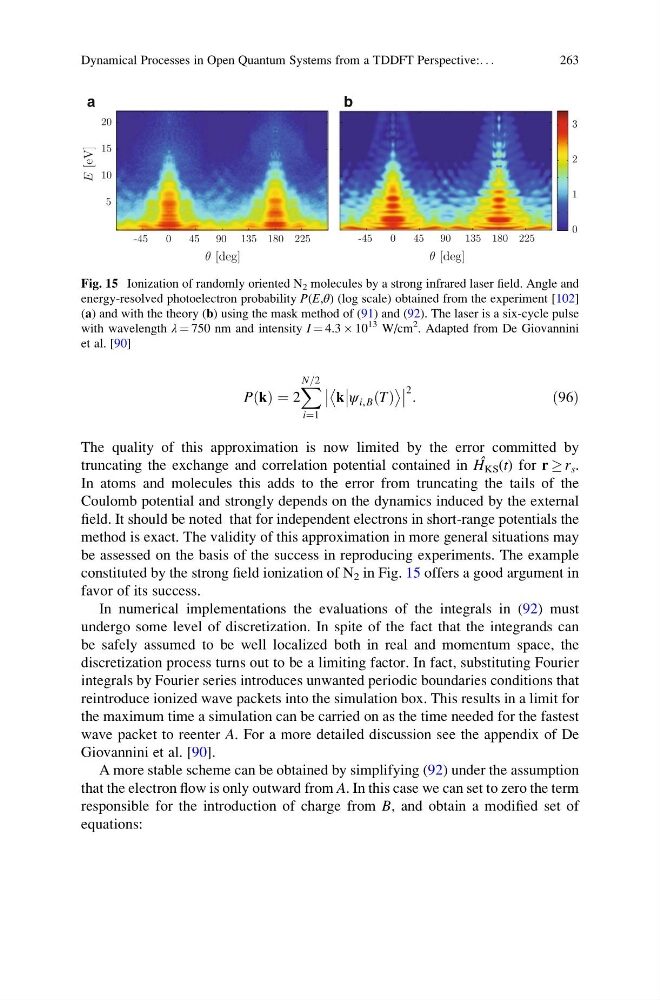
constituted by the strong field ionization of N 2 in Fig. 15 offers a good argument in
favor of its success.
In numerical implementations the evaluations of the integrals in (92) must
undergo some level of discretization. In spite of the fact that the integrands can
be safely assumed to be well localized both in real and momentum space, the
discretization process turns out to be a limiting factor. In fact, substituting Fourier
integrals by Fourier series introduces unwanted periodic boundaries conditions that
reintroduce ionized wave packets into the simulation box. This results in a limit for
the maximum time a simulation can be carried on as the time needed for the fastest
wave packet to reenter A. For a more detailed discussion see the appendix of De
Giovannini et al. [90].
A more stable scheme can be obtained by simplifying (92) under the assumption
that the electron flow is only outward from A. In this case we can set to zero the term
responsible for the introduction of charge from B, and obtain a modified set of
equations:
a
b
Fig. 15 Ionization of randomly oriented N 2 molecules by a strong infrared laser field. Angle and
energy-resolved photoelectron probability P(E,θ) (log scale) obtained from the experiment [102]
(a) and with the theory (b) using the mask method of (91) and (92). The laser is a six-cycle pulse
with wavelength λ ¼ 750 nm and intensity I ¼ 4.3 Â 10
13 W/cm
2
. Adapted from De Giovannini
et al. [90]
Dynamical Processes in Open Quantum Systems from a TDDFT Perspective:. . .
263
ð Þ ¼ 2
X N=2
i¼1
k
ψ i, B T
ð Þ
2 :
ð96Þ
The quality of this approximation is now limited by the error committed by
truncating the exchange and correlation potential contained in H ˆ KS (t) for r ! r s .
In atoms and molecules this adds to the error from truncating the tails of the
Coulomb potential and strongly depends on the dynamics induced by the external
field. It should be noted that for independent electrons in short-range potentials the
method is exact. The validity of this approximation in more general situations may
be assessed on the basis of the success in reproducing experiments. The example
constituted by the strong field ionization of N 2 in Fig. 15 offers a good argument in
favor of its success.
In numerical implementations the evaluations of the integrals in (92) must
undergo some level of discretization. In spite of the fact that the integrands can
be safely assumed to be well localized both in real and momentum space, the
discretization process turns out to be a limiting factor. In fact, substituting Fourier
integrals by Fourier series introduces unwanted periodic boundaries conditions that
reintroduce ionized wave packets into the simulation box. This results in a limit for
the maximum time a simulation can be carried on as the time needed for the fastest
wave packet to reenter A. For a more detailed discussion see the appendix of De
Giovannini et al. [90].
A more stable scheme can be obtained by simplifying (92) under the assumption
that the electron flow is only outward from A. In this case we can set to zero the term
responsible for the introduction of charge from B, and obtain a modified set of
equations:
a
b
Fig. 15 Ionization of randomly oriented N 2 molecules by a strong infrared laser field. Angle and
energy-resolved photoelectron probability P(E,θ) (log scale) obtained from the experiment [102]
(a) and with the theory (b) using the mask method of (91) and (92). The laser is a six-cycle pulse
with wavelength λ ¼ 750 nm and intensity I ¼ 4.3 Â 10
13 W/cm
2
. Adapted from De Giovannini
et al. [90]
Dynamical Processes in Open Quantum Systems from a TDDFT Perspective:. . .
263