

for the description of outgoing and incoming particle flows. In this respect it
directly relates to the exact boundary conditions of Sect. 5.1.
Once (91) and (92) are propagated up to a time T such that the external field has
vanished and the bound and scattering components of Ψ(t) are well separated, the
momentum-resolved probability can be obtained just by taking the square modulus
of the wavefunction in B: P(k) ¼ |hk|Ψ B (T )i|
2 . This definition is consistent with that
of the surface flux method, noting that, at time T, Volkov and plane waves differ
only by a phase |ϕ k (T )i ¼ |ki exp{iΦ(k,T )}. Extending the mask method to the case
of infinite-range potentials incurs the same approximation errors as in the flux
method with Volkov states.
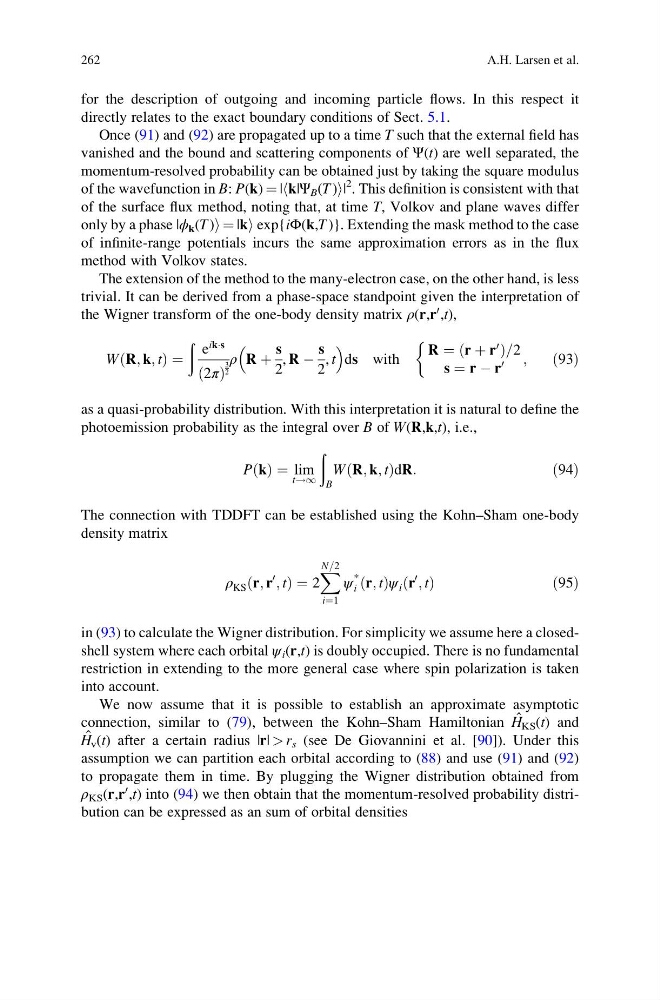
The extension of the method to the many-electron case, on the other hand, is less
trivial. It can be derived from a phase-space standpoint given the interpretation of
the Wigner transform of the one-body density matrix ρ(r,r
0 ,t),
W R; k; t
ð
Þ¼
ð e
ikÁs
2π
ð Þ
3
2
ρ R þ
s
2
, R À
s
2
, t
ds with
R ¼ r þ r
0
ð
Þ=2
s ¼ r À r
0
&
;
ð93Þ
as a quasi-probability distribution. With this interpretation it is natural to define the
photoemission probability as the integral over B of W(R,k,t), i.e.,
P k
ð Þ ¼ lim
t!1
ð
B
W R; k; t
ð
ÞdR:
ð94Þ
The connection with TDDFT can be established using the Kohn–Sham one-body
density matrix
ρ KS r; r
0
; t
ð
Þ¼2
X N=2
i¼1
ψ
*
i r; t
ð Þψ i r
0
; t
ð Þ
ð95Þ
in (93) to calculate the Wigner distribution. For simplicity we assume here a closedshell system where each orbital ψ i (r,t) is doubly occupied. There is no fundamental
restriction in extending to the more general case where spin polarization is taken
into account.
We now assume that it is possible to establish an approximate asymptotic
connection, similar to (79), between the Kohn–Sham Hamiltonian H ˆ
KS (t) and
H ˆ
v (t) after a certain radius |r| > r s (see De Giovannini et al. [90]). Under this
assumption we can partition each orbital according to (88) and use (91) and (92)
to propagate them in time. By plugging the Wigner distribution obtained from
ρ KS (r,r
0 ,t) into (94) we then obtain that the momentum-resolved probability distribution can be expressed as an sum of orbital densities
262
A.H. Larsen et al.
directly relates to the exact boundary conditions of Sect. 5.1.
Once (91) and (92) are propagated up to a time T such that the external field has
vanished and the bound and scattering components of Ψ(t) are well separated, the
momentum-resolved probability can be obtained just by taking the square modulus
of the wavefunction in B: P(k) ¼ |hk|Ψ B (T )i|
2 . This definition is consistent with that
of the surface flux method, noting that, at time T, Volkov and plane waves differ
only by a phase |ϕ k (T )i ¼ |ki exp{iΦ(k,T )}. Extending the mask method to the case
of infinite-range potentials incurs the same approximation errors as in the flux
method with Volkov states.
The extension of the method to the many-electron case, on the other hand, is less
trivial. It can be derived from a phase-space standpoint given the interpretation of
the Wigner transform of the one-body density matrix ρ(r,r
0 ,t),
W R; k; t
ð
Þ¼
ð e
ikÁs
2π
ð Þ
3
2
ρ R þ
s
2
, R À
s
2
, t
ds with
R ¼ r þ r
0
ð
Þ=2
s ¼ r À r
0
&
;
ð93Þ
as a quasi-probability distribution. With this interpretation it is natural to define the
photoemission probability as the integral over B of W(R,k,t), i.e.,
P k
ð Þ ¼ lim
t!1
ð
B
W R; k; t
ð
ÞdR:
ð94Þ
The connection with TDDFT can be established using the Kohn–Sham one-body
density matrix
ρ KS r; r
0
; t
ð
Þ¼2
X N=2
i¼1
ψ
*
i r; t
ð Þψ i r
0
; t
ð Þ
ð95Þ
in (93) to calculate the Wigner distribution. For simplicity we assume here a closedshell system where each orbital ψ i (r,t) is doubly occupied. There is no fundamental
restriction in extending to the more general case where spin polarization is taken
into account.
We now assume that it is possible to establish an approximate asymptotic
connection, similar to (79), between the Kohn–Sham Hamiltonian H ˆ
KS (t) and
H ˆ
v (t) after a certain radius |r| > r s (see De Giovannini et al. [90]). Under this
assumption we can partition each orbital according to (88) and use (91) and (92)
to propagate them in time. By plugging the Wigner distribution obtained from
ρ KS (r,r
0 ,t) into (94) we then obtain that the momentum-resolved probability distribution can be expressed as an sum of orbital densities
262
A.H. Larsen et al.