

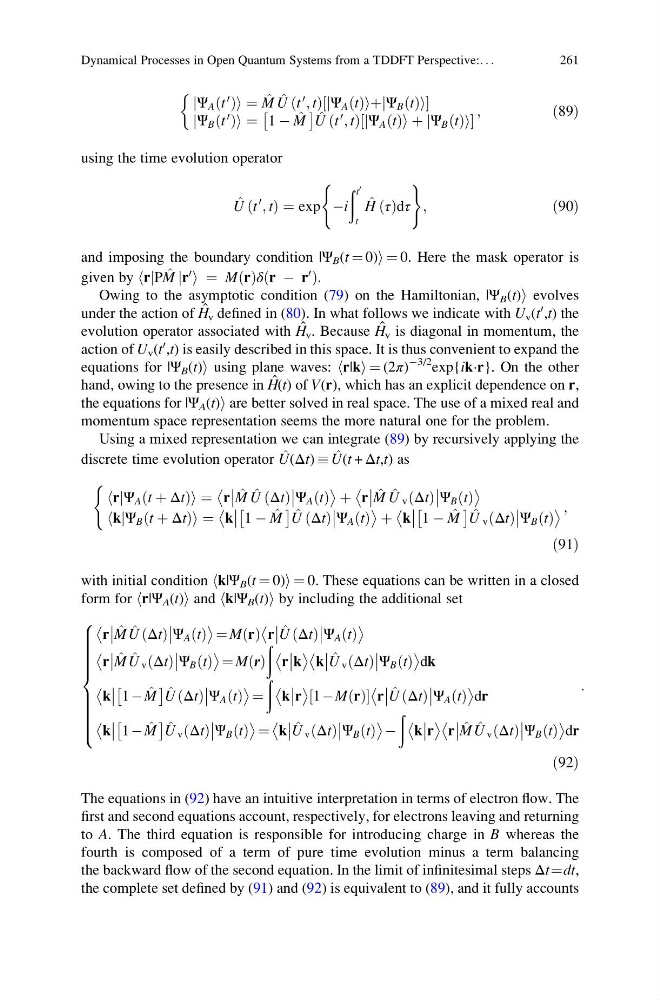
Ψ A t
0
ð Þ
j
i¼ ^
M ^
U t
0
; t
ð Þ Ψ A t
ð Þiþ
j
Ψ B t
ð Þ
j
i
½
Ψ B t
0
ð Þ
j
i¼ 1 À ^
M
Â
à ^
U t
0
; t
ð Þ Ψ A t
ð Þi þ Ψ B t
ð Þ
j
i
j
½
&
;
ð89Þ
using the time evolution operator
^
U t
0
; t
ð Þ ¼ exp Ài
ð t
0
t
^
H τ
ð Þdτ
(
)
;
ð90Þ
and imposing the boundary condition |Ψ B (t ¼ 0)i ¼ 0. Here the mask operator is
given by r
h jP ^
M r
0
j i ¼ M r
ð Þδ r À r
0
ð
Þ.
Owing to the asymptotic condition (79) on the Hamiltonian, |Ψ B (t)i evolves
under the action of H ˆ
v defined in (80). In what follows we indicate with U v (t
0 ,t) the
evolution operator associated with H ˆ
v . Because H ˆ
v is diagonal in momentum, the
action of U v (t
0 ,t) is easily described in this space. It is thus convenient to expand the
equations for |Ψ B (t)i using plane waves: hr|ki ¼ (2π)
À3/2 exp{ikÁr}. On the other
hand, owing to the presence in H ˆ (t) of V(r), which has an explicit dependence on r,
the equations for |Ψ A (t)i are better solved in real space. The use of a mixed real and
momentum space representation seems the more natural one for the problem.
Using a mixed representation we can integrate (89) by recursively applying the
discrete time evolution operator ^
U(Δt) ^
U(t + Δt,t) as
r Ψ A t þ Δt
ð
Þ
j
h
i¼ r ^
M ^
U Δt
ð Þ
Ψ A t
ð Þ
þ r ^
M ^
U v Δt
ð Þ
Ψ B t
ð Þ
k Ψ B t þ Δt
ð
Þ
j
h
i¼ k 1 À ^
M
Â
à ^
U Δt
ð Þ
Ψ A t
ð Þ
þ k 1 À ^
M
Â
à ^
U v Δt
ð Þ
Ψ B t
ð Þ
(
;
ð91Þ
with initial condition hk|Ψ B (t ¼ 0)i ¼ 0. These equations can be written in a closed
form for hr|Ψ A (t)i and hk|Ψ B (t)i by including the additional set
r ^
M ^
U Δt
ð Þ
Ψ A t
ð Þ
¼ M r
ð Þ r ^
U Δt
ð Þ
Ψ A t
ð Þ
r ^
M ^
U v Δt
ð Þ
Ψ B t
ð Þ
¼ M r
ð Þ
ð
r
k
k ^
U v Δt
ð Þ
Ψ B t
ð Þ
dk
k 1 À ^
M
Â
à ^
U Δt
ð Þ
Ψ A t
ð Þ
¼
ð
k
r
1 À M r
ð Þ
½
r ^
U Δt
ð Þ
Ψ A t
ð Þ
dr
k 1 À ^
M
Â
à ^
U v Δt
ð Þ
Ψ B t
ð Þ
¼ k ^
U v Δt
ð Þ
Ψ B t
ð Þ
À
ð
k
r
r ^
M ^
U v Δt
ð Þ
Ψ B t
ð Þ
dr
8
> > > > > > > > <
> > > > > > > > :
:
ð92Þ
The equations in (92) have an intuitive interpretation in terms of electron flow. The
first and second equations account, respectively, for electrons leaving and returning
to A. The third equation is responsible for introducing charge in B whereas the
fourth is composed of a term of pure time evolution minus a term balancing
the backward flow of the second equation. In the limit of infinitesimal steps Δt¼dt,
the complete set defined by (91) and (92) is equivalent to (89), and it fully accounts
Dynamical Processes in Open Quantum Systems from a TDDFT Perspective:. . .
261
0
ð Þ
j
i¼ ^
M ^
U t
0
; t
ð Þ Ψ A t
ð Þiþ
j
Ψ B t
ð Þ
j
i
½
Ψ B t
0
ð Þ
j
i¼ 1 À ^
M
Â
à ^
U t
0
; t
ð Þ Ψ A t
ð Þi þ Ψ B t
ð Þ
j
i
j
½
&
;
ð89Þ
using the time evolution operator
^
U t
0
; t
ð Þ ¼ exp Ài
ð t
0
t
^
H τ
ð Þdτ
(
)
;
ð90Þ
and imposing the boundary condition |Ψ B (t ¼ 0)i ¼ 0. Here the mask operator is
given by r
h jP ^
M r
0
j i ¼ M r
ð Þδ r À r
0
ð
Þ.
Owing to the asymptotic condition (79) on the Hamiltonian, |Ψ B (t)i evolves
under the action of H ˆ
v defined in (80). In what follows we indicate with U v (t
0 ,t) the
evolution operator associated with H ˆ
v . Because H ˆ
v is diagonal in momentum, the
action of U v (t
0 ,t) is easily described in this space. It is thus convenient to expand the
equations for |Ψ B (t)i using plane waves: hr|ki ¼ (2π)
À3/2 exp{ikÁr}. On the other
hand, owing to the presence in H ˆ (t) of V(r), which has an explicit dependence on r,
the equations for |Ψ A (t)i are better solved in real space. The use of a mixed real and
momentum space representation seems the more natural one for the problem.
Using a mixed representation we can integrate (89) by recursively applying the
discrete time evolution operator ^
U(Δt) ^
U(t + Δt,t) as
r Ψ A t þ Δt
ð
Þ
j
h
i¼ r ^
M ^
U Δt
ð Þ
Ψ A t
ð Þ
þ r ^
M ^
U v Δt
ð Þ
Ψ B t
ð Þ
k Ψ B t þ Δt
ð
Þ
j
h
i¼ k 1 À ^
M
Â
à ^
U Δt
ð Þ
Ψ A t
ð Þ
þ k 1 À ^
M
Â
à ^
U v Δt
ð Þ
Ψ B t
ð Þ
(
;
ð91Þ
with initial condition hk|Ψ B (t ¼ 0)i ¼ 0. These equations can be written in a closed
form for hr|Ψ A (t)i and hk|Ψ B (t)i by including the additional set
r ^
M ^
U Δt
ð Þ
Ψ A t
ð Þ
¼ M r
ð Þ r ^
U Δt
ð Þ
Ψ A t
ð Þ
r ^
M ^
U v Δt
ð Þ
Ψ B t
ð Þ
¼ M r
ð Þ
ð
r
k
k ^
U v Δt
ð Þ
Ψ B t
ð Þ
dk
k 1 À ^
M
Â
à ^
U Δt
ð Þ
Ψ A t
ð Þ
¼
ð
k
r
1 À M r
ð Þ
½
r ^
U Δt
ð Þ
Ψ A t
ð Þ
dr
k 1 À ^
M
Â
à ^
U v Δt
ð Þ
Ψ B t
ð Þ
¼ k ^
U v Δt
ð Þ
Ψ B t
ð Þ
À
ð
k
r
r ^
M ^
U v Δt
ð Þ
Ψ B t
ð Þ
dr
8
> > > > > > > > <
> > > > > > > > :
:
ð92Þ
The equations in (92) have an intuitive interpretation in terms of electron flow. The
first and second equations account, respectively, for electrons leaving and returning
to A. The third equation is responsible for introducing charge in B whereas the
fourth is composed of a term of pure time evolution minus a term balancing
the backward flow of the second equation. In the limit of infinitesimal steps Δt¼dt,
the complete set defined by (91) and (92) is equivalent to (89), and it fully accounts
Dynamical Processes in Open Quantum Systems from a TDDFT Perspective:. . .
261