

6.3 Mask Method
This mask method is based on the idea that the photoelectron emission probability
can be calculated by explicitly propagating the ionized electron wave packets as a
superposition of plane waves. The problem of matching inner and outer solutions is
solved here with the aid of a mask function [90]. This approach as been successfully
employed within TDDFT in situations involving atoms and molecules under the
influence of a variety of external fields ranging from strong and weak laser fields
[90] to pump and probe configurations [100, 101].
We begin here by introducing the equations governing time propagation for the
single-electron case and then turn to the many-electron one. Let us consider the case
where the Hamiltonian H ˆ (t) is of short range and satisfies the asymptotic condition
(79), i.e., it coincides with H ˆ
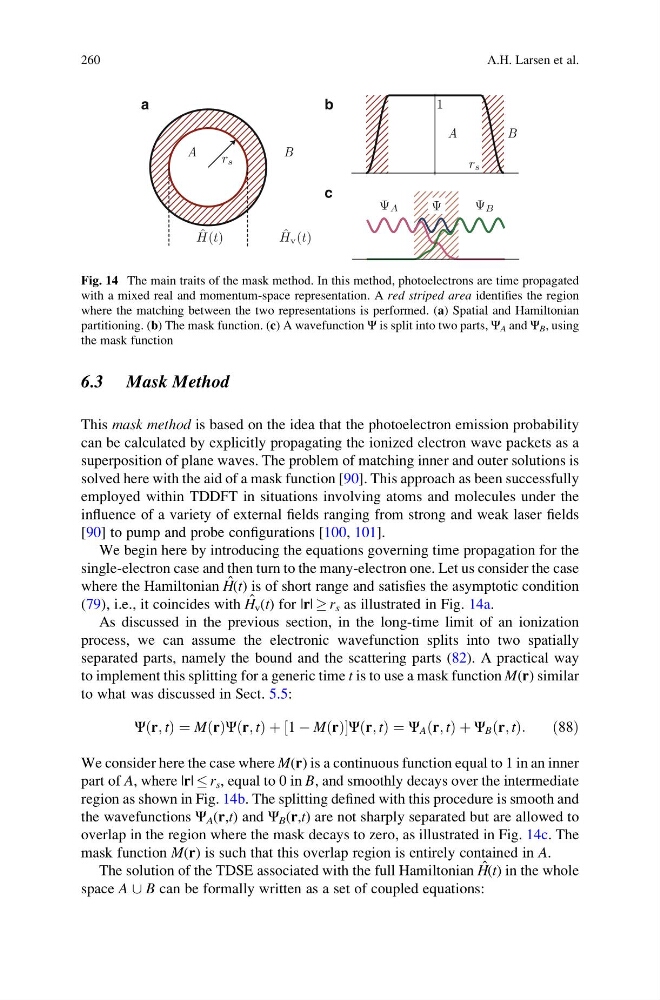
v (t) for |r| ! r s as illustrated in Fig. 14a.
As discussed in the previous section, in the long-time limit of an ionization
process, we can assume the electronic wavefunction splits into two spatially
separated parts, namely the bound and the scattering parts (82). A practical way
to implement this splitting for a generic time t is to use a mask function M(r) similar
to what was discussed in Sect. 5.5:
Ψ r; t
ð Þ ¼ M r
ð ÞΨ r; t
ð Þ þ 1 À M r
ð Þ
½
Ψ r; t
ð Þ ¼ Ψ A r; t
ð Þ þ Ψ B r; t
ð Þ:
ð88Þ
We consider here the case where M(r) is a continuous function equal to 1 in an inner
part of A, where |r| r s , equal to 0 in B, and smoothly decays over the intermediate
region as shown in Fig. 14b. The splitting defined with this procedure is smooth and
the wavefunctions Ψ A (r,t) and Ψ B (r,t) are not sharply separated but are allowed to
overlap in the region where the mask decays to zero, as illustrated in Fig. 14c. The
mask function M(r) is such that this overlap region is entirely contained in A.
The solution of the TDSE associated with the full Hamiltonian H ˆ (t) in the whole
space A [ B can be formally written as a set of coupled equations:
a
b
c
Fig. 14 The main traits of the mask method. In this method, photoelectrons are time propagated
with a mixed real and momentum-space representation. A red striped area identifies the region
where the matching between the two representations is performed. (a) Spatial and Hamiltonian
partitioning. (b) The mask function. (c) A wavefunction Ψ is split into two parts, Ψ A and Ψ B , using
the mask function
260
A.H. Larsen et al.
This mask method is based on the idea that the photoelectron emission probability
can be calculated by explicitly propagating the ionized electron wave packets as a
superposition of plane waves. The problem of matching inner and outer solutions is
solved here with the aid of a mask function [90]. This approach as been successfully
employed within TDDFT in situations involving atoms and molecules under the
influence of a variety of external fields ranging from strong and weak laser fields
[90] to pump and probe configurations [100, 101].
We begin here by introducing the equations governing time propagation for the
single-electron case and then turn to the many-electron one. Let us consider the case
where the Hamiltonian H ˆ (t) is of short range and satisfies the asymptotic condition
(79), i.e., it coincides with H ˆ
v (t) for |r| ! r s as illustrated in Fig. 14a.
As discussed in the previous section, in the long-time limit of an ionization
process, we can assume the electronic wavefunction splits into two spatially
separated parts, namely the bound and the scattering parts (82). A practical way
to implement this splitting for a generic time t is to use a mask function M(r) similar
to what was discussed in Sect. 5.5:
Ψ r; t
ð Þ ¼ M r
ð ÞΨ r; t
ð Þ þ 1 À M r
ð Þ
½
Ψ r; t
ð Þ ¼ Ψ A r; t
ð Þ þ Ψ B r; t
ð Þ:
ð88Þ
We consider here the case where M(r) is a continuous function equal to 1 in an inner
part of A, where |r| r s , equal to 0 in B, and smoothly decays over the intermediate
region as shown in Fig. 14b. The splitting defined with this procedure is smooth and
the wavefunctions Ψ A (r,t) and Ψ B (r,t) are not sharply separated but are allowed to
overlap in the region where the mask decays to zero, as illustrated in Fig. 14c. The
mask function M(r) is such that this overlap region is entirely contained in A.
The solution of the TDSE associated with the full Hamiltonian H ˆ (t) in the whole
space A [ B can be formally written as a set of coupled equations:
a
b
c
Fig. 14 The main traits of the mask method. In this method, photoelectrons are time propagated
with a mixed real and momentum-space representation. A red striped area identifies the region
where the matching between the two representations is performed. (a) Spatial and Hamiltonian
partitioning. (b) The mask function. (c) A wavefunction Ψ is split into two parts, Ψ A and Ψ B , using
the mask function
260
A.H. Larsen et al.