

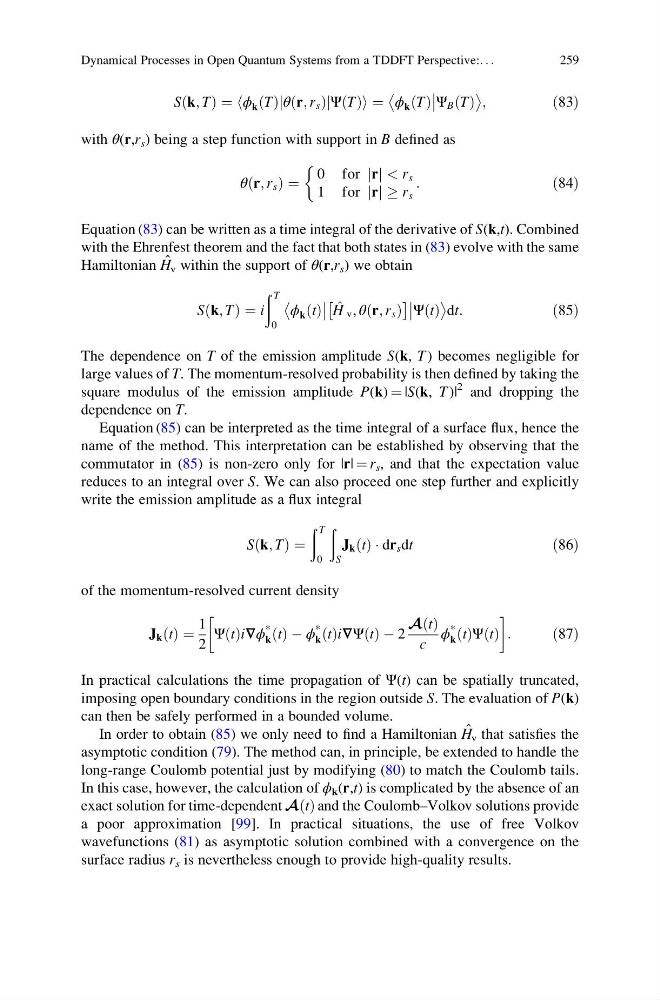
S k; T
ð
Þ ¼ ϕ k T
ð Þ θ r; r s
ð
Þ
j
jΨ T
ð Þ
h
i ¼ ϕ k T
ð Þ
Ψ B T
ð Þ
;
ð83Þ
with θ(r,r s ) being a step function with support in B defined as
θ r; r s
ð
Þ ¼
0 for r
j j < r s
1 for r
j j ! r s
&
:
ð84Þ
Equation (83) can be written as a time integral of the derivative of S(k,t). Combined
with the Ehrenfest theorem and the fact that both states in (83) evolve with the same
Hamiltonian H ˆ
v within the support of θ(r,r s ) we obtain
S k; T
ð
Þ ¼ i
ð T
0
ϕ k t
ð Þ ^
H v , θ r; r s
ð
Þ
Â
Ã
Ψ t
ð Þ
dt:
ð85Þ
The dependence on T of the emission amplitude S(k, T ) becomes negligible for
large values of T. The momentum-resolved probability is then defined by taking the
square modulus of the emission amplitude P(k) ¼ |S(k, T )|
2 and dropping the
dependence on T.
Equation (85) can be interpreted as the time integral of a surface flux, hence the
name of the method. This interpretation can be established by observing that the
commutator in (85) is non-zero only for |r| ¼ r s , and that the expectation value
reduces to an integral over S. We can also proceed one step further and explicitly
write the emission amplitude as a flux integral
S k; T
ð
Þ ¼
ð T
0
ð
S
J k t
ð Þ Á dr s dt
ð86Þ
of the momentum-resolved current density
J k t
ð Þ ¼
1
2
Ψ t
ð Þi∇ϕ
*
k t
ð Þ À ϕ
*
k t
ð Þi∇Ψ t
ð Þ À 2
A t
ð Þ
c
ϕ
*
k t
ð ÞΨ t
ð Þ
!
:
ð87Þ
In practical calculations the time propagation of Ψ(t) can be spatially truncated,
imposing open boundary conditions in the region outside S. The evaluation of P(k)
can then be safely performed in a bounded volume.
In order to obtain (85) we only need to find a Hamiltonian H ˆ
v that satisfies the
asymptotic condition (79). The method can, in principle, be extended to handle the
long-range Coulomb potential just by modifying (80) to match the Coulomb tails.
In this case, however, the calculation of ϕ k (r,t) is complicated by the absence of an
exact solution for time-dependent A t
ð Þ and the Coulomb–Volkov solutions provide
a poor approximation [99]. In practical situations, the use of free Volkov
wavefunctions (81) as asymptotic solution combined with a convergence on the
surface radius r s is nevertheless enough to provide high-quality results.
Dynamical Processes in Open Quantum Systems from a TDDFT Perspective:. . .
259
ð
Þ ¼ ϕ k T
ð Þ θ r; r s
ð
Þ
j
jΨ T
ð Þ
h
i ¼ ϕ k T
ð Þ
Ψ B T
ð Þ
;
ð83Þ
with θ(r,r s ) being a step function with support in B defined as
θ r; r s
ð
Þ ¼
0 for r
j j < r s
1 for r
j j ! r s
&
:
ð84Þ
Equation (83) can be written as a time integral of the derivative of S(k,t). Combined
with the Ehrenfest theorem and the fact that both states in (83) evolve with the same
Hamiltonian H ˆ
v within the support of θ(r,r s ) we obtain
S k; T
ð
Þ ¼ i
ð T
0
ϕ k t
ð Þ ^
H v , θ r; r s
ð
Þ
Â
Ã
Ψ t
ð Þ
dt:
ð85Þ
The dependence on T of the emission amplitude S(k, T ) becomes negligible for
large values of T. The momentum-resolved probability is then defined by taking the
square modulus of the emission amplitude P(k) ¼ |S(k, T )|
2 and dropping the
dependence on T.
Equation (85) can be interpreted as the time integral of a surface flux, hence the
name of the method. This interpretation can be established by observing that the
commutator in (85) is non-zero only for |r| ¼ r s , and that the expectation value
reduces to an integral over S. We can also proceed one step further and explicitly
write the emission amplitude as a flux integral
S k; T
ð
Þ ¼
ð T
0
ð
S
J k t
ð Þ Á dr s dt
ð86Þ
of the momentum-resolved current density
J k t
ð Þ ¼
1
2
Ψ t
ð Þi∇ϕ
*
k t
ð Þ À ϕ
*
k t
ð Þi∇Ψ t
ð Þ À 2
A t
ð Þ
c
ϕ
*
k t
ð ÞΨ t
ð Þ
!
:
ð87Þ
In practical calculations the time propagation of Ψ(t) can be spatially truncated,
imposing open boundary conditions in the region outside S. The evaluation of P(k)
can then be safely performed in a bounded volume.
In order to obtain (85) we only need to find a Hamiltonian H ˆ
v that satisfies the
asymptotic condition (79). The method can, in principle, be extended to handle the
long-range Coulomb potential just by modifying (80) to match the Coulomb tails.
In this case, however, the calculation of ϕ k (r,t) is complicated by the absence of an
exact solution for time-dependent A t
ð Þ and the Coulomb–Volkov solutions provide
a poor approximation [99]. In practical situations, the use of free Volkov
wavefunctions (81) as asymptotic solution combined with a convergence on the
surface radius r s is nevertheless enough to provide high-quality results.
Dynamical Processes in Open Quantum Systems from a TDDFT Perspective:. . .
259