

b, . . . for virtual spin-orbitals, and p, q, . . . for unspecified spin-orbitals (either
occupied or unoccupied).
6 We have also introduced the compact notation
ε rsÁÁÁ, uvÁÁÁ ¼ ε r þ ε s þ Á Á Á
ð
ÞÀε u þ ε v þ Á Á Á
ð
Þ :
ð30Þ
Equation (28) has paired excitation and de-excitation solutions. Its eigenvalues
are (de-)excitation energies, the vectors X and Y providing information about
transition moments. In particular, the oscillator strength, of the transition with
excitation energy ω I may be calculated from X I and Y I [38]. When the adiabatic
approximation (AA) to the xc-kernel is made, the A and B matrices become
independent of frequency. As a consequence, the number of solutions is equal to
the number of one-electron excitations, albeit dressed to include electron correlation effects. Allowing the A and B matrices to have a frequency dependence allows
the explicit inclusion of two-electron (and higher) excited states.
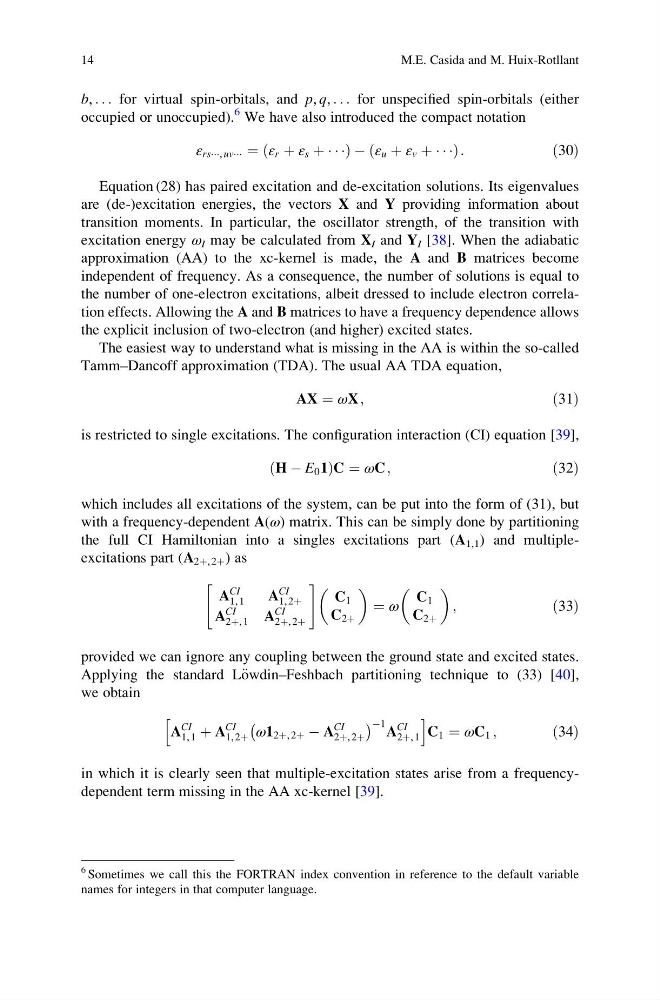
The easiest way to understand what is missing in the AA is within the so-called
Tamm–Dancoff approximation (TDA). The usual AA TDA equation,
AX ¼ ωX ;
ð31Þ
is restricted to single excitations. The configuration interaction (CI) equation [39],
H À E 0 1
ð
Þ C ¼ ωC ;
ð32Þ
which includes all excitations of the system, can be put into the form of (31), but
with a frequency-dependent A(ω) matrix. This can be simply done by partitioning
the full CI Hamiltonian into a singles excitations part (A 1,1 ) and multipleexcitations part (A 2þ, 2þ ) as
A
CI
1, 1
A
CI
1, 2þ
A
CI
2þ, 1 A
CI
2þ, 2þ
"
#
C 1
C 2þ
¼ ω
C 1
C 2þ
;
ð33Þ
provided we can ignore any coupling between the ground state and excited states.
Applying the standard L€ owdin–Feshbach partitioning technique to (33) [40],
we obtain
A
CI
1, 1 þ A
CI
1, 2þ ω1 2þ, 2þ À A
CI
2þ, 2þ
À
Á À1 A
CI
2þ, 1
h
i
C 1 ¼ ωC 1 ;
ð34Þ
in which it is clearly seen that multiple-excitation states arise from a frequencydependent term missing in the AA xc-kernel [39].
6 Sometimes we call this the FORTRAN index convention in reference to the default variable
names for integers in that computer language.
14
M.E. Casida and M. Huix-Rotllant
occupied or unoccupied).
6 We have also introduced the compact notation
ε rsÁÁÁ, uvÁÁÁ ¼ ε r þ ε s þ Á Á Á
ð
ÞÀε u þ ε v þ Á Á Á
ð
Þ :
ð30Þ
Equation (28) has paired excitation and de-excitation solutions. Its eigenvalues
are (de-)excitation energies, the vectors X and Y providing information about
transition moments. In particular, the oscillator strength, of the transition with
excitation energy ω I may be calculated from X I and Y I [38]. When the adiabatic
approximation (AA) to the xc-kernel is made, the A and B matrices become
independent of frequency. As a consequence, the number of solutions is equal to
the number of one-electron excitations, albeit dressed to include electron correlation effects. Allowing the A and B matrices to have a frequency dependence allows
the explicit inclusion of two-electron (and higher) excited states.
The easiest way to understand what is missing in the AA is within the so-called
Tamm–Dancoff approximation (TDA). The usual AA TDA equation,
AX ¼ ωX ;
ð31Þ
is restricted to single excitations. The configuration interaction (CI) equation [39],
H À E 0 1
ð
Þ C ¼ ωC ;
ð32Þ
which includes all excitations of the system, can be put into the form of (31), but
with a frequency-dependent A(ω) matrix. This can be simply done by partitioning
the full CI Hamiltonian into a singles excitations part (A 1,1 ) and multipleexcitations part (A 2þ, 2þ ) as
A
CI
1, 1
A
CI
1, 2þ
A
CI
2þ, 1 A
CI
2þ, 2þ
"
#
C 1
C 2þ
¼ ω
C 1
C 2þ
;
ð33Þ
provided we can ignore any coupling between the ground state and excited states.
Applying the standard L€ owdin–Feshbach partitioning technique to (33) [40],
we obtain
A
CI
1, 1 þ A
CI
1, 2þ ω1 2þ, 2þ À A
CI
2þ, 2þ
À
Á À1 A
CI
2þ, 1
h
i
C 1 ¼ ωC 1 ;
ð34Þ
in which it is clearly seen that multiple-excitation states arise from a frequencydependent term missing in the AA xc-kernel [39].
6 Sometimes we call this the FORTRAN index convention in reference to the default variable
names for integers in that computer language.
14
M.E. Casida and M. Huix-Rotllant