

P E
ð Þ /
ð
S
P r S E
ð Þdr S :
ð78Þ
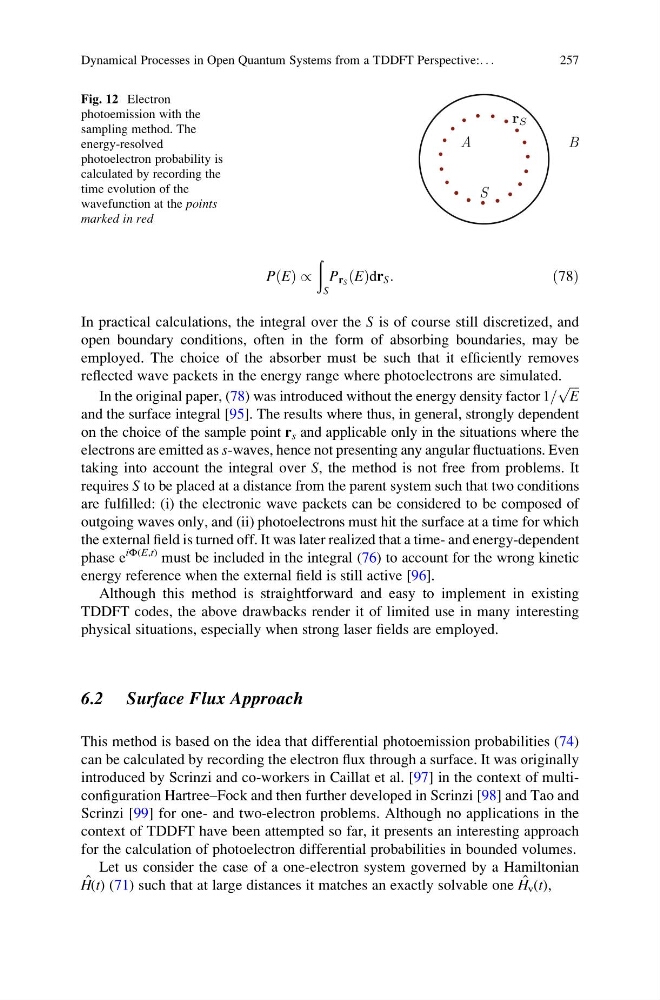
In practical calculations, the integral over the S is of course still discretized, and
open boundary conditions, often in the form of absorbing boundaries, may be
employed. The choice of the absorber must be such that it efficiently removes
reflected wave packets in the energy range where photoelectrons are simulated.
In the original paper, (78) was introduced without the energy density factor 1=
ffiffiffi
E
p
and the surface integral [95]. The results where thus, in general, strongly dependent
on the choice of the sample point r s and applicable only in the situations where the
electrons are emitted as s-waves, hence not presenting any angular fluctuations. Even
taking into account the integral over S, the method is not free from problems. It
requires S to be placed at a distance from the parent system such that two conditions
are fulfilled: (i) the electronic wave packets can be considered to be composed of
outgoing waves only, and (ii) photoelectrons must hit the surface at a time for which
the external field is turned off. It was later realized that a time- and energy-dependent
phase e
iΦ(E,t) must be included in the integral (76) to account for the wrong kinetic
energy reference when the external field is still active [96].
Although this method is straightforward and easy to implement in existing
TDDFT codes, the above drawbacks render it of limited use in many interesting
physical situations, especially when strong laser fields are employed.
6.2 Surface Flux Approach
This method is based on the idea that differential photoemission probabilities (74)
can be calculated by recording the electron flux through a surface. It was originally
introduced by Scrinzi and co-workers in Caillat et al. [97] in the context of multiconfiguration Hartree–Fock and then further developed in Scrinzi [98] and Tao and
Scrinzi [99] for one- and two-electron problems. Although no applications in the
context of TDDFT have been attempted so far, it presents an interesting approach
for the calculation of photoelectron differential probabilities in bounded volumes.
Let us consider the case of a one-electron system governed by a Hamiltonian
H ˆ (t) (71) such that at large distances it matches an exactly solvable one H ˆ
v (t),
Fig. 12 Electron
photoemission with the
sampling method. The
energy-resolved
photoelectron probability is
calculated by recording the
time evolution of the
wavefunction at the points
marked in red
Dynamical Processes in Open Quantum Systems from a TDDFT Perspective:. . .
257
ð Þ /
ð
S
P r S E
ð Þdr S :
ð78Þ
In practical calculations, the integral over the S is of course still discretized, and
open boundary conditions, often in the form of absorbing boundaries, may be
employed. The choice of the absorber must be such that it efficiently removes
reflected wave packets in the energy range where photoelectrons are simulated.
In the original paper, (78) was introduced without the energy density factor 1=
ffiffiffi
E
p
and the surface integral [95]. The results where thus, in general, strongly dependent
on the choice of the sample point r s and applicable only in the situations where the
electrons are emitted as s-waves, hence not presenting any angular fluctuations. Even
taking into account the integral over S, the method is not free from problems. It
requires S to be placed at a distance from the parent system such that two conditions
are fulfilled: (i) the electronic wave packets can be considered to be composed of
outgoing waves only, and (ii) photoelectrons must hit the surface at a time for which
the external field is turned off. It was later realized that a time- and energy-dependent
phase e
iΦ(E,t) must be included in the integral (76) to account for the wrong kinetic
energy reference when the external field is still active [96].
Although this method is straightforward and easy to implement in existing
TDDFT codes, the above drawbacks render it of limited use in many interesting
physical situations, especially when strong laser fields are employed.
6.2 Surface Flux Approach
This method is based on the idea that differential photoemission probabilities (74)
can be calculated by recording the electron flux through a surface. It was originally
introduced by Scrinzi and co-workers in Caillat et al. [97] in the context of multiconfiguration Hartree–Fock and then further developed in Scrinzi [98] and Tao and
Scrinzi [99] for one- and two-electron problems. Although no applications in the
context of TDDFT have been attempted so far, it presents an interesting approach
for the calculation of photoelectron differential probabilities in bounded volumes.
Let us consider the case of a one-electron system governed by a Hamiltonian
H ˆ (t) (71) such that at large distances it matches an exactly solvable one H ˆ
v (t),
Fig. 12 Electron
photoemission with the
sampling method. The
energy-resolved
photoelectron probability is
calculated by recording the
time evolution of the
wavefunction at the points
marked in red
Dynamical Processes in Open Quantum Systems from a TDDFT Perspective:. . .
257