

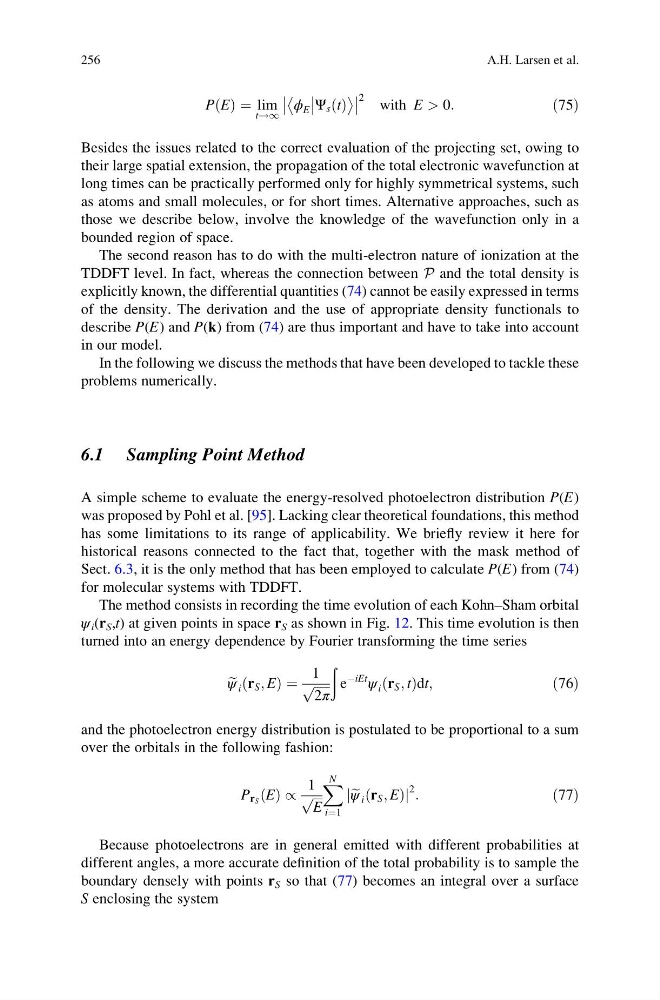
P E
ð Þ ¼ lim
t!1
ϕ E
Ψ s t
ð Þ
2 with E > 0:
ð75Þ
Besides the issues related to the correct evaluation of the projecting set, owing to
their large spatial extension, the propagation of the total electronic wavefunction at
long times can be practically performed only for highly symmetrical systems, such
as atoms and small molecules, or for short times. Alternative approaches, such as
those we describe below, involve the knowledge of the wavefunction only in a
bounded region of space.
The second reason has to do with the multi-electron nature of ionization at the
TDDFT level. In fact, whereas the connection between P and the total density is
explicitly known, the differential quantities (74) cannot be easily expressed in terms
of the density. The derivation and the use of appropriate density functionals to
describe P(E) and P(k) from (74) are thus important and have to take into account
in our model.
In the following we discuss the methods that have been developed to tackle these
problems numerically.
6.1 Sampling Point Method
A simple scheme to evaluate the energy-resolved photoelectron distribution P(E)
was proposed by Pohl et al. [95]. Lacking clear theoretical foundations, this method
has some limitations to its range of applicability. We briefly review it here for
historical reasons connected to the fact that, together with the mask method of
Sect. 6.3, it is the only method that has been employed to calculate P(E) from (74)
for molecular systems with TDDFT.
The method consists in recording the time evolution of each Kohn–Sham orbital
ψ i (r S ,t) at given points in space r S as shown in Fig. 12. This time evolution is then
turned into an energy dependence by Fourier transforming the time series
e
ψ i r S ; E
ð
Þ¼
1
ffiffiffiffiffi
2π
p
ð
e
ÀiEt
ψ i r S ; t
ð
Þdt;
ð76Þ
and the photoelectron energy distribution is postulated to be proportional to a sum
over the orbitals in the following fashion:
P r S E
ð Þ /
1
ffiffiffi
E
p
X N
i¼1
e
ψ i r S ; E
ð
Þ
j
j
2 :
ð77Þ
Because photoelectrons are in general emitted with different probabilities at
different angles, a more accurate definition of the total probability is to sample the
boundary densely with points r S so that (77) becomes an integral over a surface
S enclosing the system
256
A.H. Larsen et al.
ð Þ ¼ lim
t!1
ϕ E
Ψ s t
ð Þ
2 with E > 0:
ð75Þ
Besides the issues related to the correct evaluation of the projecting set, owing to
their large spatial extension, the propagation of the total electronic wavefunction at
long times can be practically performed only for highly symmetrical systems, such
as atoms and small molecules, or for short times. Alternative approaches, such as
those we describe below, involve the knowledge of the wavefunction only in a
bounded region of space.
The second reason has to do with the multi-electron nature of ionization at the
TDDFT level. In fact, whereas the connection between P and the total density is
explicitly known, the differential quantities (74) cannot be easily expressed in terms
of the density. The derivation and the use of appropriate density functionals to
describe P(E) and P(k) from (74) are thus important and have to take into account
in our model.
In the following we discuss the methods that have been developed to tackle these
problems numerically.
6.1 Sampling Point Method
A simple scheme to evaluate the energy-resolved photoelectron distribution P(E)
was proposed by Pohl et al. [95]. Lacking clear theoretical foundations, this method
has some limitations to its range of applicability. We briefly review it here for
historical reasons connected to the fact that, together with the mask method of
Sect. 6.3, it is the only method that has been employed to calculate P(E) from (74)
for molecular systems with TDDFT.
The method consists in recording the time evolution of each Kohn–Sham orbital
ψ i (r S ,t) at given points in space r S as shown in Fig. 12. This time evolution is then
turned into an energy dependence by Fourier transforming the time series
e
ψ i r S ; E
ð
Þ¼
1
ffiffiffiffiffi
2π
p
ð
e
ÀiEt
ψ i r S ; t
ð
Þdt;
ð76Þ
and the photoelectron energy distribution is postulated to be proportional to a sum
over the orbitals in the following fashion:
P r S E
ð Þ /
1
ffiffiffi
E
p
X N
i¼1
e
ψ i r S ; E
ð
Þ
j
j
2 :
ð77Þ
Because photoelectrons are in general emitted with different probabilities at
different angles, a more accurate definition of the total probability is to sample the
boundary densely with points r S so that (77) becomes an integral over a surface
S enclosing the system
256
A.H. Larsen et al.