

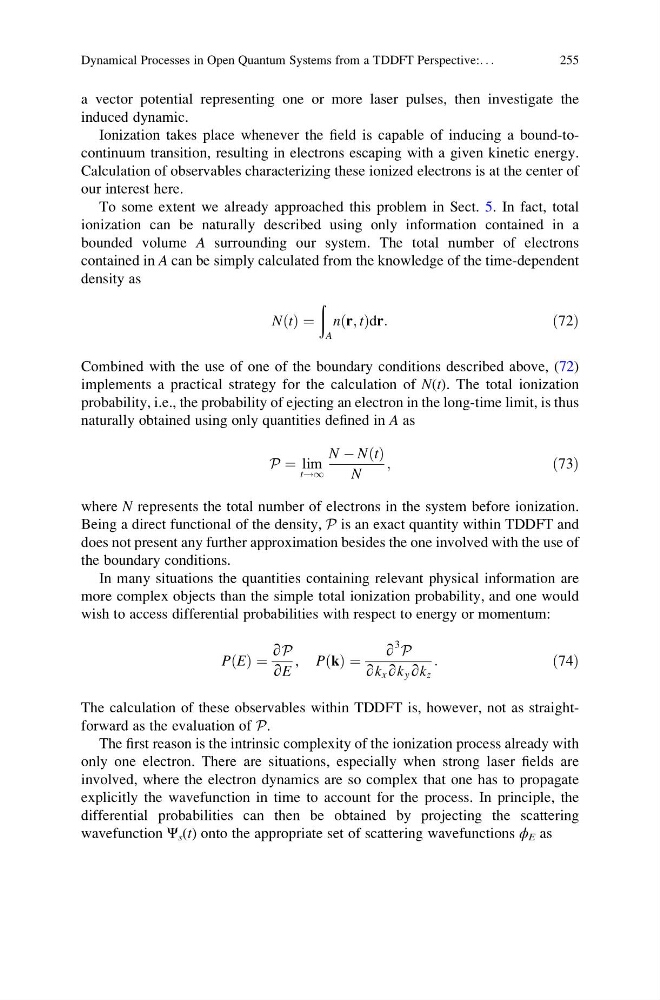
a vector potential representing one or more laser pulses, then investigate the
induced dynamic.
Ionization takes place whenever the field is capable of inducing a bound-tocontinuum transition, resulting in electrons escaping with a given kinetic energy.
Calculation of observables characterizing these ionized electrons is at the center of
our interest here.
To some extent we already approached this problem in Sect. 5. In fact, total
ionization can be naturally described using only information contained in a
bounded volume A surrounding our system. The total number of electrons
contained in A can be simply calculated from the knowledge of the time-dependent
density as
N t
ð Þ ¼
ð
A
n r; t
ð Þdr:
ð72Þ
Combined with the use of one of the boundary conditions described above, (72)
implements a practical strategy for the calculation of N(t). The total ionization
probability, i.e., the probability of ejecting an electron in the long-time limit, is thus
naturally obtained using only quantities defined in A as
P ¼ lim
t!1
N À N t
ð Þ
N
;
ð73Þ
where N represents the total number of electrons in the system before ionization.
Being a direct functional of the density, P is an exact quantity within TDDFT and
does not present any further approximation besides the one involved with the use of
the boundary conditions.
In many situations the quantities containing relevant physical information are
more complex objects than the simple total ionization probability, and one would
wish to access differential probabilities with respect to energy or momentum:
P E
ð Þ ¼
∂P
∂E
, P k
ð Þ ¼
∂
3 P
∂k x ∂k y ∂k z
:
ð74Þ
The calculation of these observables within TDDFT is, however, not as straightforward as the evaluation of P.
The first reason is the intrinsic complexity of the ionization process already with
only one electron. There are situations, especially when strong laser fields are
involved, where the electron dynamics are so complex that one has to propagate
explicitly the wavefunction in time to account for the process. In principle, the
differential probabilities can then be obtained by projecting the scattering
wavefunction Ψ s (t) onto the appropriate set of scattering wavefunctions ϕ E as
Dynamical Processes in Open Quantum Systems from a TDDFT Perspective:. . .
255
induced dynamic.
Ionization takes place whenever the field is capable of inducing a bound-tocontinuum transition, resulting in electrons escaping with a given kinetic energy.
Calculation of observables characterizing these ionized electrons is at the center of
our interest here.
To some extent we already approached this problem in Sect. 5. In fact, total
ionization can be naturally described using only information contained in a
bounded volume A surrounding our system. The total number of electrons
contained in A can be simply calculated from the knowledge of the time-dependent
density as
N t
ð Þ ¼
ð
A
n r; t
ð Þdr:
ð72Þ
Combined with the use of one of the boundary conditions described above, (72)
implements a practical strategy for the calculation of N(t). The total ionization
probability, i.e., the probability of ejecting an electron in the long-time limit, is thus
naturally obtained using only quantities defined in A as
P ¼ lim
t!1
N À N t
ð Þ
N
;
ð73Þ
where N represents the total number of electrons in the system before ionization.
Being a direct functional of the density, P is an exact quantity within TDDFT and
does not present any further approximation besides the one involved with the use of
the boundary conditions.
In many situations the quantities containing relevant physical information are
more complex objects than the simple total ionization probability, and one would
wish to access differential probabilities with respect to energy or momentum:
P E
ð Þ ¼
∂P
∂E
, P k
ð Þ ¼
∂
3 P
∂k x ∂k y ∂k z
:
ð74Þ
The calculation of these observables within TDDFT is, however, not as straightforward as the evaluation of P.
The first reason is the intrinsic complexity of the ionization process already with
only one electron. There are situations, especially when strong laser fields are
involved, where the electron dynamics are so complex that one has to propagate
explicitly the wavefunction in time to account for the process. In principle, the
differential probabilities can then be obtained by projecting the scattering
wavefunction Ψ s (t) onto the appropriate set of scattering wavefunctions ϕ E as
Dynamical Processes in Open Quantum Systems from a TDDFT Perspective:. . .
255