

stress the fact that their properties strongly depend both on their mathematical form
and the specific implementation, and, without exception, they all reflect in some
energy range [74]. For practical purposes it is thus very important to ensure that the
CAP we choose for our calculations has good absorption properties in the range of
interest.
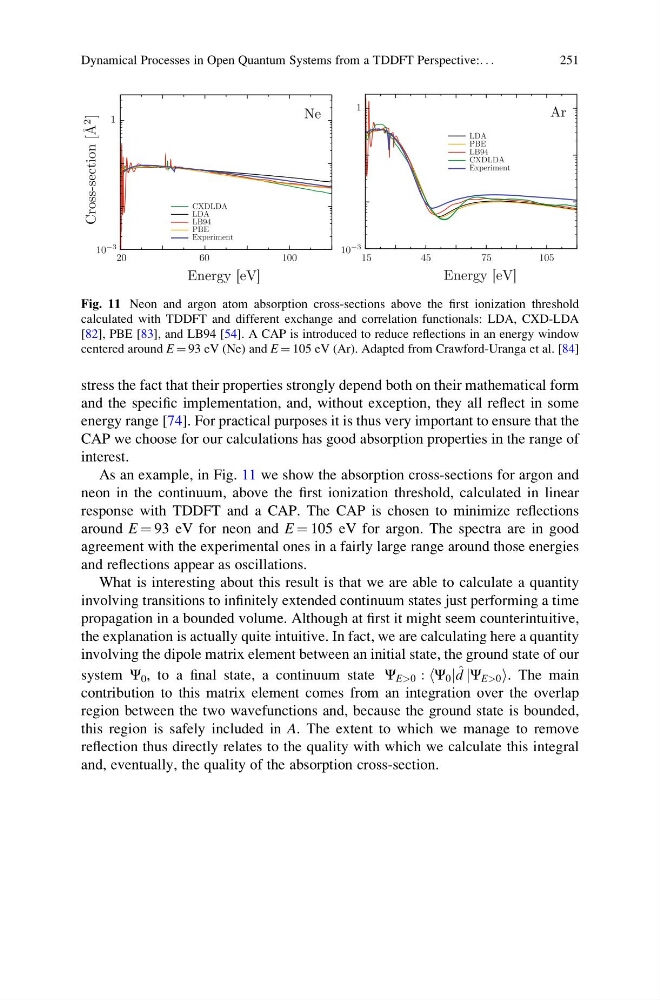
As an example, in Fig. 11 we show the absorption cross-sections for argon and
neon in the continuum, above the first ionization threshold, calculated in linear
response with TDDFT and a CAP. The CAP is chosen to minimize reflections
around E ¼ 93 eV for neon and E ¼ 105 eV for argon. The spectra are in good
agreement with the experimental ones in a fairly large range around those energies
and reflections appear as oscillations.
What is interesting about this result is that we are able to calculate a quantity
involving transitions to infinitely extended continuum states just performing a time
propagation in a bounded volume. Although at first it might seem counterintuitive,
the explanation is actually quite intuitive. In fact, we are calculating here a quantity
involving the dipole matrix element between an initial state, the ground state of our
system Ψ 0 , to a final state, a continuum state Ψ E>0 : Ψ 0
h j ^
d Ψ E>0
j
i. The main
contribution to this matrix element comes from an integration over the overlap
region between the two wavefunctions and, because the ground state is bounded,
this region is safely included in A. The extent to which we manage to remove
reflection thus directly relates to the quality with which we calculate this integral
and, eventually, the quality of the absorption cross-section.
Fig. 11 Neon and argon atom absorption cross-sections above the first ionization threshold
calculated with TDDFT and different exchange and correlation functionals: LDA, CXD-LDA
[82], PBE [83], and LB94 [54]. A CAP is introduced to reduce reflections in an energy window
centered around E ¼ 93 eV (Ne) and E ¼ 105 eV (Ar). Adapted from Crawford-Uranga et al. [84]
Dynamical Processes in Open Quantum Systems from a TDDFT Perspective:. . .
251
and the specific implementation, and, without exception, they all reflect in some
energy range [74]. For practical purposes it is thus very important to ensure that the
CAP we choose for our calculations has good absorption properties in the range of
interest.
As an example, in Fig. 11 we show the absorption cross-sections for argon and
neon in the continuum, above the first ionization threshold, calculated in linear
response with TDDFT and a CAP. The CAP is chosen to minimize reflections
around E ¼ 93 eV for neon and E ¼ 105 eV for argon. The spectra are in good
agreement with the experimental ones in a fairly large range around those energies
and reflections appear as oscillations.
What is interesting about this result is that we are able to calculate a quantity
involving transitions to infinitely extended continuum states just performing a time
propagation in a bounded volume. Although at first it might seem counterintuitive,
the explanation is actually quite intuitive. In fact, we are calculating here a quantity
involving the dipole matrix element between an initial state, the ground state of our
system Ψ 0 , to a final state, a continuum state Ψ E>0 : Ψ 0
h j ^
d Ψ E>0
j
i. The main
contribution to this matrix element comes from an integration over the overlap
region between the two wavefunctions and, because the ground state is bounded,
this region is safely included in A. The extent to which we manage to remove
reflection thus directly relates to the quality with which we calculate this integral
and, eventually, the quality of the absorption cross-section.
Fig. 11 Neon and argon atom absorption cross-sections above the first ionization threshold
calculated with TDDFT and different exchange and correlation functionals: LDA, CXD-LDA
[82], PBE [83], and LB94 [54]. A CAP is introduced to reduce reflections in an energy window
centered around E ¼ 93 eV (Ne) and E ¼ 105 eV (Ar). Adapted from Crawford-Uranga et al. [84]
Dynamical Processes in Open Quantum Systems from a TDDFT Perspective:. . .
251