

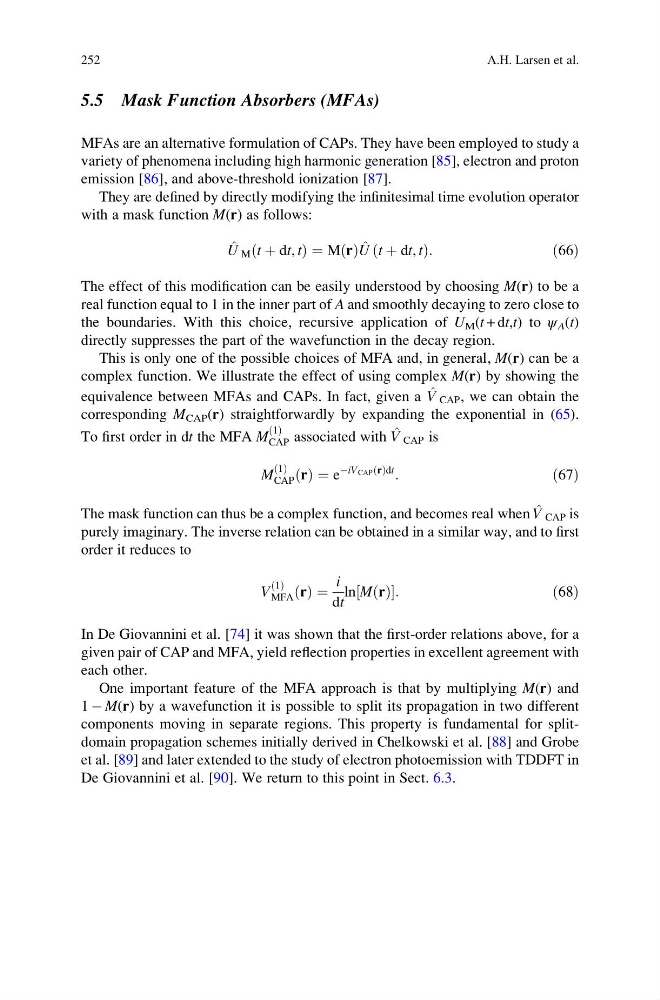
5.5 Mask Function Absorbers (MFAs)
MFAs are an alternative formulation of CAPs. They have been employed to study a
variety of phenomena including high harmonic generation [85], electron and proton
emission [86], and above-threshold ionization [87].
They are defined by directly modifying the infinitesimal time evolution operator
with a mask function M(r) as follows:
^
U M t þ dt, t
ð
Þ¼M r
ð Þ ^
U t þ dt, t
ð
Þ:
ð66Þ
The effect of this modification can be easily understood by choosing M(r) to be a
real function equal to 1 in the inner part of A and smoothly decaying to zero close to
the boundaries. With this choice, recursive application of U M (t + dt,t) to ψ A (t)
directly suppresses the part of the wavefunction in the decay region.
This is only one of the possible choices of MFA and, in general, M(r) can be a
complex function. We illustrate the effect of using complex M(r) by showing the
equivalence between MFAs and CAPs. In fact, given a ^
V CAP , we can obtain the
corresponding M CAP (r) straightforwardly by expanding the exponential in (65).
To first order in dt the MFA M
ð1Þ
CAP associated with ^
V CAP is
M
1
ð Þ
CAP r
ð Þ ¼ e
ÀiV CAP r
ð Þdt
:
ð67Þ
The mask function can thus be a complex function, and becomes real when ^
V CAP is
purely imaginary. The inverse relation can be obtained in a similar way, and to first
order it reduces to
V
1
ð Þ
MFA r
ð Þ ¼
i
dt
ln M r
ð Þ
½
:
ð68Þ
In De Giovannini et al. [74] it was shown that the first-order relations above, for a
given pair of CAP and MFA, yield reflection properties in excellent agreement with
each other.
One important feature of the MFA approach is that by multiplying M(r) and
1 À M(r) by a wavefunction it is possible to split its propagation in two different
components moving in separate regions. This property is fundamental for splitdomain propagation schemes initially derived in Chelkowski et al. [88] and Grobe
et al. [89] and later extended to the study of electron photoemission with TDDFT in
De Giovannini et al. [90]. We return to this point in Sect. 6.3.
252
A.H. Larsen et al.
MFAs are an alternative formulation of CAPs. They have been employed to study a
variety of phenomena including high harmonic generation [85], electron and proton
emission [86], and above-threshold ionization [87].
They are defined by directly modifying the infinitesimal time evolution operator
with a mask function M(r) as follows:
^
U M t þ dt, t
ð
Þ¼M r
ð Þ ^
U t þ dt, t
ð
Þ:
ð66Þ
The effect of this modification can be easily understood by choosing M(r) to be a
real function equal to 1 in the inner part of A and smoothly decaying to zero close to
the boundaries. With this choice, recursive application of U M (t + dt,t) to ψ A (t)
directly suppresses the part of the wavefunction in the decay region.
This is only one of the possible choices of MFA and, in general, M(r) can be a
complex function. We illustrate the effect of using complex M(r) by showing the
equivalence between MFAs and CAPs. In fact, given a ^
V CAP , we can obtain the
corresponding M CAP (r) straightforwardly by expanding the exponential in (65).
To first order in dt the MFA M
ð1Þ
CAP associated with ^
V CAP is
M
1
ð Þ
CAP r
ð Þ ¼ e
ÀiV CAP r
ð Þdt
:
ð67Þ
The mask function can thus be a complex function, and becomes real when ^
V CAP is
purely imaginary. The inverse relation can be obtained in a similar way, and to first
order it reduces to
V
1
ð Þ
MFA r
ð Þ ¼
i
dt
ln M r
ð Þ
½
:
ð68Þ
In De Giovannini et al. [74] it was shown that the first-order relations above, for a
given pair of CAP and MFA, yield reflection properties in excellent agreement with
each other.
One important feature of the MFA approach is that by multiplying M(r) and
1 À M(r) by a wavefunction it is possible to split its propagation in two different
components moving in separate regions. This property is fundamental for splitdomain propagation schemes initially derived in Chelkowski et al. [88] and Grobe
et al. [89] and later extended to the study of electron photoemission with TDDFT in
De Giovannini et al. [90]. We return to this point in Sect. 6.3.
252
A.H. Larsen et al.