

These families are substantially phenomenological approximations to the open
boundary problem for which the main point of attraction rests on their simplicity
of implementation and limited computational costs.
5.4 Complex Absorbing Potentials (CAPs)
We already noted above that the exact embedding potential has to be a complex
quantity to turn the Hamiltonian non-Hermitian, and the fundamental mechanism of
CAPs is precisely based on this observation. The idea was originally introduced
from a different standpoint by Neuhauser and Baer [75, 76] with the use of negative
imaginary potentials for the Schr€ odinger equation. This was in connection with the
so-called optical potentials or perfectly matched layers developed for electromagnetic waves [77].
The effect of a CAP can be easily understood by observing the action of the
infinitesimal time evolution operator on a wavefunction
^
U t þ dt, t
ð
Þψ A t
ð Þ ¼ exp Ài ^
H t
ð Þ þ ^
V CAP
À
Á
dt
Â
Ã
ψ A t
ð Þ;
ð65Þ
when ^
V CAP is a negative imaginary potential with support on a region close to the
boundaries of A. In this case, the effect simply results in an exponential suppression
of the wavefunction in the absorbing region. In other words, the time evolution
operator associated with the non-Hermitian Hamiltonian modified with ^
V CAP is
non-unitary and no longer conserves the wavefunction norm. The norm decreases if
^
V CAP is negative and increases if it is positive. In the latter case it becomes possible
to simulate charge injection, and this fact has been used to mimic reservoirs acting
as sinks or sources in the attempt to simulate electron transport [78–80].
CAPs are by no means restricted to purely imaginary potentials and there is a
huge body of literature describing their different forms and declinations [81]. We
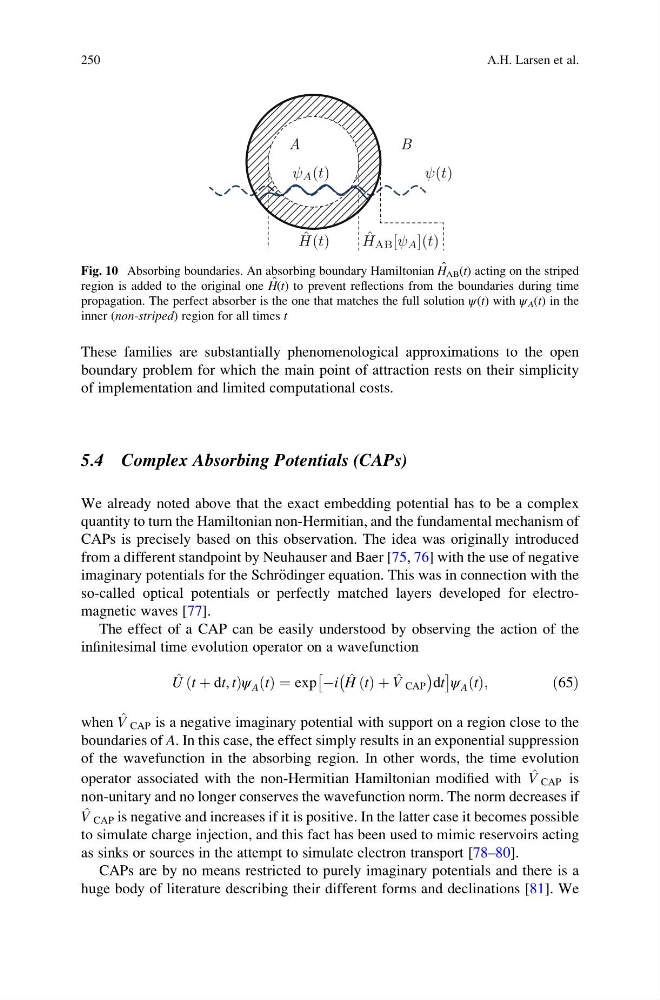
Fig. 10 Absorbing boundaries. An absorbing boundary Hamiltonian H ˆ
AB (t) acting on the striped
region is added to the original one H ˆ (t) to prevent reflections from the boundaries during time
propagation. The perfect absorber is the one that matches the full solution ψ(t) with ψ A (t) in the
inner (non-striped) region for all times t
250
A.H. Larsen et al.
boundary problem for which the main point of attraction rests on their simplicity
of implementation and limited computational costs.
5.4 Complex Absorbing Potentials (CAPs)
We already noted above that the exact embedding potential has to be a complex
quantity to turn the Hamiltonian non-Hermitian, and the fundamental mechanism of
CAPs is precisely based on this observation. The idea was originally introduced
from a different standpoint by Neuhauser and Baer [75, 76] with the use of negative
imaginary potentials for the Schr€ odinger equation. This was in connection with the
so-called optical potentials or perfectly matched layers developed for electromagnetic waves [77].
The effect of a CAP can be easily understood by observing the action of the
infinitesimal time evolution operator on a wavefunction
^
U t þ dt, t
ð
Þψ A t
ð Þ ¼ exp Ài ^
H t
ð Þ þ ^
V CAP
À
Á
dt
Â
Ã
ψ A t
ð Þ;
ð65Þ
when ^
V CAP is a negative imaginary potential with support on a region close to the
boundaries of A. In this case, the effect simply results in an exponential suppression
of the wavefunction in the absorbing region. In other words, the time evolution
operator associated with the non-Hermitian Hamiltonian modified with ^
V CAP is
non-unitary and no longer conserves the wavefunction norm. The norm decreases if
^
V CAP is negative and increases if it is positive. In the latter case it becomes possible
to simulate charge injection, and this fact has been used to mimic reservoirs acting
as sinks or sources in the attempt to simulate electron transport [78–80].
CAPs are by no means restricted to purely imaginary potentials and there is a
huge body of literature describing their different forms and declinations [81]. We
Fig. 10 Absorbing boundaries. An absorbing boundary Hamiltonian H ˆ
AB (t) acting on the striped
region is added to the original one H ˆ (t) to prevent reflections from the boundaries during time
propagation. The perfect absorber is the one that matches the full solution ψ(t) with ψ A (t) in the
inner (non-striped) region for all times t
250
A.H. Larsen et al.