

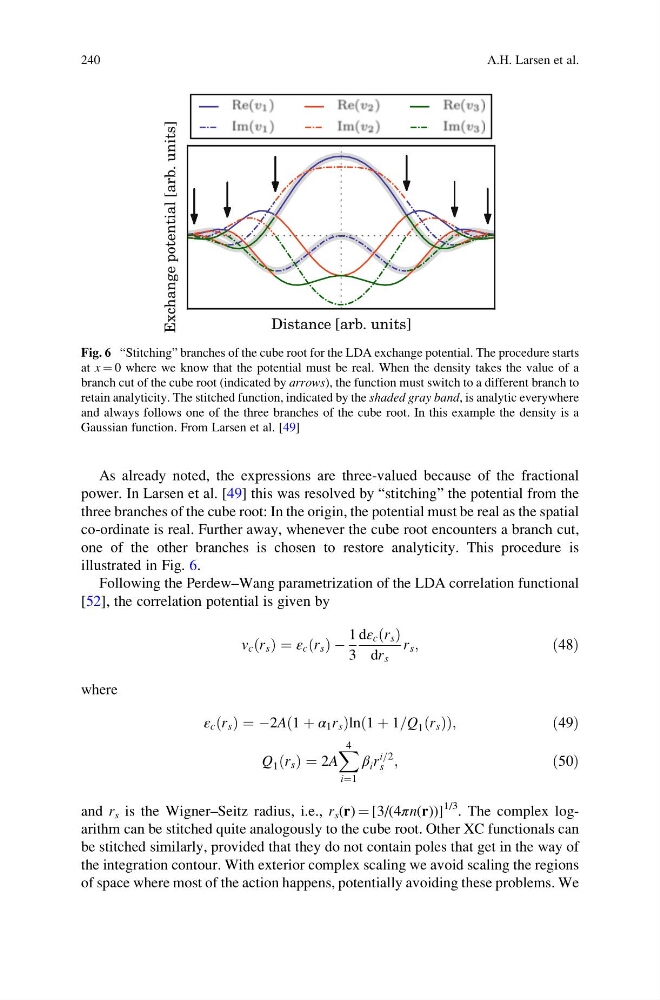
As already noted, the expressions are three-valued because of the fractional
power. In Larsen et al. [49] this was resolved by “stitching” the potential from the
three branches of the cube root: In the origin, the potential must be real as the spatial
co-ordinate is real. Further away, whenever the cube root encounters a branch cut,
one of the other branches is chosen to restore analyticity. This procedure is
illustrated in Fig. 6.
Following the Perdew–Wang parametrization of the LDA correlation functional
[52], the correlation potential is given by
v c r s
ð Þ ¼ ε c r s
ð Þ À
1
3
dε c r s
ð Þ
dr s
r s ;
ð48Þ
where
ε c r s
ð Þ ¼ À2A 1 þ α 1 r s
ð
Þ ln 1 þ 1=Q 1 r s
ð Þ
ð
Þ ;
ð49Þ
Q 1 r s
ð Þ ¼ 2A
X 4
i¼1
β i r
i=2
s ;
ð50Þ
and r s is the Wigner–Seitz radius, i.e., r s (r) ¼ [3/(4πn(r))]
1/3 . The complex logarithm can be stitched quite analogously to the cube root. Other XC functionals can
be stitched similarly, provided that they do not contain poles that get in the way of
the integration contour. With exterior complex scaling we avoid scaling the regions
of space where most of the action happens, potentially avoiding these problems. We
Fig. 6 “Stitching” branches of the cube root for the LDA exchange potential. The procedure starts
at x ¼ 0 where we know that the potential must be real. When the density takes the value of a
branch cut of the cube root (indicated by arrows), the function must switch to a different branch to
retain analyticity. The stitched function, indicated by the shaded gray band, is analytic everywhere
and always follows one of the three branches of the cube root. In this example the density is a
Gaussian function. From Larsen et al. [49]
240
A.H. Larsen et al.
power. In Larsen et al. [49] this was resolved by “stitching” the potential from the
three branches of the cube root: In the origin, the potential must be real as the spatial
co-ordinate is real. Further away, whenever the cube root encounters a branch cut,
one of the other branches is chosen to restore analyticity. This procedure is
illustrated in Fig. 6.
Following the Perdew–Wang parametrization of the LDA correlation functional
[52], the correlation potential is given by
v c r s
ð Þ ¼ ε c r s
ð Þ À
1
3
dε c r s
ð Þ
dr s
r s ;
ð48Þ
where
ε c r s
ð Þ ¼ À2A 1 þ α 1 r s
ð
Þ ln 1 þ 1=Q 1 r s
ð Þ
ð
Þ ;
ð49Þ
Q 1 r s
ð Þ ¼ 2A
X 4
i¼1
β i r
i=2
s ;
ð50Þ
and r s is the Wigner–Seitz radius, i.e., r s (r) ¼ [3/(4πn(r))]
1/3 . The complex logarithm can be stitched quite analogously to the cube root. Other XC functionals can
be stitched similarly, provided that they do not contain poles that get in the way of
the integration contour. With exterior complex scaling we avoid scaling the regions
of space where most of the action happens, potentially avoiding these problems. We
Fig. 6 “Stitching” branches of the cube root for the LDA exchange potential. The procedure starts
at x ¼ 0 where we know that the potential must be real. When the density takes the value of a
branch cut of the cube root (indicated by arrows), the function must switch to a different branch to
retain analyticity. The stitched function, indicated by the shaded gray band, is analytic everywhere
and always follows one of the three branches of the cube root. In this example the density is a
Gaussian function. From Larsen et al. [49]
240
A.H. Larsen et al.