

4.2 Complex Scaling of Exchange and Correlation
The first DFRT calculations were carried out in a one-dimensional model potential
with two electrons in the same (singlet) state [50]. The method was demonstrated
using the exact KS potential, which in this case is
v
θ
exact x
ð Þ ¼ e
Ài2θ ∇
2
ψ θ x
ð Þ
2ψ θ x
ð Þ
þ ε θ ;
ð43Þ
along with exact exchange (EXX) which, in this case, simply cancels out half the
Coulomb energy. However, for systems with more particles, and indeed for realistic
numerical calculations in the style of modern DFT software, the XC functional
would have to be one of the many commonly used approximations. For simplicity
we ignore any notion of spin below. The simplest functional is the local density
approximation (LDA), the complex scaling of which was studied by Larsen
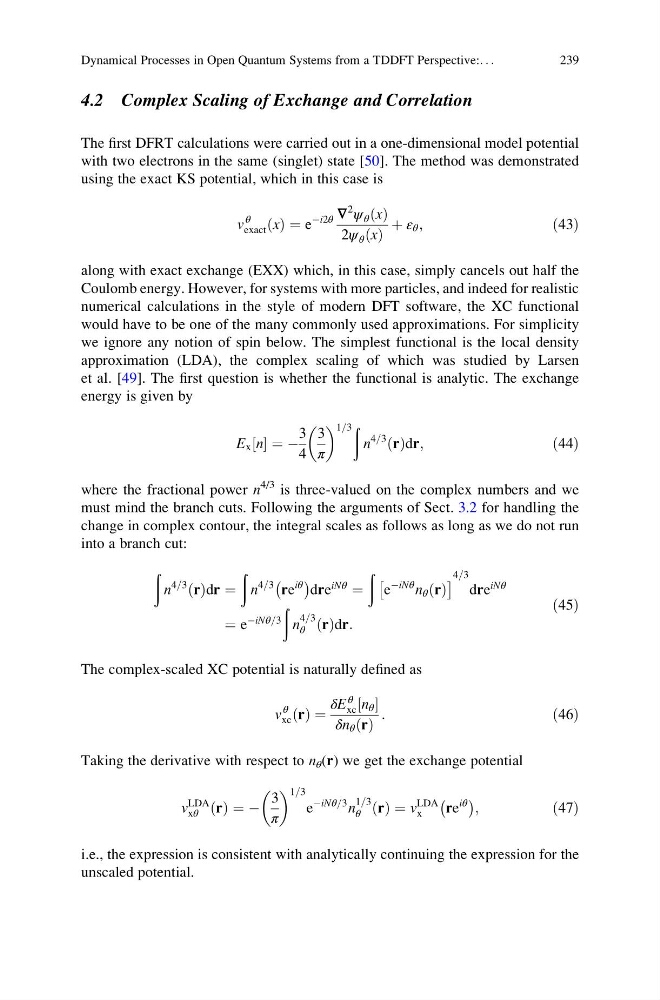
et al. [49]. The first question is whether the functional is analytic. The exchange
energy is given by
E x n
½ ¼ À
3
4
3
π
1=3 ð
n
4=3 r
ð Þdr;
ð44Þ
where the fractional power n
4/3 is three-valued on the complex numbers and we
must mind the branch cuts. Following the arguments of Sect. 3.2 for handling the
change in complex contour, the integral scales as follows as long as we do not run
into a branch cut:
ð
n
4=3 r
ð Þdr ¼
ð
n
4=3 re
iθ
À Á
dre
iNθ
¼
ð
e
ÀiNθ n θ r
ð Þ
Â
à 4=3
dre
iNθ
¼ e
ÀiNθ=3
ð
n
4=3
θ
r
ð Þdr:
ð45Þ
The complex-scaled XC potential is naturally defined as
v
θ
xc r
ð Þ ¼
δE
θ
xc n θ
½
δn θ r
ð Þ
:
ð46Þ
Taking the derivative with respect to n θ (r) we get the exchange potential
v
LDA
xθ
r
ð Þ ¼ À
3
π
1=3
e
ÀiNθ=3 n
1=3
θ
r
ð Þ ¼ v
LDA
x
re
iθ
À Á ;
ð47Þ
i.e., the expression is consistent with analytically continuing the expression for the
unscaled potential.
Dynamical Processes in Open Quantum Systems from a TDDFT Perspective:. . .
239
The first DFRT calculations were carried out in a one-dimensional model potential
with two electrons in the same (singlet) state [50]. The method was demonstrated
using the exact KS potential, which in this case is
v
θ
exact x
ð Þ ¼ e
Ài2θ ∇
2
ψ θ x
ð Þ
2ψ θ x
ð Þ
þ ε θ ;
ð43Þ
along with exact exchange (EXX) which, in this case, simply cancels out half the
Coulomb energy. However, for systems with more particles, and indeed for realistic
numerical calculations in the style of modern DFT software, the XC functional
would have to be one of the many commonly used approximations. For simplicity
we ignore any notion of spin below. The simplest functional is the local density
approximation (LDA), the complex scaling of which was studied by Larsen
et al. [49]. The first question is whether the functional is analytic. The exchange
energy is given by
E x n
½ ¼ À
3
4
3
π
1=3 ð
n
4=3 r
ð Þdr;
ð44Þ
where the fractional power n
4/3 is three-valued on the complex numbers and we
must mind the branch cuts. Following the arguments of Sect. 3.2 for handling the
change in complex contour, the integral scales as follows as long as we do not run
into a branch cut:
ð
n
4=3 r
ð Þdr ¼
ð
n
4=3 re
iθ
À Á
dre
iNθ
¼
ð
e
ÀiNθ n θ r
ð Þ
Â
à 4=3
dre
iNθ
¼ e
ÀiNθ=3
ð
n
4=3
θ
r
ð Þdr:
ð45Þ
The complex-scaled XC potential is naturally defined as
v
θ
xc r
ð Þ ¼
δE
θ
xc n θ
½
δn θ r
ð Þ
:
ð46Þ
Taking the derivative with respect to n θ (r) we get the exchange potential
v
LDA
xθ
r
ð Þ ¼ À
3
π
1=3
e
ÀiNθ=3 n
1=3
θ
r
ð Þ ¼ v
LDA
x
re
iθ
À Á ;
ð47Þ
i.e., the expression is consistent with analytically continuing the expression for the
unscaled potential.
Dynamical Processes in Open Quantum Systems from a TDDFT Perspective:. . .
239