

n θ r
ð Þ ¼
X
n
f n ψ θn r
ð Þψ θn r
ð Þdr ¼ e
iNθ n re
iθ
À Á ;
ð39Þ
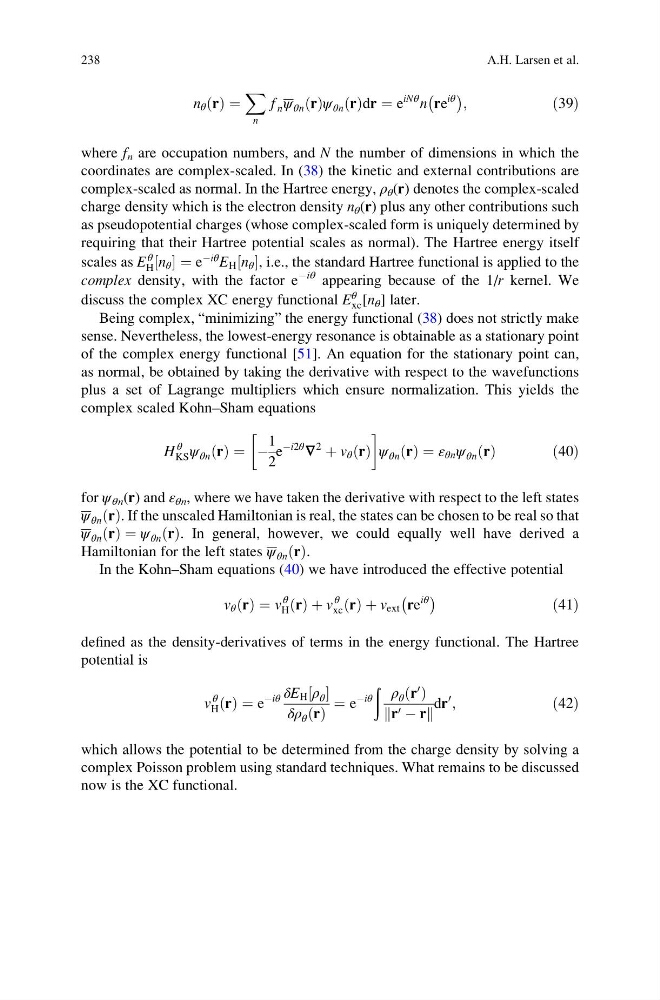
where f n are occupation numbers, and N the number of dimensions in which the
coordinates are complex-scaled. In (38) the kinetic and external contributions are
complex-scaled as normal. In the Hartree energy, ρ θ (r) denotes the complex-scaled
charge density which is the electron density n θ (r) plus any other contributions such
as pseudopotential charges (whose complex-scaled form is uniquely determined by
requiring that their Hartree potential scales as normal). The Hartree energy itself
scales as E
θ
H n θ
½ ¼ e
Àiθ E H n θ
½ , i.e., the standard Hartree functional is applied to the
complex density, with the factor e
Àiθ appearing because of the 1/r kernel. We
discuss the complex XC energy functional E
θ
xc [n θ ] later.
Being complex, “minimizing” the energy functional (38) does not strictly make
sense. Nevertheless, the lowest-energy resonance is obtainable as a stationary point
of the complex energy functional [51]. An equation for the stationary point can,
as normal, be obtained by taking the derivative with respect to the wavefunctions
plus a set of Lagrange multipliers which ensure normalization. This yields the
complex scaled Kohn–Sham equations
H
θ
KS ψ θn r
ð Þ ¼ À
1
2
e
Ài2θ
∇
2
þ v θ r
ð Þ
!
ψ θn r
ð Þ ¼ ε θn ψ θn r
ð Þ
ð40Þ
for ψ θn (r) and ε θn , where we have taken the derivative with respect to the left states
ψ θn r
ð Þ. If the unscaled Hamiltonian is real, the states can be chosen to be real so that
ψ θn r
ð Þ ¼ ψ θn r
ð Þ. In general, however, we could equally well have derived a
Hamiltonian for the left states ψ θn r
ð Þ.
In the Kohn–Sham equations (40) we have introduced the effective potential
v θ r
ð Þ ¼ v
θ
H r
ð Þ þ v
θ
xc r
ð Þ þ v ext re
iθ
À Á
ð41Þ
defined as the density-derivatives of terms in the energy functional. The Hartree
potential is
v
θ
H r
ð Þ ¼ e
Àiθ δE H ρ θ
½
δρ θ r
ð Þ
¼ e
Àiθ
ð ρ θ r
0
ð Þ
r 0 À r
k
k
dr
0
;
ð42Þ
which allows the potential to be determined from the charge density by solving a
complex Poisson problem using standard techniques. What remains to be discussed
now is the XC functional.
238
A.H. Larsen et al.
ð Þ ¼
X
n
f n ψ θn r
ð Þψ θn r
ð Þdr ¼ e
iNθ n re
iθ
À Á ;
ð39Þ
where f n are occupation numbers, and N the number of dimensions in which the
coordinates are complex-scaled. In (38) the kinetic and external contributions are
complex-scaled as normal. In the Hartree energy, ρ θ (r) denotes the complex-scaled
charge density which is the electron density n θ (r) plus any other contributions such
as pseudopotential charges (whose complex-scaled form is uniquely determined by
requiring that their Hartree potential scales as normal). The Hartree energy itself
scales as E
θ
H n θ
½ ¼ e
Àiθ E H n θ
½ , i.e., the standard Hartree functional is applied to the
complex density, with the factor e
Àiθ appearing because of the 1/r kernel. We
discuss the complex XC energy functional E
θ
xc [n θ ] later.
Being complex, “minimizing” the energy functional (38) does not strictly make
sense. Nevertheless, the lowest-energy resonance is obtainable as a stationary point
of the complex energy functional [51]. An equation for the stationary point can,
as normal, be obtained by taking the derivative with respect to the wavefunctions
plus a set of Lagrange multipliers which ensure normalization. This yields the
complex scaled Kohn–Sham equations
H
θ
KS ψ θn r
ð Þ ¼ À
1
2
e
Ài2θ
∇
2
þ v θ r
ð Þ
!
ψ θn r
ð Þ ¼ ε θn ψ θn r
ð Þ
ð40Þ
for ψ θn (r) and ε θn , where we have taken the derivative with respect to the left states
ψ θn r
ð Þ. If the unscaled Hamiltonian is real, the states can be chosen to be real so that
ψ θn r
ð Þ ¼ ψ θn r
ð Þ. In general, however, we could equally well have derived a
Hamiltonian for the left states ψ θn r
ð Þ.
In the Kohn–Sham equations (40) we have introduced the effective potential
v θ r
ð Þ ¼ v
θ
H r
ð Þ þ v
θ
xc r
ð Þ þ v ext re
iθ
À Á
ð41Þ
defined as the density-derivatives of terms in the energy functional. The Hartree
potential is
v
θ
H r
ð Þ ¼ e
Àiθ δE H ρ θ
½
δρ θ r
ð Þ
¼ e
Àiθ
ð ρ θ r
0
ð Þ
r 0 À r
k
k
dr
0
;
ð42Þ
which allows the potential to be determined from the charge density by solving a
complex Poisson problem using standard techniques. What remains to be discussed
now is the XC functional.
238
A.H. Larsen et al.