

4 Density Functional Resonance Theory
As the complex scaling formalism is based on the many-particle Schr€ odinger
equation, the method inherits the same exponential computational cost with respect
to the number of particles. The method in the original form is therefore practical
only for systems with very few particles, such as small atoms or molecules, using,
for example, correlated basis sets [44, 45]. However, larger systems require more
scalable computational methods, of which many have been investigated. Of particular interest are self-consistent field methods such as Hartree–Fock [46], postHartree–Fock methods [47, 48], and DFT [49, 50]. DFT as always has the drawback
that it relies on a complicated formalism including an approximation of the
exchange and correlation effects which is difficult to control, but its inarguable
performance advantages nevertheless make it more than worthy of consideration.
Below we describe the extension of DFT with complex scaling.
4.1 Complex Scaling and DFT
DFT is based on the minimization of a functional of the real electron density. The
minimum of the functional and the corresponding electron density are the groundstate energy and electron density [1, 3]. For practical calculations one uses a set of
single-particle states or Kohn–Sham states to facilitate evaluation of the kinetic part
of the functional. The Kohn–Sham energy functional contains the following contributions: the kinetic energy, the Hartree energy, the exchange–correlation
(XC) energy, and the energy from a system-dependent external potential. The
kinetic energy functional depends explicitly on the Kohn–Sham wavefunctions
whereas the others depend on them only through the density. Either way, all the
terms can be understood as sums of matrix elements of operators. We know from
Sect. 3.2 how the complex scaling operation conserves matrix elements of states
that are spatially localized, provided that the operators are analytic. We can
therefore reasonably expect complex scaling to be made to work within DFT,
once we know how each term in the energy functional scales. The combination
has been dubbed density functional resonance theory (DFRT) [50].
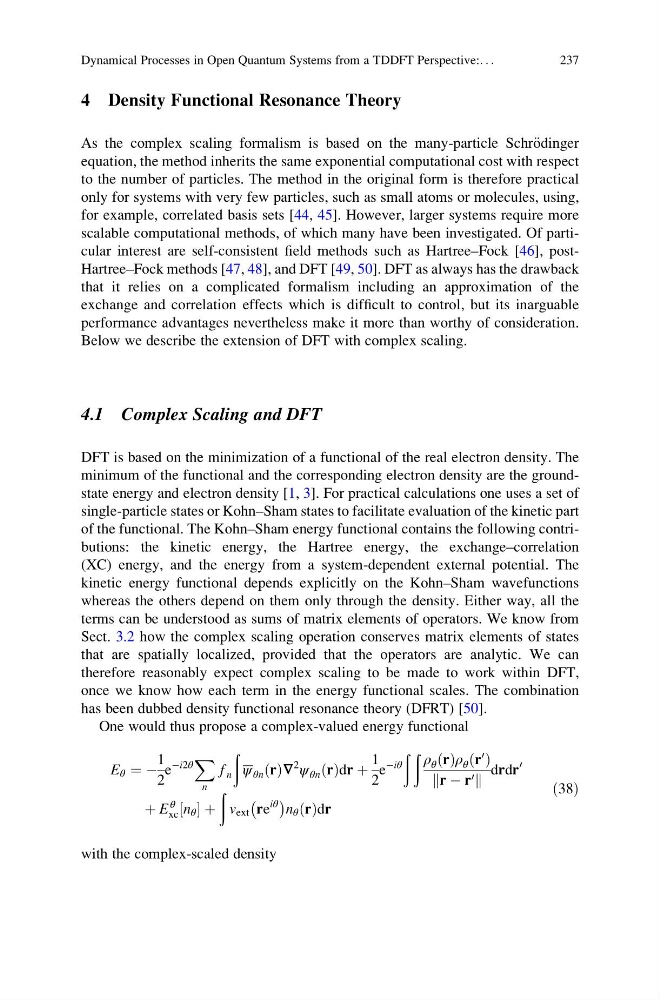
One would thus propose a complex-valued energy functional
E θ ¼ À
1
2
e
Ài2θ
X
n
f n
ð
ψ θn r
ð Þ∇
2
ψ θn r
ð Þdr þ
1
2
e
Àiθ
ð ð ρ θ r
ð Þρ θ r
0
ð Þ
r À r 0
k
k
drdr
0
þ E
θ
xc n θ
½ þ
ð
v ext re
iθ
À Á
n θ r
ð Þdr
ð38Þ
with the complex-scaled density
Dynamical Processes in Open Quantum Systems from a TDDFT Perspective:. . .
237
As the complex scaling formalism is based on the many-particle Schr€ odinger
equation, the method inherits the same exponential computational cost with respect
to the number of particles. The method in the original form is therefore practical
only for systems with very few particles, such as small atoms or molecules, using,
for example, correlated basis sets [44, 45]. However, larger systems require more
scalable computational methods, of which many have been investigated. Of particular interest are self-consistent field methods such as Hartree–Fock [46], postHartree–Fock methods [47, 48], and DFT [49, 50]. DFT as always has the drawback
that it relies on a complicated formalism including an approximation of the
exchange and correlation effects which is difficult to control, but its inarguable
performance advantages nevertheless make it more than worthy of consideration.
Below we describe the extension of DFT with complex scaling.
4.1 Complex Scaling and DFT
DFT is based on the minimization of a functional of the real electron density. The
minimum of the functional and the corresponding electron density are the groundstate energy and electron density [1, 3]. For practical calculations one uses a set of
single-particle states or Kohn–Sham states to facilitate evaluation of the kinetic part
of the functional. The Kohn–Sham energy functional contains the following contributions: the kinetic energy, the Hartree energy, the exchange–correlation
(XC) energy, and the energy from a system-dependent external potential. The
kinetic energy functional depends explicitly on the Kohn–Sham wavefunctions
whereas the others depend on them only through the density. Either way, all the
terms can be understood as sums of matrix elements of operators. We know from
Sect. 3.2 how the complex scaling operation conserves matrix elements of states
that are spatially localized, provided that the operators are analytic. We can
therefore reasonably expect complex scaling to be made to work within DFT,
once we know how each term in the energy functional scales. The combination
has been dubbed density functional resonance theory (DFRT) [50].
One would thus propose a complex-valued energy functional
E θ ¼ À
1
2
e
Ài2θ
X
n
f n
ð
ψ θn r
ð Þ∇
2
ψ θn r
ð Þdr þ
1
2
e
Àiθ
ð ð ρ θ r
ð Þρ θ r
0
ð Þ
r À r 0
k
k
drdr
0
þ E
θ
xc n θ
½ þ
ð
v ext re
iθ
À Á
n θ r
ð Þdr
ð38Þ
with the complex-scaled density
Dynamical Processes in Open Quantum Systems from a TDDFT Perspective:. . .
237