

In a more complicated potential generated by multiple atoms, the situation
would be similar sufficiently far away from the system. The asymptotic form of
the wavefunctions may differ slightly because of long-range interactions such as the
Coulomb interaction, but this doesn’t prevent the exponentially localizing effect of
the complex scaling operation from functioning.
However, let us get back to the determination of the resonance eigenvalues. The
requirement that G ¼ 0 allows us to proceed, linking F, D, and C by means of the
differentiability and continuity requirements. Once all coefficients are eliminated,
the condition for resonance is
1 À
k 2
k 1
tan k 1 a À i
k 1
k 2
e
2ik 2 bÀa
ð
Þ
þ 1 þ
k 2
k 1
tan k 1 a þ i
k 1
k 2
¼ 0:
ð37Þ
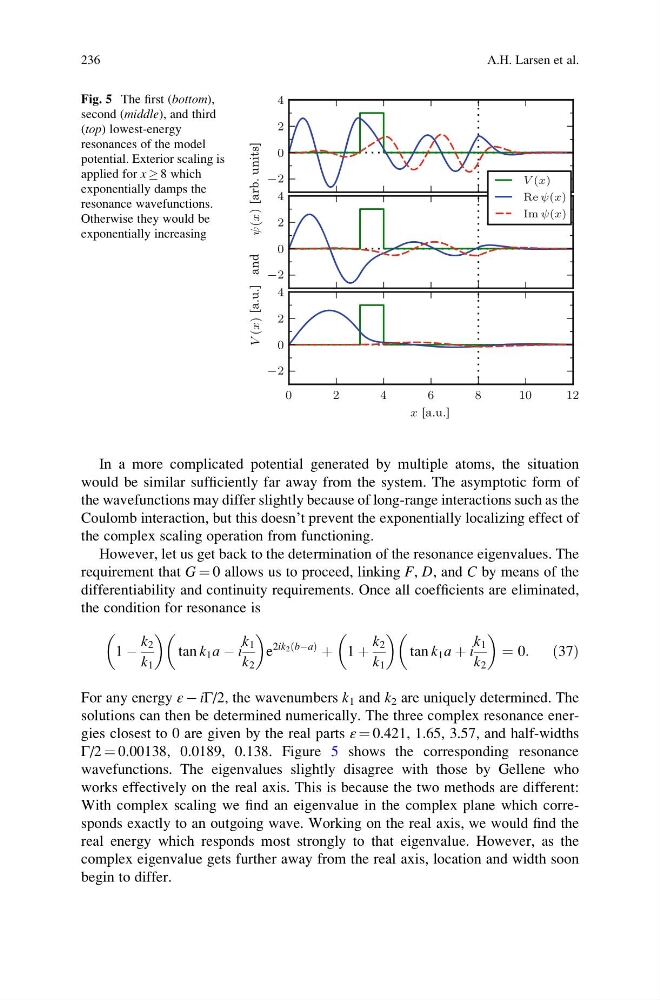
For any energy ε À iΓ/2, the wavenumbers k 1 and k 2 are uniquely determined. The
solutions can then be determined numerically. The three complex resonance energies closest to 0 are given by the real parts ε ¼ 0.421, 1.65, 3.57, and half-widths
Γ/2 ¼ 0.00138, 0.0189, 0.138. Figure 5 shows the corresponding resonance
wavefunctions. The eigenvalues slightly disagree with those by Gellene who
works effectively on the real axis. This is because the two methods are different:
With complex scaling we find an eigenvalue in the complex plane which corresponds exactly to an outgoing wave. Working on the real axis, we would find the
real energy which responds most strongly to that eigenvalue. However, as the
complex eigenvalue gets further away from the real axis, location and width soon
begin to differ.
0
2
4
6
8
1 0
1 2
x [a.u.]
−2
0
2
4
−2
0
2
4
V (x)
[a.u.] and
ψ(x) [arb. units]
−2
0
2
4
V (x)
Re ψ(x)
Im ψ(x)
Fig. 5 The first (bottom),
second (middle), and third
(top) lowest-energy
resonances of the model
potential. Exterior scaling is
applied for x ! 8 which
exponentially damps the
resonance wavefunctions.
Otherwise they would be
exponentially increasing
236
A.H. Larsen et al.
would be similar sufficiently far away from the system. The asymptotic form of
the wavefunctions may differ slightly because of long-range interactions such as the
Coulomb interaction, but this doesn’t prevent the exponentially localizing effect of
the complex scaling operation from functioning.
However, let us get back to the determination of the resonance eigenvalues. The
requirement that G ¼ 0 allows us to proceed, linking F, D, and C by means of the
differentiability and continuity requirements. Once all coefficients are eliminated,
the condition for resonance is
1 À
k 2
k 1
tan k 1 a À i
k 1
k 2
e
2ik 2 bÀa
ð
Þ
þ 1 þ
k 2
k 1
tan k 1 a þ i
k 1
k 2
¼ 0:
ð37Þ
For any energy ε À iΓ/2, the wavenumbers k 1 and k 2 are uniquely determined. The
solutions can then be determined numerically. The three complex resonance energies closest to 0 are given by the real parts ε ¼ 0.421, 1.65, 3.57, and half-widths
Γ/2 ¼ 0.00138, 0.0189, 0.138. Figure 5 shows the corresponding resonance
wavefunctions. The eigenvalues slightly disagree with those by Gellene who
works effectively on the real axis. This is because the two methods are different:
With complex scaling we find an eigenvalue in the complex plane which corresponds exactly to an outgoing wave. Working on the real axis, we would find the
real energy which responds most strongly to that eigenvalue. However, as the
complex eigenvalue gets further away from the real axis, location and width soon
begin to differ.
0
2
4
6
8
1 0
1 2
x [a.u.]
−2
0
2
4
−2
0
2
4
V (x)
[a.u.] and
ψ(x) [arb. units]
−2
0
2
4
V (x)
Re ψ(x)
Im ψ(x)
Fig. 5 The first (bottom),
second (middle), and third
(top) lowest-energy
resonances of the model
potential. Exterior scaling is
applied for x ! 8 which
exponentially damps the
resonance wavefunctions.
Otherwise they would be
exponentially increasing
236
A.H. Larsen et al.