

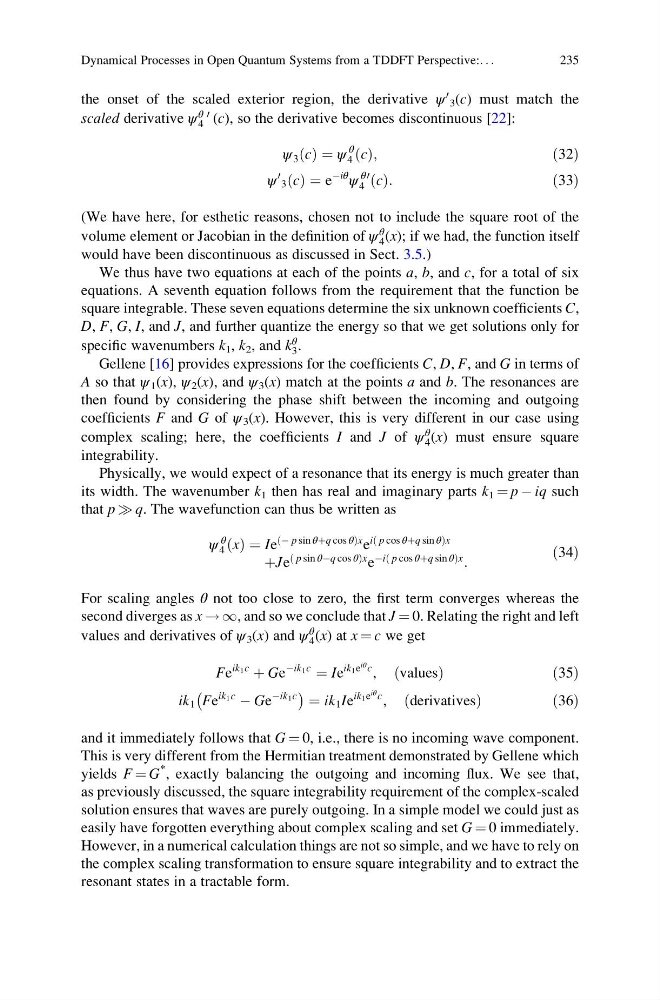
the onset of the scaled exterior region, the derivative ψ
0
3 (c) must match the
scaled derivative ψ
θ
4
0 (c), so the derivative becomes discontinuous [22]:
ψ 3 c
ð Þ ¼ ψ
θ
4 c
ð Þ;
ð32Þ
ψ
0
3 c
ð Þ ¼ e
Àiθ
ψ
θ
4
0 c
ð Þ:
ð33Þ
(We have here, for esthetic reasons, chosen not to include the square root of the
volume element or Jacobian in the definition of ψ
θ
4 (x); if we had, the function itself
would have been discontinuous as discussed in Sect. 3.5.)
We thus have two equations at each of the points a, b, and c, for a total of six
equations. A seventh equation follows from the requirement that the function be
square integrable. These seven equations determine the six unknown coefficients C,
D, F, G, I, and J, and further quantize the energy so that we get solutions only for
specific wavenumbers k 1 , k 2 , and k
θ
3 .
Gellene [16] provides expressions for the coefficients C, D, F, and G in terms of
A so that ψ 1 (x), ψ 2 (x), and ψ 3 (x) match at the points a and b. The resonances are
then found by considering the phase shift between the incoming and outgoing
coefficients F and G of ψ 3 (x). However, this is very different in our case using
complex scaling; here, the coefficients I and J of ψ
θ
4 (x) must ensure square
integrability.
Physically, we would expect of a resonance that its energy is much greater than
its width. The wavenumber k 1 then has real and imaginary parts k 1 ¼ p À iq such
that p ) q. The wavefunction can thus be written as
ψ
θ
4 x
ð Þ ¼ Ie
À p sin θþq cos θ
ð
Þ x e
i pcos θþq sin θ
ð
Þ x
þJe
p sin θÀq cos θ
ð
Þ x e
Ài pcos θþq sin θ
ð
Þ x
:
ð34Þ
For scaling angles θ not too close to zero, the first term converges whereas the
second diverges as x ! 1, and so we conclude that J ¼ 0. Relating the right and left
values and derivatives of ψ 3 (x) and ψ
θ
4 (x) at x ¼ c we get
Fe
ik 1 c
þ Ge
Àik 1 c
¼ Ie
ik 1 e
iθ c ,
values
ð
Þ
ð35Þ
ik 1 Fe
ik 1 c
À Ge
Àik 1 c
À
Á ¼ ik 1 Ie
ik 1 e
iθ c ,
derivatives
ð
Þ
ð 36Þ
and it immediately follows that G ¼ 0, i.e., there is no incoming wave component.
This is very different from the Hermitian treatment demonstrated by Gellene which
yields F ¼ G
* , exactly balancing the outgoing and incoming flux. We see that,
as previously discussed, the square integrability requirement of the complex-scaled
solution ensures that waves are purely outgoing. In a simple model we could just as
easily have forgotten everything about complex scaling and set G ¼ 0 immediately.
However, in a numerical calculation things are not so simple, and we have to rely on
the complex scaling transformation to ensure square integrability and to extract the
resonant states in a tractable form.
Dynamical Processes in Open Quantum Systems from a TDDFT Perspective:. . .
235
0
3 (c) must match the
scaled derivative ψ
θ
4
0 (c), so the derivative becomes discontinuous [22]:
ψ 3 c
ð Þ ¼ ψ
θ
4 c
ð Þ;
ð32Þ
ψ
0
3 c
ð Þ ¼ e
Àiθ
ψ
θ
4
0 c
ð Þ:
ð33Þ
(We have here, for esthetic reasons, chosen not to include the square root of the
volume element or Jacobian in the definition of ψ
θ
4 (x); if we had, the function itself
would have been discontinuous as discussed in Sect. 3.5.)
We thus have two equations at each of the points a, b, and c, for a total of six
equations. A seventh equation follows from the requirement that the function be
square integrable. These seven equations determine the six unknown coefficients C,
D, F, G, I, and J, and further quantize the energy so that we get solutions only for
specific wavenumbers k 1 , k 2 , and k
θ
3 .
Gellene [16] provides expressions for the coefficients C, D, F, and G in terms of
A so that ψ 1 (x), ψ 2 (x), and ψ 3 (x) match at the points a and b. The resonances are
then found by considering the phase shift between the incoming and outgoing
coefficients F and G of ψ 3 (x). However, this is very different in our case using
complex scaling; here, the coefficients I and J of ψ
θ
4 (x) must ensure square
integrability.
Physically, we would expect of a resonance that its energy is much greater than
its width. The wavenumber k 1 then has real and imaginary parts k 1 ¼ p À iq such
that p ) q. The wavefunction can thus be written as
ψ
θ
4 x
ð Þ ¼ Ie
À p sin θþq cos θ
ð
Þ x e
i pcos θþq sin θ
ð
Þ x
þJe
p sin θÀq cos θ
ð
Þ x e
Ài pcos θþq sin θ
ð
Þ x
:
ð34Þ
For scaling angles θ not too close to zero, the first term converges whereas the
second diverges as x ! 1, and so we conclude that J ¼ 0. Relating the right and left
values and derivatives of ψ 3 (x) and ψ
θ
4 (x) at x ¼ c we get
Fe
ik 1 c
þ Ge
Àik 1 c
¼ Ie
ik 1 e
iθ c ,
values
ð
Þ
ð35Þ
ik 1 Fe
ik 1 c
À Ge
Àik 1 c
À
Á ¼ ik 1 Ie
ik 1 e
iθ c ,
derivatives
ð
Þ
ð 36Þ
and it immediately follows that G ¼ 0, i.e., there is no incoming wave component.
This is very different from the Hermitian treatment demonstrated by Gellene which
yields F ¼ G
* , exactly balancing the outgoing and incoming flux. We see that,
as previously discussed, the square integrability requirement of the complex-scaled
solution ensures that waves are purely outgoing. In a simple model we could just as
easily have forgotten everything about complex scaling and set G ¼ 0 immediately.
However, in a numerical calculation things are not so simple, and we have to rely on
the complex scaling transformation to ensure square integrability and to extract the
resonant states in a tractable form.
Dynamical Processes in Open Quantum Systems from a TDDFT Perspective:. . .
235