

mention a recent time-dependent study [53] which uses smooth exterior complex
scaling with the LB94 [54] XC model potential for spin σ:
v
LB94
xc, σ r
ð Þ ¼ v
LDA
xc, σ r
ð Þ À
βx
2
σ r
ð Þn
1=3
σ
r
ð Þ
1 þ 3βx σ r
ð Þsinh
À1 x σ r
ð Þ
ð51Þ
with
x σ r
ð Þ ¼
∇n σ r
ð Þ
k
k
n
4=3
σ
r
ð Þ
:
ð52Þ
This expression also has several issues with analyticity as it involves both division
and fractional powers. In Telnov et al. [53] the exterior scaling contour was
probably chosen so as to avoid these, but unfortunately the issue was not mentioned.
4.3 Resonance Lifetimes in DFRT
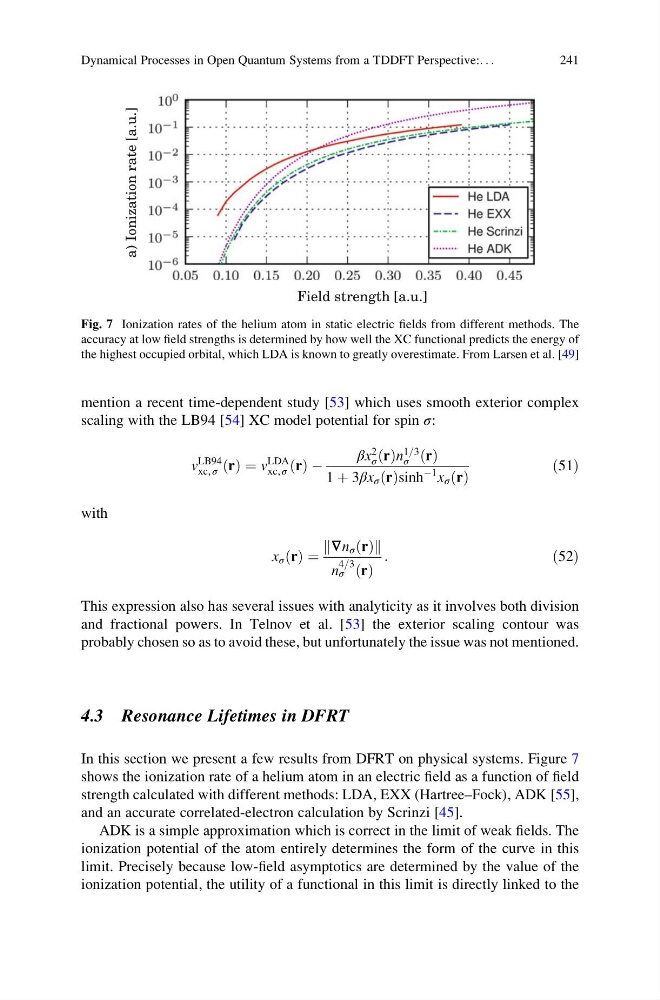
In this section we present a few results from DFRT on physical systems. Figure 7
shows the ionization rate of a helium atom in an electric field as a function of field
strength calculated with different methods: LDA, EXX (Hartree–Fock), ADK [55],
and an accurate correlated-electron calculation by Scrinzi [45].
ADK is a simple approximation which is correct in the limit of weak fields. The
ionization potential of the atom entirely determines the form of the curve in this
limit. Precisely because low-field asymptotics are determined by the value of the
ionization potential, the utility of a functional in this limit is directly linked to the
Fig. 7 Ionization rates of the helium atom in static electric fields from different methods. The
accuracy at low field strengths is determined by how well the XC functional predicts the energy of
the highest occupied orbital, which LDA is known to greatly overestimate. From Larsen et al. [49]
Dynamical Processes in Open Quantum Systems from a TDDFT Perspective:. . .
241
scaling with the LB94 [54] XC model potential for spin σ:
v
LB94
xc, σ r
ð Þ ¼ v
LDA
xc, σ r
ð Þ À
βx
2
σ r
ð Þn
1=3
σ
r
ð Þ
1 þ 3βx σ r
ð Þsinh
À1 x σ r
ð Þ
ð51Þ
with
x σ r
ð Þ ¼
∇n σ r
ð Þ
k
k
n
4=3
σ
r
ð Þ
:
ð52Þ
This expression also has several issues with analyticity as it involves both division
and fractional powers. In Telnov et al. [53] the exterior scaling contour was
probably chosen so as to avoid these, but unfortunately the issue was not mentioned.
4.3 Resonance Lifetimes in DFRT
In this section we present a few results from DFRT on physical systems. Figure 7
shows the ionization rate of a helium atom in an electric field as a function of field
strength calculated with different methods: LDA, EXX (Hartree–Fock), ADK [55],
and an accurate correlated-electron calculation by Scrinzi [45].
ADK is a simple approximation which is correct in the limit of weak fields. The
ionization potential of the atom entirely determines the form of the curve in this
limit. Precisely because low-field asymptotics are determined by the value of the
ionization potential, the utility of a functional in this limit is directly linked to the
Fig. 7 Ionization rates of the helium atom in static electric fields from different methods. The
accuracy at low field strengths is determined by how well the XC functional predicts the energy of
the highest occupied orbital, which LDA is known to greatly overestimate. From Larsen et al. [49]
Dynamical Processes in Open Quantum Systems from a TDDFT Perspective:. . .
241