

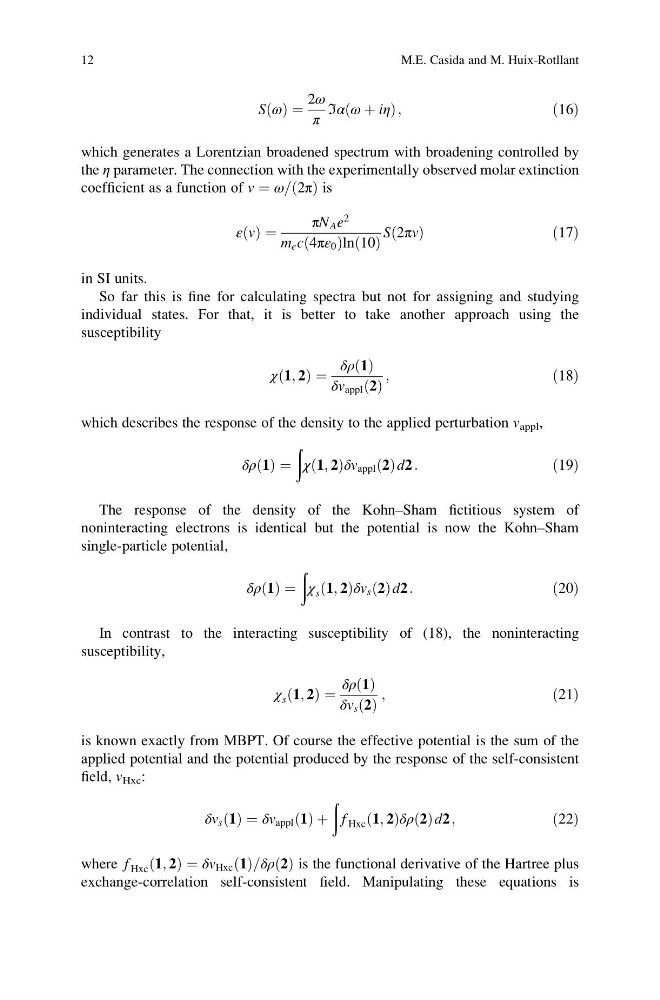
S ω
ð Þ ¼
2ω
π
ℑα ω þ iη
ð
Þ;
ð16Þ
which generates a Lorentzian broadened spectrum with broadening controlled by
the η parameter. The connection with the experimentally observed molar extinction
coefficient as a function of v ¼ ω= 2π
ð Þ is
ε v
ð Þ ¼
πN A e
2
m e c 4πε 0
ð
Þln 10
ð Þ
S 2πv
ð Þ
ð17Þ
in SI units.
So far this is fine for calculating spectra but not for assigning and studying
individual states. For that, it is better to take another approach using the
susceptibility
χ 1; 2
ð Þ ¼
δρ 1
ð Þ
δv appl 2
ð Þ
;
ð18Þ
which describes the response of the density to the applied perturbation v appl ,
δρ 1
ð Þ ¼
ð
χ 1; 2
ð Þδv appl 2
ð Þd2 :
ð19Þ
The response of the density of the Kohn–Sham fictitious system of
noninteracting electrons is identical but the potential is now the Kohn–Sham
single-particle potential,
δρ 1
ð Þ ¼
ð
χ s 1; 2
ð Þδv s 2
ð Þd2:
ð20Þ
In contrast to the interacting susceptibility of (18), the noninteracting
susceptibility,
χ s 1; 2
ð Þ ¼
δρ 1
ð Þ
δv s 2
ð Þ
;
ð21Þ
is known exactly from MBPT. Of course the effective potential is the sum of the
applied potential and the potential produced by the response of the self-consistent
field, v Hxc :
δv s 1
ð Þ ¼ δv appl 1
ð Þ þ
ð
f Hxc 1; 2
ð Þδρ 2
ð Þd2;
ð22Þ
where f Hxc 1; 2
ð Þ ¼ δv Hxc 1
ð Þ=δρ 2
ð Þ is the functional derivative of the Hartree plus
exchange-correlation self-consistent field. Manipulating these equations is
12
M.E. Casida and M. Huix-Rotllant
ð Þ ¼
2ω
π
ℑα ω þ iη
ð
Þ;
ð16Þ
which generates a Lorentzian broadened spectrum with broadening controlled by
the η parameter. The connection with the experimentally observed molar extinction
coefficient as a function of v ¼ ω= 2π
ð Þ is
ε v
ð Þ ¼
πN A e
2
m e c 4πε 0
ð
Þln 10
ð Þ
S 2πv
ð Þ
ð17Þ
in SI units.
So far this is fine for calculating spectra but not for assigning and studying
individual states. For that, it is better to take another approach using the
susceptibility
χ 1; 2
ð Þ ¼
δρ 1
ð Þ
δv appl 2
ð Þ
;
ð18Þ
which describes the response of the density to the applied perturbation v appl ,
δρ 1
ð Þ ¼
ð
χ 1; 2
ð Þδv appl 2
ð Þd2 :
ð19Þ
The response of the density of the Kohn–Sham fictitious system of
noninteracting electrons is identical but the potential is now the Kohn–Sham
single-particle potential,
δρ 1
ð Þ ¼
ð
χ s 1; 2
ð Þδv s 2
ð Þd2:
ð20Þ
In contrast to the interacting susceptibility of (18), the noninteracting
susceptibility,
χ s 1; 2
ð Þ ¼
δρ 1
ð Þ
δv s 2
ð Þ
;
ð21Þ
is known exactly from MBPT. Of course the effective potential is the sum of the
applied potential and the potential produced by the response of the self-consistent
field, v Hxc :
δv s 1
ð Þ ¼ δv appl 1
ð Þ þ
ð
f Hxc 1; 2
ð Þδρ 2
ð Þd2;
ð22Þ
where f Hxc 1; 2
ð Þ ¼ δv Hxc 1
ð Þ=δρ 2
ð Þ is the functional derivative of the Hartree plus
exchange-correlation self-consistent field. Manipulating these equations is
12
M.E. Casida and M. Huix-Rotllant