

“complex virial theorem,” would best approximate the fully converged complex
energy [32, 33].
3.5 Exterior Complex Scaling
We established previously that the complex scaling operation preserves scalar
products of square integrable states because it corresponds to a change of integration contour of an analytic function. Suppose we want to calculate a resonance of a
molecule in the Born–Oppenheimer approximation. The nuclear point charges
cause poles in the Coulomb potential at each nuclear position. Uniform complex
scaling does not work because of these poles. A solution to this problem is to
change the integration contour to avoid the poles. From complex analysis we know
that we could have chosen many other integration paths, corresponding to other
definitions of the scaling operation ^
R θ , and those contours would equally well
preserve scalar products as long as the integration contours have the same start and
end points and do not enclose poles. This is the basis for exterior complex scaling
which was proposed by Simon [22] to solve exactly this problem. Another method
is to use the analytic continuation of matrix elements within a basis set representation [34–36], which effectively approximates the exterior complex scaling
approach [37].
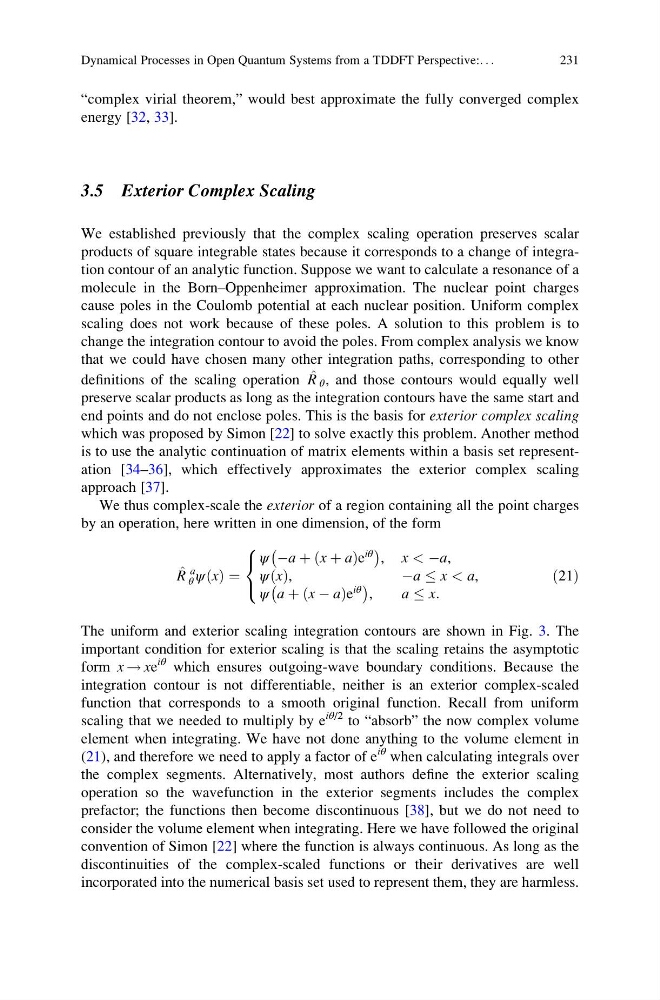
We thus complex-scale the exterior of a region containing all the point charges
by an operation, here written in one dimension, of the form
^
R
a
θ ψ x
ð Þ ¼
ψ Àa þ x þ a
ð
Þe
iθ
À
Á
, x < Àa,
ψ x
ð Þ,
Àa x < a,
ψ a þ x À a
ð
Þe
iθ
À
Á
,
a x:
8
<
:
ð21Þ
The uniform and exterior scaling integration contours are shown in Fig. 3. The
important condition for exterior scaling is that the scaling retains the asymptotic
form x ! xe
iθ which ensures outgoing-wave boundary conditions. Because the
integration contour is not differentiable, neither is an exterior complex-scaled
function that corresponds to a smooth original function. Recall from uniform
scaling that we needed to multiply by e
iθ/2 to “absorb” the now complex volume
element when integrating. We have not done anything to the volume element in
(21), and therefore we need to apply a factor of e
iθ when calculating integrals over
the complex segments. Alternatively, most authors define the exterior scaling
operation so the wavefunction in the exterior segments includes the complex
prefactor; the functions then become discontinuous [38], but we do not need to
consider the volume element when integrating. Here we have followed the original
convention of Simon [22] where the function is always continuous. As long as the
discontinuities of the complex-scaled functions or their derivatives are well
incorporated into the numerical basis set used to represent them, they are harmless.
Dynamical Processes in Open Quantum Systems from a TDDFT Perspective:. . .
231
energy [32, 33].
3.5 Exterior Complex Scaling
We established previously that the complex scaling operation preserves scalar
products of square integrable states because it corresponds to a change of integration contour of an analytic function. Suppose we want to calculate a resonance of a
molecule in the Born–Oppenheimer approximation. The nuclear point charges
cause poles in the Coulomb potential at each nuclear position. Uniform complex
scaling does not work because of these poles. A solution to this problem is to
change the integration contour to avoid the poles. From complex analysis we know
that we could have chosen many other integration paths, corresponding to other
definitions of the scaling operation ^
R θ , and those contours would equally well
preserve scalar products as long as the integration contours have the same start and
end points and do not enclose poles. This is the basis for exterior complex scaling
which was proposed by Simon [22] to solve exactly this problem. Another method
is to use the analytic continuation of matrix elements within a basis set representation [34–36], which effectively approximates the exterior complex scaling
approach [37].
We thus complex-scale the exterior of a region containing all the point charges
by an operation, here written in one dimension, of the form
^
R
a
θ ψ x
ð Þ ¼
ψ Àa þ x þ a
ð
Þe
iθ
À
Á
, x < Àa,
ψ x
ð Þ,
Àa x < a,
ψ a þ x À a
ð
Þe
iθ
À
Á
,
a x:
8
<
:
ð21Þ
The uniform and exterior scaling integration contours are shown in Fig. 3. The
important condition for exterior scaling is that the scaling retains the asymptotic
form x ! xe
iθ which ensures outgoing-wave boundary conditions. Because the
integration contour is not differentiable, neither is an exterior complex-scaled
function that corresponds to a smooth original function. Recall from uniform
scaling that we needed to multiply by e
iθ/2 to “absorb” the now complex volume
element when integrating. We have not done anything to the volume element in
(21), and therefore we need to apply a factor of e
iθ when calculating integrals over
the complex segments. Alternatively, most authors define the exterior scaling
operation so the wavefunction in the exterior segments includes the complex
prefactor; the functions then become discontinuous [38], but we do not need to
consider the volume element when integrating. Here we have followed the original
convention of Simon [22] where the function is always continuous. As long as the
discontinuities of the complex-scaled functions or their derivatives are well
incorporated into the numerical basis set used to represent them, they are harmless.
Dynamical Processes in Open Quantum Systems from a TDDFT Perspective:. . .
231