

their properties depend on the scaling angle θ as we saw for free particles. However,
from what we have seen so far, one could well imagine using complex scaling in
some directions and not others – for example, to describe electrons escaping in the
z direction from a surface which is periodic along x and y, or radially from a
one-dimensional nanowire.
3.4 Resonant States
From standard scattering theory we know that resonances are associated with
wavefunctions that diverge exponentially at increasing distances. If the resonance
is generated by a short-range potential, the resonance wavefunction must far away
equal or approach that of a free particle.
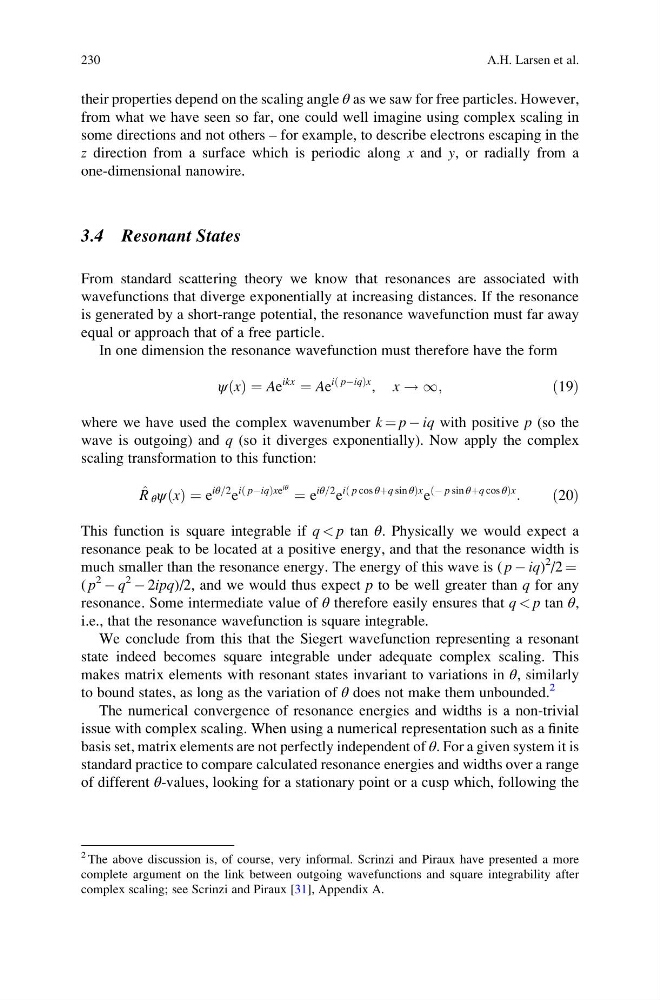
In one dimension the resonance wavefunction must therefore have the form
ψ x
ð Þ ¼ Ae
ikx
¼ Ae
i pÀiq
ð
Þ x , x ! 1;
ð19Þ
where we have used the complex wavenumber k ¼ p À iq with positive p (so the
wave is outgoing) and q (so it diverges exponentially). Now apply the complex
scaling transformation to this function:
^
R θ ψ x
ð Þ ¼ e
iθ=2 e
i pÀiq
ð
Þ xe
iθ ¼ e
iθ=2 e
i pcos θþq sin θ
ð
Þ x e
À p sin θþq cos θ
ð
Þ x
:
ð20Þ
This function is square integrable if q < p tan θ. Physically we would expect a
resonance peak to be located at a positive energy, and that the resonance width is
much smaller than the resonance energy. The energy of this wave is ( p À iq)
2 /2 ¼
( p
2
À q
2
À 2ipq)/2, and we would thus expect p to be well greater than q for any
resonance. Some intermediate value of θ therefore easily ensures that q < p tan θ,
i.e., that the resonance wavefunction is square integrable.
We conclude from this that the Siegert wavefunction representing a resonant
state indeed becomes square integrable under adequate complex scaling. This
makes matrix elements with resonant states invariant to variations in θ, similarly
to bound states, as long as the variation of θ does not make them unbounded.
2
The numerical convergence of resonance energies and widths is a non-trivial
issue with complex scaling. When using a numerical representation such as a finite
basis set, matrix elements are not perfectly independent of θ. For a given system it is
standard practice to compare calculated resonance energies and widths over a range
of different θ-values, looking for a stationary point or a cusp which, following the
2 The above discussion is, of course, very informal. Scrinzi and Piraux have presented a more
complete argument on the link between outgoing wavefunctions and square integrability after
complex scaling; see Scrinzi and Piraux [31], Appendix A.
230
A.H. Larsen et al.
from what we have seen so far, one could well imagine using complex scaling in
some directions and not others – for example, to describe electrons escaping in the
z direction from a surface which is periodic along x and y, or radially from a
one-dimensional nanowire.
3.4 Resonant States
From standard scattering theory we know that resonances are associated with
wavefunctions that diverge exponentially at increasing distances. If the resonance
is generated by a short-range potential, the resonance wavefunction must far away
equal or approach that of a free particle.
In one dimension the resonance wavefunction must therefore have the form
ψ x
ð Þ ¼ Ae
ikx
¼ Ae
i pÀiq
ð
Þ x , x ! 1;
ð19Þ
where we have used the complex wavenumber k ¼ p À iq with positive p (so the
wave is outgoing) and q (so it diverges exponentially). Now apply the complex
scaling transformation to this function:
^
R θ ψ x
ð Þ ¼ e
iθ=2 e
i pÀiq
ð
Þ xe
iθ ¼ e
iθ=2 e
i pcos θþq sin θ
ð
Þ x e
À p sin θþq cos θ
ð
Þ x
:
ð20Þ
This function is square integrable if q < p tan θ. Physically we would expect a
resonance peak to be located at a positive energy, and that the resonance width is
much smaller than the resonance energy. The energy of this wave is ( p À iq)
2 /2 ¼
( p
2
À q
2
À 2ipq)/2, and we would thus expect p to be well greater than q for any
resonance. Some intermediate value of θ therefore easily ensures that q < p tan θ,
i.e., that the resonance wavefunction is square integrable.
We conclude from this that the Siegert wavefunction representing a resonant
state indeed becomes square integrable under adequate complex scaling. This
makes matrix elements with resonant states invariant to variations in θ, similarly
to bound states, as long as the variation of θ does not make them unbounded.
2
The numerical convergence of resonance energies and widths is a non-trivial
issue with complex scaling. When using a numerical representation such as a finite
basis set, matrix elements are not perfectly independent of θ. For a given system it is
standard practice to compare calculated resonance energies and widths over a range
of different θ-values, looking for a stationary point or a cusp which, following the
2 The above discussion is, of course, very informal. Scrinzi and Piraux have presented a more
complete argument on the link between outgoing wavefunctions and square integrability after
complex scaling; see Scrinzi and Piraux [31], Appendix A.
230
A.H. Larsen et al.