

À
1
2
d
2
ψ θ x
ð Þ
dx 2 e
Ài2θ
¼ ε θ ψ θ x
ð Þ:
ð15Þ
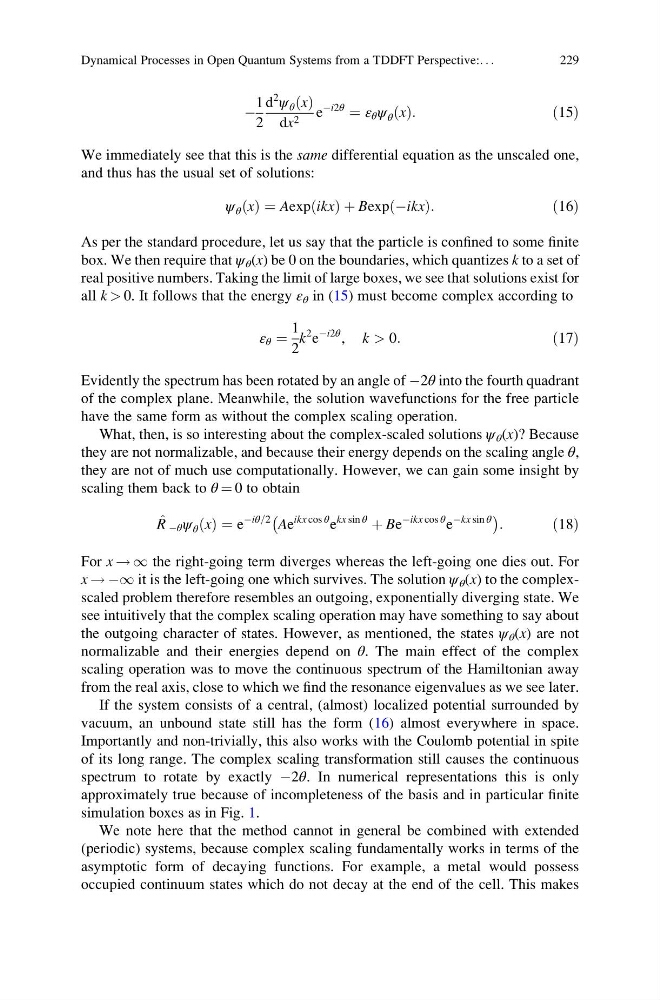
We immediately see that this is the same differential equation as the unscaled one,
and thus has the usual set of solutions:
ψ θ x
ð Þ ¼ Aexp ikx
ð Þ þ Bexp Àikx
ð
Þ:
ð16Þ
As per the standard procedure, let us say that the particle is confined to some finite
box. We then require that ψ θ (x) be 0 on the boundaries, which quantizes k to a set of
real positive numbers. Taking the limit of large boxes, we see that solutions exist for
all k > 0. It follows that the energy ε θ in (15) must become complex according to
ε θ ¼
1
2
k
2 e
Ài2θ , k > 0:
ð17Þ
Evidently the spectrum has been rotated by an angle of À2θ into the fourth quadrant
of the complex plane. Meanwhile, the solution wavefunctions for the free particle
have the same form as without the complex scaling operation.
What, then, is so interesting about the complex-scaled solutions ψ θ (x)? Because
they are not normalizable, and because their energy depends on the scaling angle θ,
they are not of much use computationally. However, we can gain some insight by
scaling them back to θ ¼ 0 to obtain
^
R Àθ ψ θ x
ð Þ ¼ e
Àiθ=2 Ae
ikx cos θ e
kx sin θ
þ Be
Àikx cos θ e
Àkx sin θ
À
Á :
ð18Þ
For x ! 1 the right-going term diverges whereas the left-going one dies out. For
x ! À1 it is the left-going one which survives. The solution ψ θ (x) to the complexscaled problem therefore resembles an outgoing, exponentially diverging state. We
see intuitively that the complex scaling operation may have something to say about
the outgoing character of states. However, as mentioned, the states ψ θ (x) are not
normalizable and their energies depend on θ. The main effect of the complex
scaling operation was to move the continuous spectrum of the Hamiltonian away
from the real axis, close to which we find the resonance eigenvalues as we see later.
If the system consists of a central, (almost) localized potential surrounded by
vacuum, an unbound state still has the form (16) almost everywhere in space.
Importantly and non-trivially, this also works with the Coulomb potential in spite
of its long range. The complex scaling transformation still causes the continuous
spectrum to rotate by exactly À2θ. In numerical representations this is only
approximately true because of incompleteness of the basis and in particular finite
simulation boxes as in Fig. 1.
We note here that the method cannot in general be combined with extended
(periodic) systems, because complex scaling fundamentally works in terms of the
asymptotic form of decaying functions. For example, a metal would possess
occupied continuum states which do not decay at the end of the cell. This makes
Dynamical Processes in Open Quantum Systems from a TDDFT Perspective:. . .
229
1
2
d
2
ψ θ x
ð Þ
dx 2 e
Ài2θ
¼ ε θ ψ θ x
ð Þ:
ð15Þ
We immediately see that this is the same differential equation as the unscaled one,
and thus has the usual set of solutions:
ψ θ x
ð Þ ¼ Aexp ikx
ð Þ þ Bexp Àikx
ð
Þ:
ð16Þ
As per the standard procedure, let us say that the particle is confined to some finite
box. We then require that ψ θ (x) be 0 on the boundaries, which quantizes k to a set of
real positive numbers. Taking the limit of large boxes, we see that solutions exist for
all k > 0. It follows that the energy ε θ in (15) must become complex according to
ε θ ¼
1
2
k
2 e
Ài2θ , k > 0:
ð17Þ
Evidently the spectrum has been rotated by an angle of À2θ into the fourth quadrant
of the complex plane. Meanwhile, the solution wavefunctions for the free particle
have the same form as without the complex scaling operation.
What, then, is so interesting about the complex-scaled solutions ψ θ (x)? Because
they are not normalizable, and because their energy depends on the scaling angle θ,
they are not of much use computationally. However, we can gain some insight by
scaling them back to θ ¼ 0 to obtain
^
R Àθ ψ θ x
ð Þ ¼ e
Àiθ=2 Ae
ikx cos θ e
kx sin θ
þ Be
Àikx cos θ e
Àkx sin θ
À
Á :
ð18Þ
For x ! 1 the right-going term diverges whereas the left-going one dies out. For
x ! À1 it is the left-going one which survives. The solution ψ θ (x) to the complexscaled problem therefore resembles an outgoing, exponentially diverging state. We
see intuitively that the complex scaling operation may have something to say about
the outgoing character of states. However, as mentioned, the states ψ θ (x) are not
normalizable and their energies depend on θ. The main effect of the complex
scaling operation was to move the continuous spectrum of the Hamiltonian away
from the real axis, close to which we find the resonance eigenvalues as we see later.
If the system consists of a central, (almost) localized potential surrounded by
vacuum, an unbound state still has the form (16) almost everywhere in space.
Importantly and non-trivially, this also works with the Coulomb potential in spite
of its long range. The complex scaling transformation still causes the continuous
spectrum to rotate by exactly À2θ. In numerical representations this is only
approximately true because of incompleteness of the basis and in particular finite
simulation boxes as in Fig. 1.
We note here that the method cannot in general be combined with extended
(periodic) systems, because complex scaling fundamentally works in terms of the
asymptotic form of decaying functions. For example, a metal would possess
occupied continuum states which do not decay at the end of the cell. This makes
Dynamical Processes in Open Quantum Systems from a TDDFT Perspective:. . .
229