

figure), and the integrand is analytic and sufficiently localized, then the integral
along the vertical segments is zero. Thus the integral over the diagonal z ¼ xe
iθ is
independent of θ and equal to that along the real line:
ð
Ádx ¼ lim
a!1
ð ae
iθ
Àae iθ
Ádx:
ð9Þ
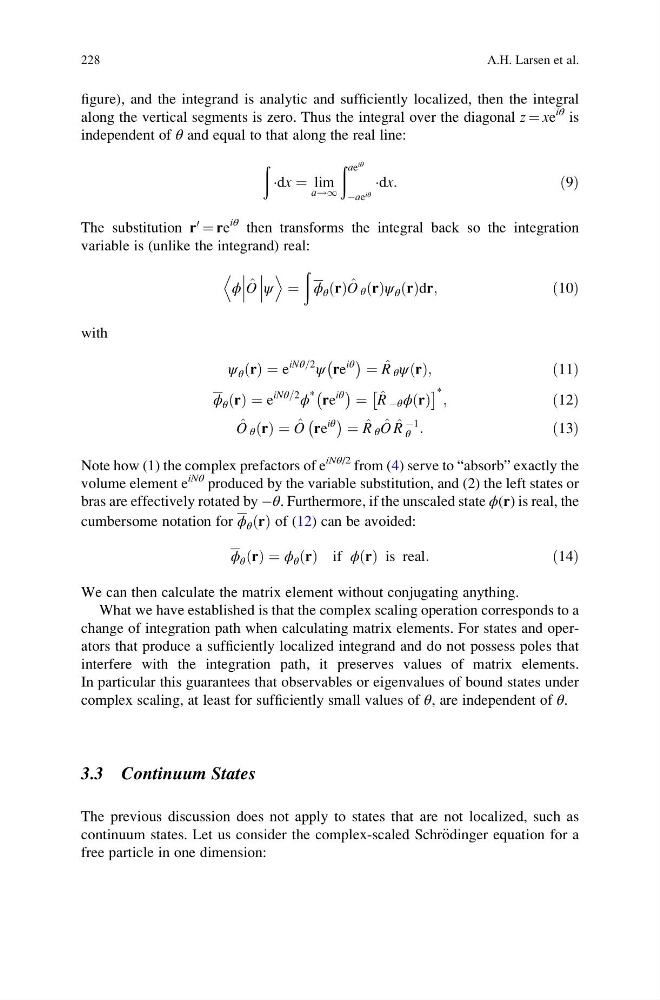
The substitution r
0
¼ re
iθ then transforms the integral back so the integration
variable is (unlike the integrand) real:
ϕ ^
O
ψ
D
E
¼
ð
ϕ θ r
ð Þ ^
O θ r
ð Þψ θ r
ð Þdr;
ð10Þ
with
ψ θ r
ð Þ ¼ e
iNθ=2
ψ re
iθ
À Á ¼ ^
R θ ψ r
ð Þ;
ð11Þ
ϕ θ r
ð Þ ¼ e
iNθ=2
ϕ
* re
iθ
À Á ¼ ^
R Àθ ϕ r
ð Þ
Â
à * ;
ð12Þ
^
O θ r
ð Þ ¼ ^
O re
iθ
À Á ¼ ^
R θ ^
O ^
R
À1
θ :
ð13Þ
Note how (1) the complex prefactors of e
iNθ/2 from (4) serve to “absorb” exactly the
volume element e
iNθ produced by the variable substitution, and (2) the left states or
bras are effectively rotated by Àθ. Furthermore, if the unscaled state ϕ(r) is real, the
cumbersome notation for ϕ θ r
ð Þ of (12) can be avoided:
ϕ θ r
ð Þ ¼ ϕ θ r
ð Þ if ϕ r
ð Þ is real:
ð14Þ
We can then calculate the matrix element without conjugating anything.
What we have established is that the complex scaling operation corresponds to a
change of integration path when calculating matrix elements. For states and operators that produce a sufficiently localized integrand and do not possess poles that
interfere with the integration path, it preserves values of matrix elements.
In particular this guarantees that observables or eigenvalues of bound states under
complex scaling, at least for sufficiently small values of θ, are independent of θ.
3.3 Continuum States
The previous discussion does not apply to states that are not localized, such as
continuum states. Let us consider the complex-scaled Schr€ odinger equation for a
free particle in one dimension:
228
A.H. Larsen et al.
along the vertical segments is zero. Thus the integral over the diagonal z ¼ xe
iθ is
independent of θ and equal to that along the real line:
ð
Ádx ¼ lim
a!1
ð ae
iθ
Àae iθ
Ádx:
ð9Þ
The substitution r
0
¼ re
iθ then transforms the integral back so the integration
variable is (unlike the integrand) real:
ϕ ^
O
ψ
D
E
¼
ð
ϕ θ r
ð Þ ^
O θ r
ð Þψ θ r
ð Þdr;
ð10Þ
with
ψ θ r
ð Þ ¼ e
iNθ=2
ψ re
iθ
À Á ¼ ^
R θ ψ r
ð Þ;
ð11Þ
ϕ θ r
ð Þ ¼ e
iNθ=2
ϕ
* re
iθ
À Á ¼ ^
R Àθ ϕ r
ð Þ
Â
à * ;
ð12Þ
^
O θ r
ð Þ ¼ ^
O re
iθ
À Á ¼ ^
R θ ^
O ^
R
À1
θ :
ð13Þ
Note how (1) the complex prefactors of e
iNθ/2 from (4) serve to “absorb” exactly the
volume element e
iNθ produced by the variable substitution, and (2) the left states or
bras are effectively rotated by Àθ. Furthermore, if the unscaled state ϕ(r) is real, the
cumbersome notation for ϕ θ r
ð Þ of (12) can be avoided:
ϕ θ r
ð Þ ¼ ϕ θ r
ð Þ if ϕ r
ð Þ is real:
ð14Þ
We can then calculate the matrix element without conjugating anything.
What we have established is that the complex scaling operation corresponds to a
change of integration path when calculating matrix elements. For states and operators that produce a sufficiently localized integrand and do not possess poles that
interfere with the integration path, it preserves values of matrix elements.
In particular this guarantees that observables or eigenvalues of bound states under
complex scaling, at least for sufficiently small values of θ, are independent of θ.
3.3 Continuum States
The previous discussion does not apply to states that are not localized, such as
continuum states. Let us consider the complex-scaled Schr€ odinger equation for a
free particle in one dimension:
228
A.H. Larsen et al.