

3.2 Bound States
Suppose ϕ(r) and ψ(r) are square-integrable and reasonably well-behaved states.
We consider first the scaling operation ^
U η ψ(r) ¼ e
Nη/2
ψ(re
η
) where η is a real
number. This operation is easily seen to be unitary; for example it preserves scalar
products:
ϕ ^
U
{
η
^
U η
ψ
D
E
¼
ð
ϕ
* re
η
ð Þψ re
η
ð Þdre
Nη
¼
ð
ϕ
* r
0
ð Þψ r
0
ð Þdr
0
¼
D
ϕ
ψ
E
;
ð7Þ
where we used the substitution r
0
¼ re
η
. A real scaling therefore preserves matrix
elements and eigenvalues.
The derivation of the complex scaling method starts with the unitarity of the real
scaling, then considers the extension to the complex plane of the scaling parameter
η. However, as we see, the situation becomes radically different when the scaling is
complex. In order for the method to be correct, the scaling operation must retain
some property resembling unitarity to make sure that observables do not arbitrarily
change with the scaling parameter. The analytic continuations of functions defined
originally on the real axis are not always within the Hilbert space (hence breaking
unitarity). However, for suitable states and operators, as we see later, the complex
scaling operation corresponds simply to a change of integration path which preserves scalar products. Let us consider a matrix element of some local operator
ϕ ^
O
ψ
D
E
¼
ð
ϕ
* r
ð Þ ^
O r
ð Þψ r
ð Þdr:
ð8Þ
This integral is taken for each coordinate axis over all real numbers À1 to 1.
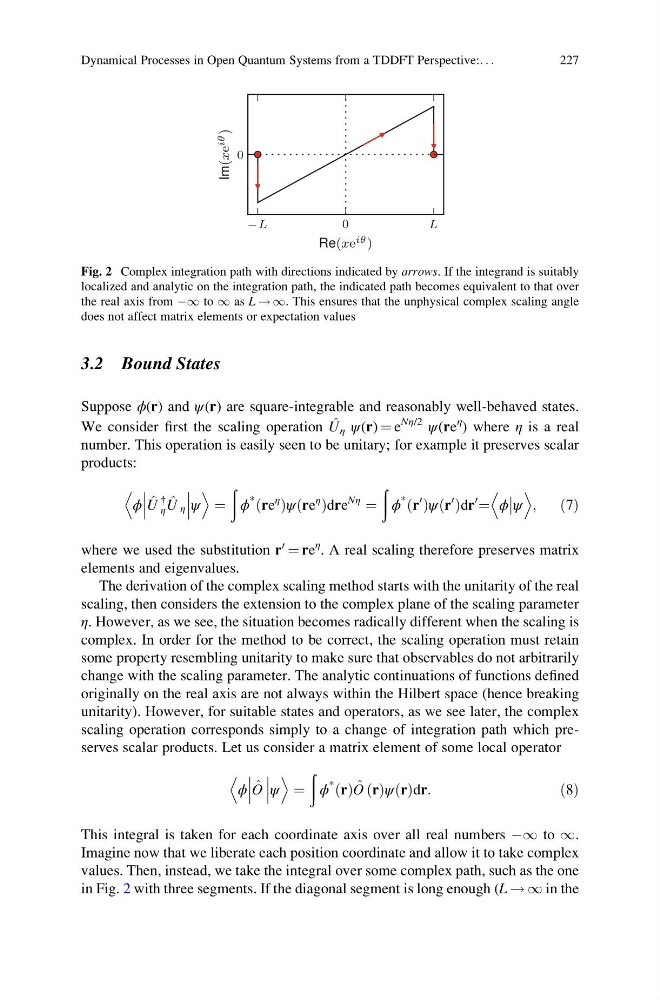
Imagine now that we liberate each position coordinate and allow it to take complex
values. Then, instead, we take the integral over some complex path, such as the one
in Fig. 2 with three segments. If the diagonal segment is long enough (L ! 1 in the
L
0
L
Re(xe iθ )
0
Im(xe iθ
)
Fig. 2 Complex integration path with directions indicated by arrows. If the integrand is suitably
localized and analytic on the integration path, the indicated path becomes equivalent to that over
the real axis from À1 to 1 as L ! 1. This ensures that the unphysical complex scaling angle
does not affect matrix elements or expectation values
Dynamical Processes in Open Quantum Systems from a TDDFT Perspective:. . .
227
Suppose ϕ(r) and ψ(r) are square-integrable and reasonably well-behaved states.
We consider first the scaling operation ^
U η ψ(r) ¼ e
Nη/2
ψ(re
η
) where η is a real
number. This operation is easily seen to be unitary; for example it preserves scalar
products:
ϕ ^
U
{
η
^
U η
ψ
D
E
¼
ð
ϕ
* re
η
ð Þψ re
η
ð Þdre
Nη
¼
ð
ϕ
* r
0
ð Þψ r
0
ð Þdr
0
¼
D
ϕ
ψ
E
;
ð7Þ
where we used the substitution r
0
¼ re
η
. A real scaling therefore preserves matrix
elements and eigenvalues.
The derivation of the complex scaling method starts with the unitarity of the real
scaling, then considers the extension to the complex plane of the scaling parameter
η. However, as we see, the situation becomes radically different when the scaling is
complex. In order for the method to be correct, the scaling operation must retain
some property resembling unitarity to make sure that observables do not arbitrarily
change with the scaling parameter. The analytic continuations of functions defined
originally on the real axis are not always within the Hilbert space (hence breaking
unitarity). However, for suitable states and operators, as we see later, the complex
scaling operation corresponds simply to a change of integration path which preserves scalar products. Let us consider a matrix element of some local operator
ϕ ^
O
ψ
D
E
¼
ð
ϕ
* r
ð Þ ^
O r
ð Þψ r
ð Þdr:
ð8Þ
This integral is taken for each coordinate axis over all real numbers À1 to 1.
Imagine now that we liberate each position coordinate and allow it to take complex
values. Then, instead, we take the integral over some complex path, such as the one
in Fig. 2 with three segments. If the diagonal segment is long enough (L ! 1 in the
L
0
L
Re(xe iθ )
0
Im(xe iθ
)
Fig. 2 Complex integration path with directions indicated by arrows. If the integrand is suitably
localized and analytic on the integration path, the indicated path becomes equivalent to that over
the real axis from À1 to 1 as L ! 1. This ensures that the unphysical complex scaling angle
does not affect matrix elements or expectation values
Dynamical Processes in Open Quantum Systems from a TDDFT Perspective:. . .
227