

initially in its ground stationary state exposed to a time-dependent perturbation.
This is because if the initial state is the ground stationary state, then, according to
the first Hohenberg–Kohn theorem of conventional DFT, Ψ 0 ¼ Ψ 0 ρ
½ and
e
Ψ 0 ¼ e
Ψ 0 ρ
½ .
The simplest and most successful TD-DFA is the TD-DFT adiabatic approximation (AA) which states that the xc-potential reacts instantaneously and without
memory to any temporal change in the time-dependent density,
v
AA
xc ρ
½ 1
ð Þ ¼
δE xc ρ t 1 1
ð Þ
Â
Ã
δρ t 1 1
ð Þ
:
ð10Þ
The notation is a bit subtle here: ρ t 1 1
ð Þ is ρ 1
ð Þ ¼ ρ 1; t 1
ð
Þat a fixed value of time,
meaning that ρ t 1 1
ð Þis uniquely a function of the space and spin coordinates, albeit at
fixed time t 1 . The AA approximation has been remarkably successful and effectively defines conventional TD-DFT.
Going beyond the TD-DFT AA is the subject of ongoing work. Defining new
Jacob’s ladders for TD-DFT may be helpful here. The first attempt to do so was the
definition by one of us (MEC) of a “Jacob’s jungle gym” consisting of parallel
Jacob’s ladders for E xc , v xc (1), f xc 1; 2
ð Þ ¼ δv xc 1
ð Þ=δρ 2
ð Þ, etc. [3]. This permitted
the simultaneous use of different functionals on different ladders on the grounds
that accurate lower derivatives did not necessarily mean accurate higher derivatives. Of course, being able to use a consistent level of approximation across
all ladders could be important for some types of applications (e.g., those involving
analytical derivatives). With this in mind, the authors recently suggested a new
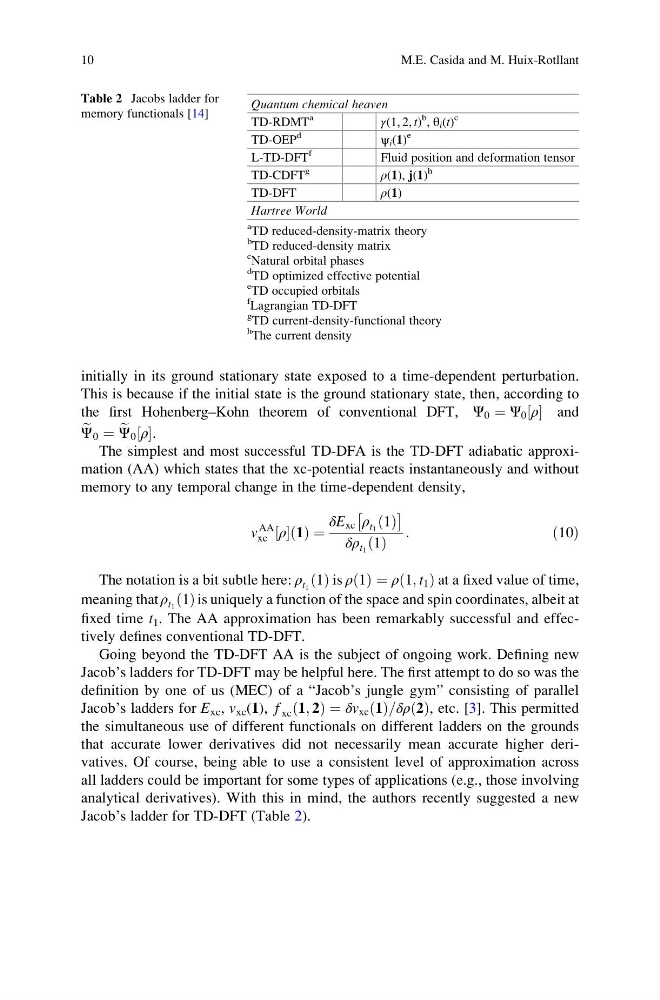
Jacob’s ladder for TD-DFT (Table 2).
Table 2 Jacobs ladder for
memory functionals [14]
Quantum chemical heaven
TD-RDMT
a
γ(1, 2, t)
b
, θ i (t)
c
TD-OEP
d
ψ i (1)
e
L-TD-DFT
f
Fluid position and deformation tensor
TD-CDFT
g
ρ(1), j(1)
h
TD-DFT
ρ(1)
Hartree World
a
TD reduced-density-matrix theory
b
TD reduced-density matrix
c
Natural orbital phases
d
TD optimized effective potential
e
TD occupied orbitals
f
Lagrangian TD-DFT
g
TD current-density-functional theory
h
The current density
10
M.E. Casida and M. Huix-Rotllant
This is because if the initial state is the ground stationary state, then, according to
the first Hohenberg–Kohn theorem of conventional DFT, Ψ 0 ¼ Ψ 0 ρ
½ and
e
Ψ 0 ¼ e
Ψ 0 ρ
½ .
The simplest and most successful TD-DFA is the TD-DFT adiabatic approximation (AA) which states that the xc-potential reacts instantaneously and without
memory to any temporal change in the time-dependent density,
v
AA
xc ρ
½ 1
ð Þ ¼
δE xc ρ t 1 1
ð Þ
Â
Ã
δρ t 1 1
ð Þ
:
ð10Þ
The notation is a bit subtle here: ρ t 1 1
ð Þ is ρ 1
ð Þ ¼ ρ 1; t 1
ð
Þat a fixed value of time,
meaning that ρ t 1 1
ð Þis uniquely a function of the space and spin coordinates, albeit at
fixed time t 1 . The AA approximation has been remarkably successful and effectively defines conventional TD-DFT.
Going beyond the TD-DFT AA is the subject of ongoing work. Defining new
Jacob’s ladders for TD-DFT may be helpful here. The first attempt to do so was the
definition by one of us (MEC) of a “Jacob’s jungle gym” consisting of parallel
Jacob’s ladders for E xc , v xc (1), f xc 1; 2
ð Þ ¼ δv xc 1
ð Þ=δρ 2
ð Þ, etc. [3]. This permitted
the simultaneous use of different functionals on different ladders on the grounds
that accurate lower derivatives did not necessarily mean accurate higher derivatives. Of course, being able to use a consistent level of approximation across
all ladders could be important for some types of applications (e.g., those involving
analytical derivatives). With this in mind, the authors recently suggested a new
Jacob’s ladder for TD-DFT (Table 2).
Table 2 Jacobs ladder for
memory functionals [14]
Quantum chemical heaven
TD-RDMT
a
γ(1, 2, t)
b
, θ i (t)
c
TD-OEP
d
ψ i (1)
e
L-TD-DFT
f
Fluid position and deformation tensor
TD-CDFT
g
ρ(1), j(1)
h
TD-DFT
ρ(1)
Hartree World
a
TD reduced-density-matrix theory
b
TD reduced-density matrix
c
Natural orbital phases
d
TD optimized effective potential
e
TD occupied orbitals
f
Lagrangian TD-DFT
g
TD current-density-functional theory
h
The current density
10
M.E. Casida and M. Huix-Rotllant