

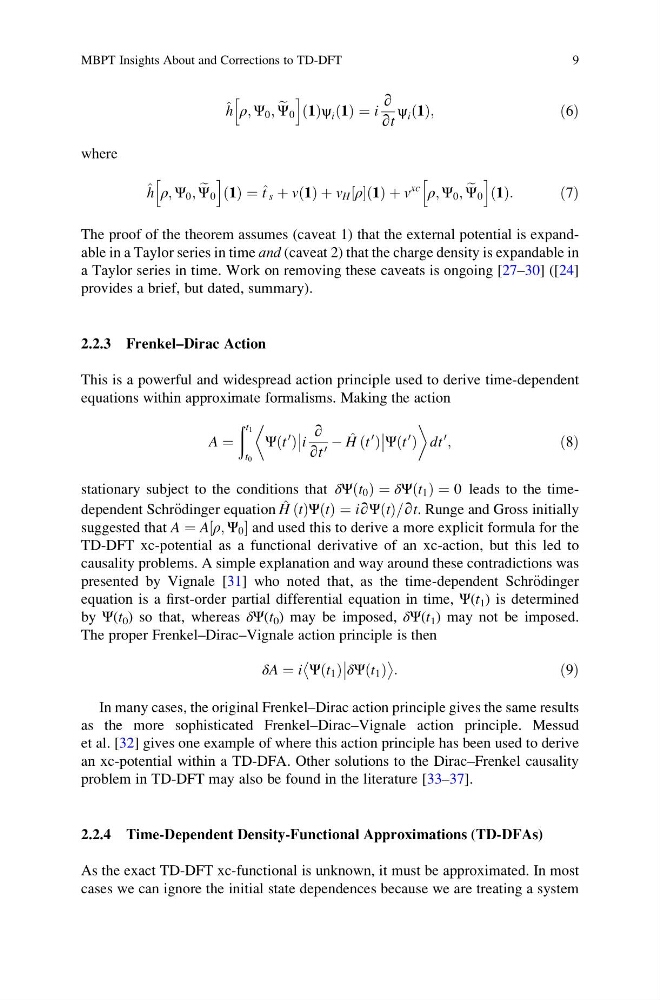
^ h ρ; Ψ 0 ; e
Ψ 0
h
i
1
ð Þψ i 1
ð Þ ¼ i
∂
∂t
ψ i 1
ð Þ;
ð6Þ
where
^ h ρ; Ψ 0 ; e
Ψ 0
h
i
1
ð Þ ¼ ^ t s þ v 1
ð Þ þ v H ρ
½ 1
ð Þ þ v
xc
ρ; Ψ 0 ; e
Ψ 0
h
i
1
ð Þ:
ð7Þ
The proof of the theorem assumes (caveat 1) that the external potential is expandable in a Taylor series in time and (caveat 2) that the charge density is expandable in
a Taylor series in time. Work on removing these caveats is ongoing [27–30] ([24]
provides a brief, but dated, summary).
2.2.3 Frenkel–Dirac Action
This is a powerful and widespread action principle used to derive time-dependent
equations within approximate formalisms. Making the action
A ¼
ð t 1
t 0
Ψ t
0
ð Þ
i
∂
∂t 0 À ^
H t
0
ð Þ
Ψ t
0
ð Þ
(
)
dt
0
;
ð8Þ
stationary subject to the conditions that δΨ t 0
ð Þ ¼ δΨ t 1
ð Þ ¼ 0 leads to the timedependent Schr€ odinger equation ^
H t
ð ÞΨ t
ð Þ ¼ i∂Ψ t
ð Þ=∂t. Runge and Gross initially
suggested that A ¼ A ρ; Ψ 0
½
and used this to derive a more explicit formula for the
TD-DFT xc-potential as a functional derivative of an xc-action, but this led to
causality problems. A simple explanation and way around these contradictions was
presented by Vignale [31] who noted that, as the time-dependent Schr€ odinger
equation is a first-order partial differential equation in time, Ψ(t 1 ) is determined
by Ψ(t 0 ) so that, whereas δΨ(t 0 ) may be imposed, δΨ(t 1 ) may not be imposed.
The proper Frenkel–Dirac–Vignale action principle is then
δA ¼ i Ψ t 1
ð Þ
δΨ t 1
ð Þ
:
ð9Þ
In many cases, the original Frenkel–Dirac action principle gives the same results
as the more sophisticated Frenkel–Dirac–Vignale action principle. Messud
et al. [32] gives one example of where this action principle has been used to derive
an xc-potential within a TD-DFA. Other solutions to the Dirac–Frenkel causality
problem in TD-DFT may also be found in the literature [33–37].
2.2.4 Time-Dependent Density-Functional Approximations (TD-DFAs)
As the exact TD-DFT xc-functional is unknown, it must be approximated. In most
cases we can ignore the initial state dependences because we are treating a system
MBPT Insights About and Corrections to TD-DFT
9
Ψ 0
h
i
1
ð Þψ i 1
ð Þ ¼ i
∂
∂t
ψ i 1
ð Þ;
ð6Þ
where
^ h ρ; Ψ 0 ; e
Ψ 0
h
i
1
ð Þ ¼ ^ t s þ v 1
ð Þ þ v H ρ
½ 1
ð Þ þ v
xc
ρ; Ψ 0 ; e
Ψ 0
h
i
1
ð Þ:
ð7Þ
The proof of the theorem assumes (caveat 1) that the external potential is expandable in a Taylor series in time and (caveat 2) that the charge density is expandable in
a Taylor series in time. Work on removing these caveats is ongoing [27–30] ([24]
provides a brief, but dated, summary).
2.2.3 Frenkel–Dirac Action
This is a powerful and widespread action principle used to derive time-dependent
equations within approximate formalisms. Making the action
A ¼
ð t 1
t 0
Ψ t
0
ð Þ
i
∂
∂t 0 À ^
H t
0
ð Þ
Ψ t
0
ð Þ
(
)
dt
0
;
ð8Þ
stationary subject to the conditions that δΨ t 0
ð Þ ¼ δΨ t 1
ð Þ ¼ 0 leads to the timedependent Schr€ odinger equation ^
H t
ð ÞΨ t
ð Þ ¼ i∂Ψ t
ð Þ=∂t. Runge and Gross initially
suggested that A ¼ A ρ; Ψ 0
½
and used this to derive a more explicit formula for the
TD-DFT xc-potential as a functional derivative of an xc-action, but this led to
causality problems. A simple explanation and way around these contradictions was
presented by Vignale [31] who noted that, as the time-dependent Schr€ odinger
equation is a first-order partial differential equation in time, Ψ(t 1 ) is determined
by Ψ(t 0 ) so that, whereas δΨ(t 0 ) may be imposed, δΨ(t 1 ) may not be imposed.
The proper Frenkel–Dirac–Vignale action principle is then
δA ¼ i Ψ t 1
ð Þ
δΨ t 1
ð Þ
:
ð9Þ
In many cases, the original Frenkel–Dirac action principle gives the same results
as the more sophisticated Frenkel–Dirac–Vignale action principle. Messud
et al. [32] gives one example of where this action principle has been used to derive
an xc-potential within a TD-DFA. Other solutions to the Dirac–Frenkel causality
problem in TD-DFT may also be found in the literature [33–37].
2.2.4 Time-Dependent Density-Functional Approximations (TD-DFAs)
As the exact TD-DFT xc-functional is unknown, it must be approximated. In most
cases we can ignore the initial state dependences because we are treating a system
MBPT Insights About and Corrections to TD-DFT
9