

k n; E g
À
Á ¼ À
αn
β
B n
ð Þ
þ
E
2
g 1 þ E g
À
Á
4πq 2 n B n
ð Þ þ E g
Â
Ã;
ð66Þ
and [136]
B n
ð Þ ¼
1 þ a 1 r
1=2
s
þ a 2 r
3=2
s
3 þ b 1 r
1=2
s
þ b 2 r
3=2
s
:
ð67Þ
Here, r s ¼ [3/(4πn)]
1/3
, ε c is the LDA correlation energy per particle [137], and
α ¼ À0.02552, β ¼ À0.6916, a 1 ¼ 2.15, a 2 ¼ 0.435, b 1 ¼ 1.57, and b 2 ¼ 0.409. The
performance of the JGM kernel is similar to that of the bootstrap kernel for continuum
spectra; unfortunately, it also severely underestimates exciton binding energies.
5.4.9 Some Results
We now present some results for exciton binding energies, obtained using (40), to
demonstrate the performance of several of the xc kernels we have discussed. All
TDDFT calculations are done on top of scissor-corrected [74, 75] LDA band
structures, so that only the excitonic part of the exact xc kernel is approximated
by the functionals that we consider. All calculations include only the head of the xc
coupling matrix K
xc
iak, jkk 0 . Ignoring the wings and the body of the xc coupling matrix
gives an estimated error of less than 5%. Other details specific to our numerical
implementation are described in Yang and Ullrich [19].
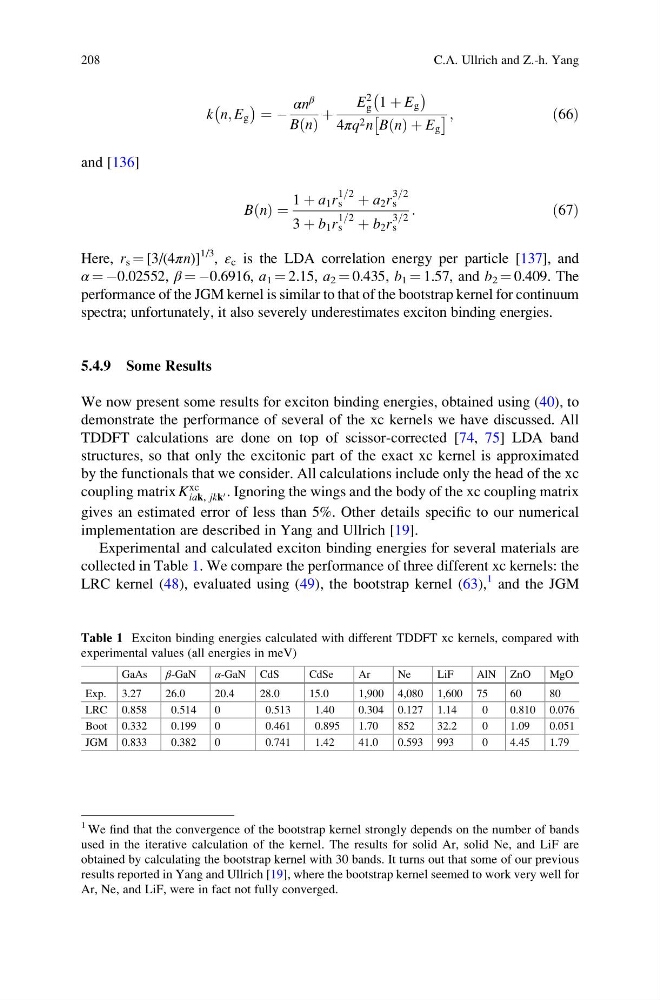
Experimental and calculated exciton binding energies for several materials are
collected in Table 1. We compare the performance of three different xc kernels: the
LRC kernel (48), evaluated using (49), the bootstrap kernel (63),
1 and the JGM
1 We find that the convergence of the bootstrap kernel strongly depends on the number of bands
used in the iterative calculation of the kernel. The results for solid Ar, solid Ne, and LiF are
obtained by calculating the bootstrap kernel with 30 bands. It turns out that some of our previous
results reported in Yang and Ullrich [19], where the bootstrap kernel seemed to work very well for
Ar, Ne, and LiF, were in fact not fully converged.
Table 1 Exciton binding energies calculated with different TDDFT xc kernels, compared with
experimental values (all energies in meV)
GaAs
β-GaN
α-GaN CdS
CdSe
Ar
Ne
LiF
AlN ZnO
MgO
Exp. 3.27
26.0
20.4
28.0
15.0
1,900 4,080 1,600 75
60
80
LRC 0.858
0.514
0
0.513
1.40
0.304 0.127 1.14
0
0.810 0.076
Boot 0.332
0.199
0
0.461
0.895
1.70
852
32.2
0
1.09
0.051
JGM 0.833
0.382
0
0.741
1.42
41.0
0.593 993
0
4.45
1.79
208
C.A. Ullrich and Z.-h. Yang
À
Á ¼ À
αn
β
B n
ð Þ
þ
E
2
g 1 þ E g
À
Á
4πq 2 n B n
ð Þ þ E g
Â
Ã;
ð66Þ
and [136]
B n
ð Þ ¼
1 þ a 1 r
1=2
s
þ a 2 r
3=2
s
3 þ b 1 r
1=2
s
þ b 2 r
3=2
s
:
ð67Þ
Here, r s ¼ [3/(4πn)]
1/3
, ε c is the LDA correlation energy per particle [137], and
α ¼ À0.02552, β ¼ À0.6916, a 1 ¼ 2.15, a 2 ¼ 0.435, b 1 ¼ 1.57, and b 2 ¼ 0.409. The
performance of the JGM kernel is similar to that of the bootstrap kernel for continuum
spectra; unfortunately, it also severely underestimates exciton binding energies.
5.4.9 Some Results
We now present some results for exciton binding energies, obtained using (40), to
demonstrate the performance of several of the xc kernels we have discussed. All
TDDFT calculations are done on top of scissor-corrected [74, 75] LDA band
structures, so that only the excitonic part of the exact xc kernel is approximated
by the functionals that we consider. All calculations include only the head of the xc
coupling matrix K
xc
iak, jkk 0 . Ignoring the wings and the body of the xc coupling matrix
gives an estimated error of less than 5%. Other details specific to our numerical
implementation are described in Yang and Ullrich [19].
Experimental and calculated exciton binding energies for several materials are
collected in Table 1. We compare the performance of three different xc kernels: the
LRC kernel (48), evaluated using (49), the bootstrap kernel (63),
1 and the JGM
1 We find that the convergence of the bootstrap kernel strongly depends on the number of bands
used in the iterative calculation of the kernel. The results for solid Ar, solid Ne, and LiF are
obtained by calculating the bootstrap kernel with 30 bands. It turns out that some of our previous
results reported in Yang and Ullrich [19], where the bootstrap kernel seemed to work very well for
Ar, Ne, and LiF, were in fact not fully converged.
Table 1 Exciton binding energies calculated with different TDDFT xc kernels, compared with
experimental values (all energies in meV)
GaAs
β-GaN
α-GaN CdS
CdSe
Ar
Ne
LiF
AlN ZnO
MgO
Exp. 3.27
26.0
20.4
28.0
15.0
1,900 4,080 1,600 75
60
80
LRC 0.858
0.514
0
0.513
1.40
0.304 0.127 1.14
0
0.810 0.076
Boot 0.332
0.199
0
0.461
0.895
1.70
852
32.2
0
1.09
0.051
JGM 0.833
0.382
0
0.741
1.42
41.0
0.593 993
0
4.45
1.79
208
C.A. Ullrich and Z.-h. Yang