

kernel (64). Except for α-GaN and AlN, all three TDDFT methods produce a bound
exciton; however, the results are quantitatively not very accurate. By and large, the
excitons are significantly underbound, sometimes by up to two to three orders of
magnitude.
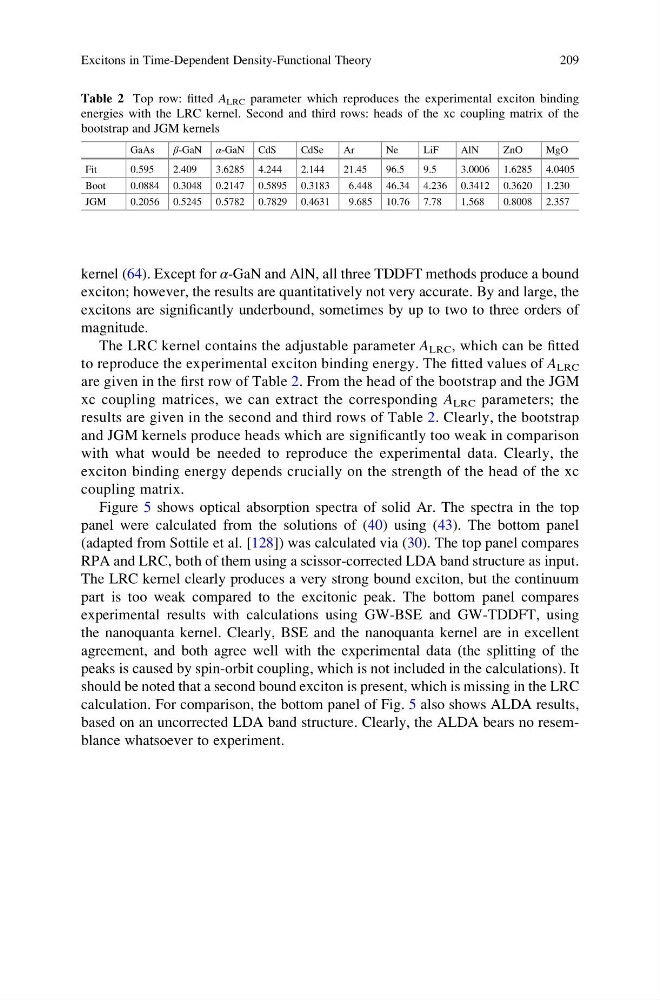
The LRC kernel contains the adjustable parameter A LRC , which can be fitted
to reproduce the experimental exciton binding energy. The fitted values of A LRC
are given in the first row of Table 2. From the head of the bootstrap and the JGM
xc coupling matrices, we can extract the corresponding A LRC parameters; the
results are given in the second and third rows of Table 2. Clearly, the bootstrap
and JGM kernels produce heads which are significantly too weak in comparison
with what would be needed to reproduce the experimental data. Clearly, the
exciton binding energy depends crucially on the strength of the head of the xc
coupling matrix.
Figure 5 shows optical absorption spectra of solid Ar. The spectra in the top
panel were calculated from the solutions of (40) using (43). The bottom panel
(adapted from Sottile et al. [128]) was calculated via (30). The top panel compares
RPA and LRC, both of them using a scissor-corrected LDA band structure as input.
The LRC kernel clearly produces a very strong bound exciton, but the continuum
part is too weak compared to the excitonic peak. The bottom panel compares
experimental results with calculations using GW-BSE and GW-TDDFT, using
the nanoquanta kernel. Clearly, BSE and the nanoquanta kernel are in excellent
agreement, and both agree well with the experimental data (the splitting of the
peaks is caused by spin-orbit coupling, which is not included in the calculations). It
should be noted that a second bound exciton is present, which is missing in the LRC
calculation. For comparison, the bottom panel of Fig. 5 also shows ALDA results,
based on an uncorrected LDA band structure. Clearly, the ALDA bears no resemblance whatsoever to experiment.
Table 2 Top row: fitted A LRC parameter which reproduces the experimental exciton binding
energies with the LRC kernel. Second and third rows: heads of the xc coupling matrix of the
bootstrap and JGM kernels
GaAs
β-GaN α-GaN CdS
CdSe
Ar
Ne
LiF
AlN
ZnO
MgO
Fit
0.595
2.409
3.6285 4.244
2.144
21.45
96.5
9.5
3.0006 1.6285 4.0405
Boot
0.0884 0.3048 0.2147 0.5895 0.3183
6.448 46.34 4.236 0.3412 0.3620 1.230
JGM
0.2056 0.5245 0.5782 0.7829 0.4631
9.685 10.76 7.78
1.568
0.8008 2.357
Excitons in Time-Dependent Density-Functional Theory
209
exciton; however, the results are quantitatively not very accurate. By and large, the
excitons are significantly underbound, sometimes by up to two to three orders of
magnitude.
The LRC kernel contains the adjustable parameter A LRC , which can be fitted
to reproduce the experimental exciton binding energy. The fitted values of A LRC
are given in the first row of Table 2. From the head of the bootstrap and the JGM
xc coupling matrices, we can extract the corresponding A LRC parameters; the
results are given in the second and third rows of Table 2. Clearly, the bootstrap
and JGM kernels produce heads which are significantly too weak in comparison
with what would be needed to reproduce the experimental data. Clearly, the
exciton binding energy depends crucially on the strength of the head of the xc
coupling matrix.
Figure 5 shows optical absorption spectra of solid Ar. The spectra in the top
panel were calculated from the solutions of (40) using (43). The bottom panel
(adapted from Sottile et al. [128]) was calculated via (30). The top panel compares
RPA and LRC, both of them using a scissor-corrected LDA band structure as input.
The LRC kernel clearly produces a very strong bound exciton, but the continuum
part is too weak compared to the excitonic peak. The bottom panel compares
experimental results with calculations using GW-BSE and GW-TDDFT, using
the nanoquanta kernel. Clearly, BSE and the nanoquanta kernel are in excellent
agreement, and both agree well with the experimental data (the splitting of the
peaks is caused by spin-orbit coupling, which is not included in the calculations). It
should be noted that a second bound exciton is present, which is missing in the LRC
calculation. For comparison, the bottom panel of Fig. 5 also shows ALDA results,
based on an uncorrected LDA band structure. Clearly, the ALDA bears no resemblance whatsoever to experiment.
Table 2 Top row: fitted A LRC parameter which reproduces the experimental exciton binding
energies with the LRC kernel. Second and third rows: heads of the xc coupling matrix of the
bootstrap and JGM kernels
GaAs
β-GaN α-GaN CdS
CdSe
Ar
Ne
LiF
AlN
ZnO
MgO
Fit
0.595
2.409
3.6285 4.244
2.144
21.45
96.5
9.5
3.0006 1.6285 4.0405
Boot
0.0884 0.3048 0.2147 0.5895 0.3183
6.448 46.34 4.236 0.3412 0.3620 1.230
JGM
0.2056 0.5245 0.5782 0.7829 0.4631
9.685 10.76 7.78
1.568
0.8008 2.357
Excitons in Time-Dependent Density-Functional Theory
209