

f
boot
xc
q, G, G
0
ð
Þ¼
q
j j
2 δ GG 0 þ v
1=2
G q
ð Þv
1=2
G 0 q
ð Þχðq, G, G
0
Þ
h
i
q þ G
j
jq þ G 0
j
jχ s q; 0; 0
ð
Þ
;
ð63Þ
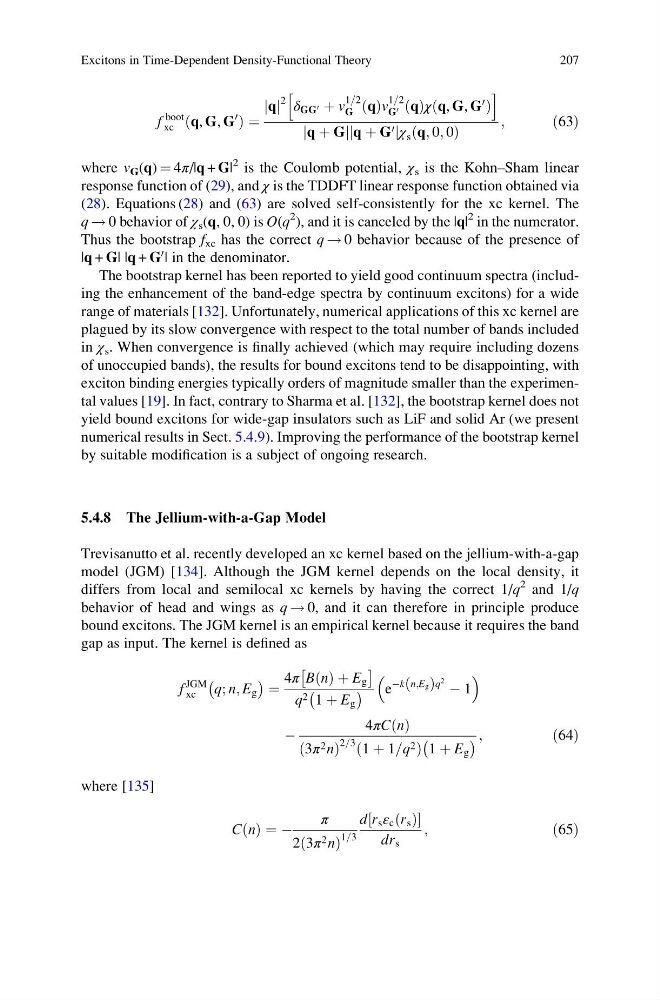
where v G (q) ¼ 4π/|q + G|
2 is the Coulomb potential, χ s is the Kohn–Sham linear
response function of (29), and χ is the TDDFT linear response function obtained via
(28). Equations (28) and (63) are solved self-consistently for the xc kernel. The
q ! 0 behavior of χ s (q, 0, 0) is O(q
2 ), and it is canceled by the |q|
2 in the numerator.
Thus the bootstrap f xc has the correct q ! 0 behavior because of the presence of
|q + G| |q + G
0 | in the denominator.
The bootstrap kernel has been reported to yield good continuum spectra (including the enhancement of the band-edge spectra by continuum excitons) for a wide
range of materials [132]. Unfortunately, numerical applications of this xc kernel are
plagued by its slow convergence with respect to the total number of bands included
in χ s . When convergence is finally achieved (which may require including dozens
of unoccupied bands), the results for bound excitons tend to be disappointing, with
exciton binding energies typically orders of magnitude smaller than the experimental values [19]. In fact, contrary to Sharma et al. [132], the bootstrap kernel does not
yield bound excitons for wide-gap insulators such as LiF and solid Ar (we present
numerical results in Sect. 5.4.9). Improving the performance of the bootstrap kernel
by suitable modification is a subject of ongoing research.
5.4.8 The Jellium-with-a-Gap Model
Trevisanutto et al. recently developed an xc kernel based on the jellium-with-a-gap
model (JGM) [134]. Although the JGM kernel depends on the local density, it
differs from local and semilocal xc kernels by having the correct 1/q
2 and 1/q
behavior of head and wings as q ! 0, and it can therefore in principle produce
bound excitons. The JGM kernel is an empirical kernel because it requires the band
gap as input. The kernel is defined as
f
JGM
xc
q; n; E g
À
Á ¼
4π B n
ð Þ þ E g
Â
Ã
q 2 1 þ E g
À
Á e
Àk n;E g
ð Þq
2 À 1
À
4πC n
ð Þ
3π 2 n
ð
Þ
2=3 1 þ 1=q 2
ð
Þ1 þ E g
À
Á;
ð64Þ
where [135]
C n
ð Þ ¼ À
π
2 3π 2 n
ð
Þ
1=3
d r s ε c r s
ð Þ
½
dr s
;
ð65Þ
Excitons in Time-Dependent Density-Functional Theory
207
boot
xc
q, G, G
0
ð
Þ¼
q
j j
2 δ GG 0 þ v
1=2
G q
ð Þv
1=2
G 0 q
ð Þχðq, G, G
0
Þ
h
i
q þ G
j
jq þ G 0
j
jχ s q; 0; 0
ð
Þ
;
ð63Þ
where v G (q) ¼ 4π/|q + G|
2 is the Coulomb potential, χ s is the Kohn–Sham linear
response function of (29), and χ is the TDDFT linear response function obtained via
(28). Equations (28) and (63) are solved self-consistently for the xc kernel. The
q ! 0 behavior of χ s (q, 0, 0) is O(q
2 ), and it is canceled by the |q|
2 in the numerator.
Thus the bootstrap f xc has the correct q ! 0 behavior because of the presence of
|q + G| |q + G
0 | in the denominator.
The bootstrap kernel has been reported to yield good continuum spectra (including the enhancement of the band-edge spectra by continuum excitons) for a wide
range of materials [132]. Unfortunately, numerical applications of this xc kernel are
plagued by its slow convergence with respect to the total number of bands included
in χ s . When convergence is finally achieved (which may require including dozens
of unoccupied bands), the results for bound excitons tend to be disappointing, with
exciton binding energies typically orders of magnitude smaller than the experimental values [19]. In fact, contrary to Sharma et al. [132], the bootstrap kernel does not
yield bound excitons for wide-gap insulators such as LiF and solid Ar (we present
numerical results in Sect. 5.4.9). Improving the performance of the bootstrap kernel
by suitable modification is a subject of ongoing research.
5.4.8 The Jellium-with-a-Gap Model
Trevisanutto et al. recently developed an xc kernel based on the jellium-with-a-gap
model (JGM) [134]. Although the JGM kernel depends on the local density, it
differs from local and semilocal xc kernels by having the correct 1/q
2 and 1/q
behavior of head and wings as q ! 0, and it can therefore in principle produce
bound excitons. The JGM kernel is an empirical kernel because it requires the band
gap as input. The kernel is defined as
f
JGM
xc
q; n; E g
À
Á ¼
4π B n
ð Þ þ E g
Â
Ã
q 2 1 þ E g
À
Á e
Àk n;E g
ð Þq
2 À 1
À
4πC n
ð Þ
3π 2 n
ð
Þ
2=3 1 þ 1=q 2
ð
Þ1 þ E g
À
Á;
ð64Þ
where [135]
C n
ð Þ ¼ À
π
2 3π 2 n
ð
Þ
1=3
d r s ε c r s
ð Þ
½
dr s
;
ð65Þ
Excitons in Time-Dependent Density-Functional Theory
207