

f
ALDA
xc, GG 0 q
ð Þ ¼
1
V cell
ð
d
3 r e
Ài GÀG
0
ð
Þ Á r d
2 e xc n
ð Þ
dn 2
n¼n 0 r
ð Þ
;
ð45Þ
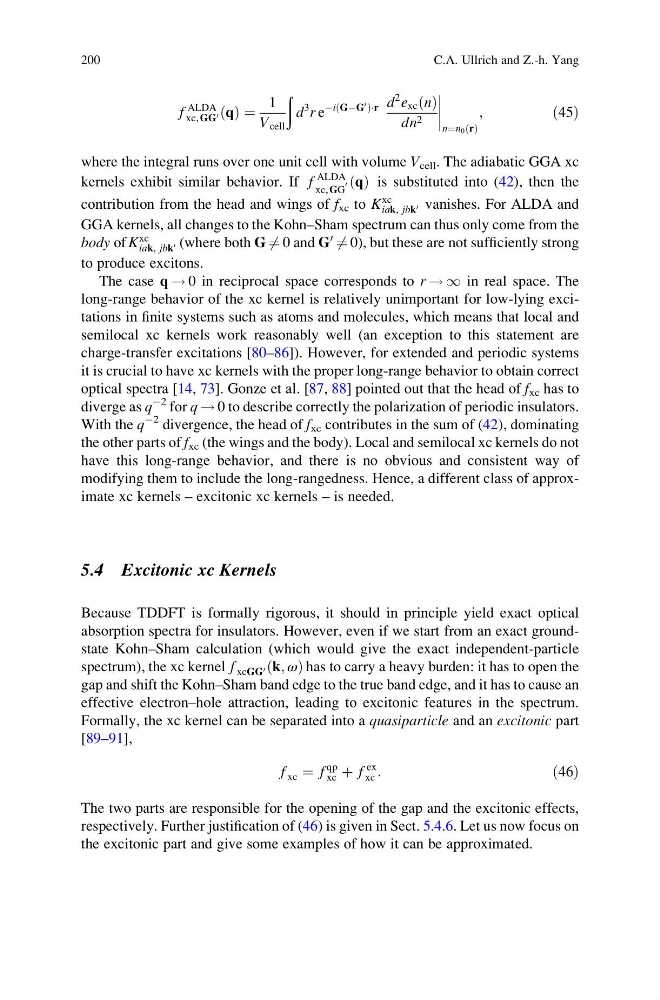
where the integral runs over one unit cell with volume V cell . The adiabatic GGA xc
kernels exhibit similar behavior. If f
ALDA
xc, GG
0 q
ð Þ is substituted into (42), then the
contribution from the head and wings of f xc to K
xc
iak, jbk 0 vanishes. For ALDA and
GGA kernels, all changes to the Kohn–Sham spectrum can thus only come from the
body of K
xc
iak, jbk 0 (where both G 6 ¼ 0 and G
0
6 ¼ 0), but these are not sufficiently strong
to produce excitons.
The case q ! 0 in reciprocal space corresponds to r ! 1 in real space. The
long-range behavior of the xc kernel is relatively unimportant for low-lying excitations in finite systems such as atoms and molecules, which means that local and
semilocal xc kernels work reasonably well (an exception to this statement are
charge-transfer excitations [80–86]). However, for extended and periodic systems
it is crucial to have xc kernels with the proper long-range behavior to obtain correct
optical spectra [14, 73]. Gonze et al. [87, 88] pointed out that the head of f xc has to
diverge as q
À2 for q ! 0 to describe correctly the polarization of periodic insulators.
With the q
À2 divergence, the head of f xc contributes in the sum of (42), dominating
the other parts of f xc (the wings and the body). Local and semilocal xc kernels do not
have this long-range behavior, and there is no obvious and consistent way of
modifying them to include the long-rangedness. Hence, a different class of approximate xc kernels – excitonic xc kernels – is needed.
5.4 Excitonic xc Kernels
Because TDDFT is formally rigorous, it should in principle yield exact optical
absorption spectra for insulators. However, even if we start from an exact groundstate Kohn–Sham calculation (which would give the exact independent-particle
spectrum), the xc kernel f xcGG 0 k; ω
ð
Þhas to carry a heavy burden: it has to open the
gap and shift the Kohn–Sham band edge to the true band edge, and it has to cause an
effective electron–hole attraction, leading to excitonic features in the spectrum.
Formally, the xc kernel can be separated into a quasiparticle and an excitonic part
[89–91],
f xc ¼ f
qp
xc þ f
ex
xc :
ð46Þ
The two parts are responsible for the opening of the gap and the excitonic effects,
respectively. Further justification of (46) is given in Sect. 5.4.6. Let us now focus on
the excitonic part and give some examples of how it can be approximated.
200
C.A. Ullrich and Z.-h. Yang
ALDA
xc, GG 0 q
ð Þ ¼
1
V cell
ð
d
3 r e
Ài GÀG
0
ð
Þ Á r d
2 e xc n
ð Þ
dn 2
n¼n 0 r
ð Þ
;
ð45Þ
where the integral runs over one unit cell with volume V cell . The adiabatic GGA xc
kernels exhibit similar behavior. If f
ALDA
xc, GG
0 q
ð Þ is substituted into (42), then the
contribution from the head and wings of f xc to K
xc
iak, jbk 0 vanishes. For ALDA and
GGA kernels, all changes to the Kohn–Sham spectrum can thus only come from the
body of K
xc
iak, jbk 0 (where both G 6 ¼ 0 and G
0
6 ¼ 0), but these are not sufficiently strong
to produce excitons.
The case q ! 0 in reciprocal space corresponds to r ! 1 in real space. The
long-range behavior of the xc kernel is relatively unimportant for low-lying excitations in finite systems such as atoms and molecules, which means that local and
semilocal xc kernels work reasonably well (an exception to this statement are
charge-transfer excitations [80–86]). However, for extended and periodic systems
it is crucial to have xc kernels with the proper long-range behavior to obtain correct
optical spectra [14, 73]. Gonze et al. [87, 88] pointed out that the head of f xc has to
diverge as q
À2 for q ! 0 to describe correctly the polarization of periodic insulators.
With the q
À2 divergence, the head of f xc contributes in the sum of (42), dominating
the other parts of f xc (the wings and the body). Local and semilocal xc kernels do not
have this long-range behavior, and there is no obvious and consistent way of
modifying them to include the long-rangedness. Hence, a different class of approximate xc kernels – excitonic xc kernels – is needed.
5.4 Excitonic xc Kernels
Because TDDFT is formally rigorous, it should in principle yield exact optical
absorption spectra for insulators. However, even if we start from an exact groundstate Kohn–Sham calculation (which would give the exact independent-particle
spectrum), the xc kernel f xcGG 0 k; ω
ð
Þhas to carry a heavy burden: it has to open the
gap and shift the Kohn–Sham band edge to the true band edge, and it has to cause an
effective electron–hole attraction, leading to excitonic features in the spectrum.
Formally, the xc kernel can be separated into a quasiparticle and an excitonic part
[89–91],
f xc ¼ f
qp
xc þ f
ex
xc :
ð46Þ
The two parts are responsible for the opening of the gap and the excitonic effects,
respectively. Further justification of (46) is given in Sect. 5.4.6. Let us now focus on
the excitonic part and give some examples of how it can be approximated.
200
C.A. Ullrich and Z.-h. Yang