

5.4.1 Contact Exciton
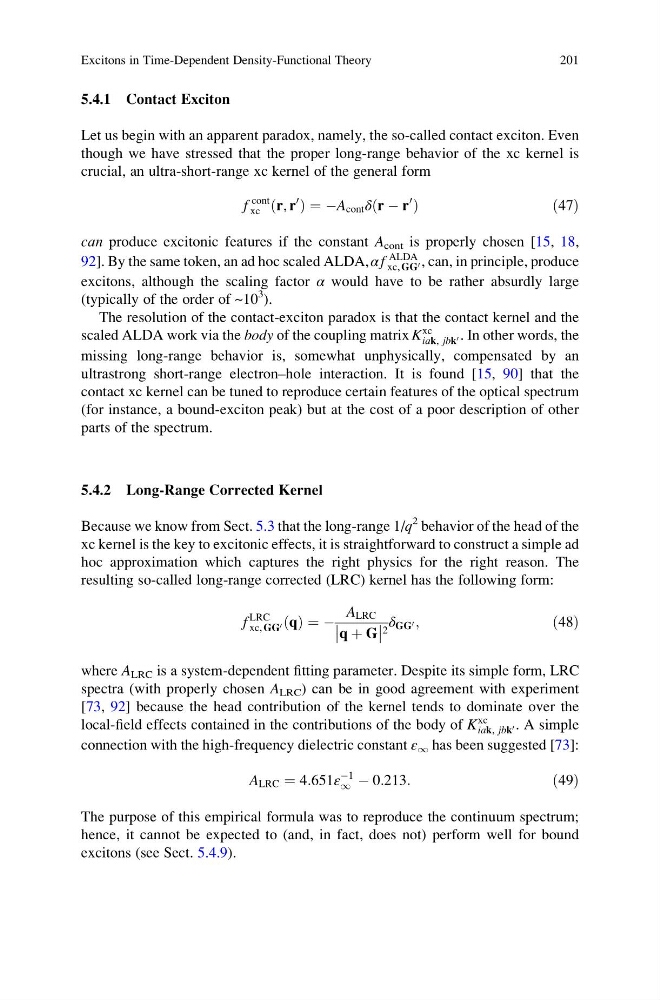
Let us begin with an apparent paradox, namely, the so-called contact exciton. Even
though we have stressed that the proper long-range behavior of the xc kernel is
crucial, an ultra-short-range xc kernel of the general form
f
cont
xc ðr, r
0
Þ ¼ ÀA cont δ r À r
0
ð
Þ
ð47Þ
can produce excitonic features if the constant A cont is properly chosen [15, 18,
92]. By the same token, an ad hoc scaled ALDA, α f
ALDA
xc, GG 0 , can, in principle, produce
excitons, although the scaling factor α would have to be rather absurdly large
(typically of the order of ~10
3 ).
The resolution of the contact-exciton paradox is that the contact kernel and the
scaled ALDA work via the body of the coupling matrix K
xc
iak, jbk 0 . In other words, the
missing long-range behavior is, somewhat unphysically, compensated by an
ultrastrong short-range electron–hole interaction. It is found [15, 90] that the
contact xc kernel can be tuned to reproduce certain features of the optical spectrum
(for instance, a bound-exciton peak) but at the cost of a poor description of other
parts of the spectrum.
5.4.2 Long-Range Corrected Kernel
Because we know from Sect. 5.3 that the long-range 1/q
2 behavior of the head of the
xc kernel is the key to excitonic effects, it is straightforward to construct a simple ad
hoc approximation which captures the right physics for the right reason. The
resulting so-called long-range corrected (LRC) kernel has the following form:
f
LRC
xc, GG 0 q
ð Þ ¼ À
A LRC
q þ G
2 δ GG 0 ;
ð48Þ
where A LRC is a system-dependent fitting parameter. Despite its simple form, LRC
spectra (with properly chosen A LRC ) can be in good agreement with experiment
[73, 92] because the head contribution of the kernel tends to dominate over the
local-field effects contained in the contributions of the body of K
xc
iak, jbk 0 . A simple
connection with the high-frequency dielectric constant ε 1 has been suggested [73]:
A LRC ¼ 4:651ε
À1
1 À 0:213:
ð49Þ
The purpose of this empirical formula was to reproduce the continuum spectrum;
hence, it cannot be expected to (and, in fact, does not) perform well for bound
excitons (see Sect. 5.4.9).
Excitons in Time-Dependent Density-Functional Theory
201
Let us begin with an apparent paradox, namely, the so-called contact exciton. Even
though we have stressed that the proper long-range behavior of the xc kernel is
crucial, an ultra-short-range xc kernel of the general form
f
cont
xc ðr, r
0
Þ ¼ ÀA cont δ r À r
0
ð
Þ
ð47Þ
can produce excitonic features if the constant A cont is properly chosen [15, 18,
92]. By the same token, an ad hoc scaled ALDA, α f
ALDA
xc, GG 0 , can, in principle, produce
excitons, although the scaling factor α would have to be rather absurdly large
(typically of the order of ~10
3 ).
The resolution of the contact-exciton paradox is that the contact kernel and the
scaled ALDA work via the body of the coupling matrix K
xc
iak, jbk 0 . In other words, the
missing long-range behavior is, somewhat unphysically, compensated by an
ultrastrong short-range electron–hole interaction. It is found [15, 90] that the
contact xc kernel can be tuned to reproduce certain features of the optical spectrum
(for instance, a bound-exciton peak) but at the cost of a poor description of other
parts of the spectrum.
5.4.2 Long-Range Corrected Kernel
Because we know from Sect. 5.3 that the long-range 1/q
2 behavior of the head of the
xc kernel is the key to excitonic effects, it is straightforward to construct a simple ad
hoc approximation which captures the right physics for the right reason. The
resulting so-called long-range corrected (LRC) kernel has the following form:
f
LRC
xc, GG 0 q
ð Þ ¼ À
A LRC
q þ G
2 δ GG 0 ;
ð48Þ
where A LRC is a system-dependent fitting parameter. Despite its simple form, LRC
spectra (with properly chosen A LRC ) can be in good agreement with experiment
[73, 92] because the head contribution of the kernel tends to dominate over the
local-field effects contained in the contributions of the body of K
xc
iak, jbk 0 . A simple
connection with the high-frequency dielectric constant ε 1 has been suggested [73]:
A LRC ¼ 4:651ε
À1
1 À 0:213:
ð49Þ
The purpose of this empirical formula was to reproduce the continuum spectrum;
hence, it cannot be expected to (and, in fact, does not) perform well for bound
excitons (see Sect. 5.4.9).
Excitons in Time-Dependent Density-Functional Theory
201