

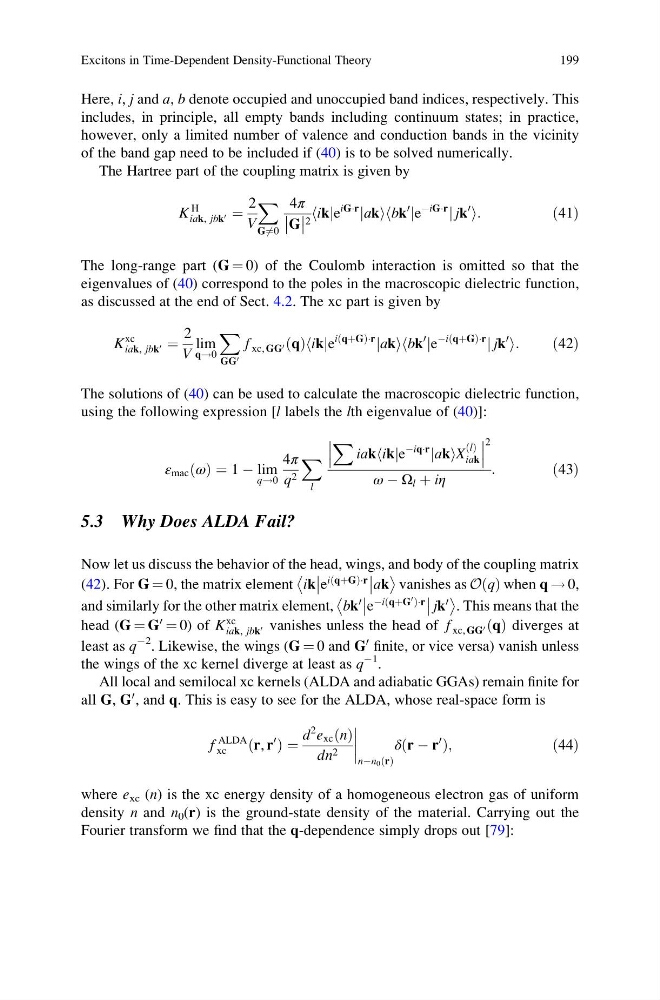
Here, i, j and a, b denote occupied and unoccupied band indices, respectively. This
includes, in principle, all empty bands including continuum states; in practice,
however, only a limited number of valence and conduction bands in the vicinity
of the band gap need to be included if (40) is to be solved numerically.
The Hartree part of the coupling matrix is given by
K
H
iak, jbk 0 ¼
2
V
X
G6 ¼0
4π
G
2 ik
h je
iGÁr ak
j i bk
0
h je
ÀiGÁr jk
0
j i:
ð41Þ
The long-range part (G ¼ 0) of the Coulomb interaction is omitted so that the
eigenvalues of (40) correspond to the poles in the macroscopic dielectric function,
as discussed at the end of Sect. 4.2. The xc part is given by
K
xc
iak, jbk 0 ¼
2
V
lim
q!0
X
GG 0
f xc, GG 0 q
ð Þ ik
h je
i qþG
ð
Þ Ár ak
j i bk
0
h je
Ài qþG
ð
Þ Ár jk
0
j i:
ð42Þ
The solutions of (40) can be used to calculate the macroscopic dielectric function,
using the following expression [l labels the lth eigenvalue of (40)]:
ε mac ω
ð Þ ¼ 1 À lim
q!0
4π
q 2
X
l
X
iak ik
h je
ÀiqÁr ak
j iX
l
ð Þ
iak
2
ω À Ω l þ iη
:
ð43Þ
5.3 Why Does ALDA Fail?
Now let us discuss the behavior of the head, wings, and body of the coupling matrix
(42). For G ¼ 0, the matrix element ik
e
i qþG
ð
Þ Ár
ak
vanishes as O q
ð Þ when q ! 0,
and similarly for the other matrix element, bk
0
e
Ài qþG
0
ð
Þ Á r
jk
0
. This means that the
head (G ¼ G
0
¼ 0) of K
xc
iak, jbk 0 vanishes unless the head of f xc, GG 0 q
ð Þ diverges at
least as q
À2 . Likewise, the wings (G ¼ 0 and G
0 finite, or vice versa) vanish unless
the wings of the xc kernel diverge at least as q
À1 .
All local and semilocal xc kernels (ALDA and adiabatic GGAs) remain finite for
all G, G
0 , and q. This is easy to see for the ALDA, whose real-space form is
f
ALDA
xc
r, r
0
ð
Þ ¼
d
2 e xc n
ð Þ
dn 2
nÀn 0 r
ð Þ
δ r À r
0
ð
Þ;
ð44Þ
where e xc (n) is the xc energy density of a homogeneous electron gas of uniform
density n and n 0 (r) is the ground-state density of the material. Carrying out the
Fourier transform we find that the q-dependence simply drops out [79]:
Excitons in Time-Dependent Density-Functional Theory
199
includes, in principle, all empty bands including continuum states; in practice,
however, only a limited number of valence and conduction bands in the vicinity
of the band gap need to be included if (40) is to be solved numerically.
The Hartree part of the coupling matrix is given by
K
H
iak, jbk 0 ¼
2
V
X
G6 ¼0
4π
G
2 ik
h je
iGÁr ak
j i bk
0
h je
ÀiGÁr jk
0
j i:
ð41Þ
The long-range part (G ¼ 0) of the Coulomb interaction is omitted so that the
eigenvalues of (40) correspond to the poles in the macroscopic dielectric function,
as discussed at the end of Sect. 4.2. The xc part is given by
K
xc
iak, jbk 0 ¼
2
V
lim
q!0
X
GG 0
f xc, GG 0 q
ð Þ ik
h je
i qþG
ð
Þ Ár ak
j i bk
0
h je
Ài qþG
ð
Þ Ár jk
0
j i:
ð42Þ
The solutions of (40) can be used to calculate the macroscopic dielectric function,
using the following expression [l labels the lth eigenvalue of (40)]:
ε mac ω
ð Þ ¼ 1 À lim
q!0
4π
q 2
X
l
X
iak ik
h je
ÀiqÁr ak
j iX
l
ð Þ
iak
2
ω À Ω l þ iη
:
ð43Þ
5.3 Why Does ALDA Fail?
Now let us discuss the behavior of the head, wings, and body of the coupling matrix
(42). For G ¼ 0, the matrix element ik
e
i qþG
ð
Þ Ár
ak
vanishes as O q
ð Þ when q ! 0,
and similarly for the other matrix element, bk
0
e
Ài qþG
0
ð
Þ Á r
jk
0
. This means that the
head (G ¼ G
0
¼ 0) of K
xc
iak, jbk 0 vanishes unless the head of f xc, GG 0 q
ð Þ diverges at
least as q
À2 . Likewise, the wings (G ¼ 0 and G
0 finite, or vice versa) vanish unless
the wings of the xc kernel diverge at least as q
À1 .
All local and semilocal xc kernels (ALDA and adiabatic GGAs) remain finite for
all G, G
0 , and q. This is easy to see for the ALDA, whose real-space form is
f
ALDA
xc
r, r
0
ð
Þ ¼
d
2 e xc n
ð Þ
dn 2
nÀn 0 r
ð Þ
δ r À r
0
ð
Þ;
ð44Þ
where e xc (n) is the xc energy density of a homogeneous electron gas of uniform
density n and n 0 (r) is the ground-state density of the material. Carrying out the
Fourier transform we find that the q-dependence simply drops out [79]:
Excitons in Time-Dependent Density-Functional Theory
199