

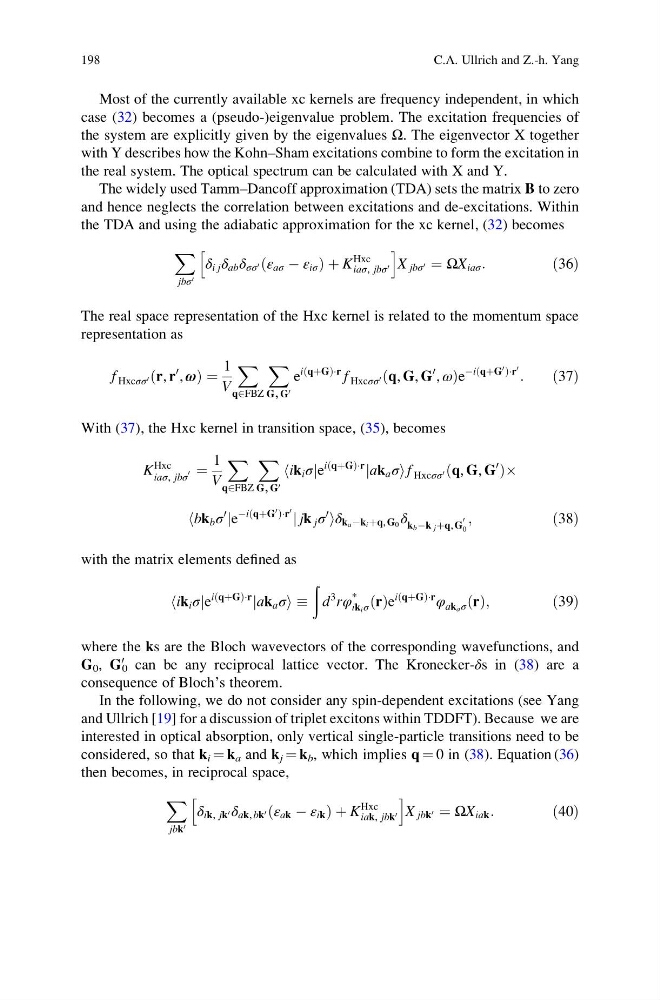
Most of the currently available xc kernels are frequency independent, in which
case (32) becomes a (pseudo-)eigenvalue problem. The excitation frequencies of
the system are explicitly given by the eigenvalues Ω. The eigenvector X together
with Y describes how the Kohn–Sham excitations combine to form the excitation in
the real system. The optical spectrum can be calculated with X and Y.
The widely used Tamm–Dancoff approximation (TDA) sets the matrix B to zero
and hence neglects the correlation between excitations and de-excitations. Within
the TDA and using the adiabatic approximation for the xc kernel, (32) becomes
X
jbσ 0
δ i j δ ab δ σσ 0 ε aσ À ε iσ
ð
ÞþK
Hxc
iaσ, jbσ 0
h
i
X jbσ 0 ¼ ΩX iaσ :
ð36Þ
The real space representation of the Hxc kernel is related to the momentum space
representation as
f Hxcσσ 0 r, r
0 , ω
ð
Þ¼
1
V
X
q2FBZ
X
G, G 0
e
i qþG
ð
Þ Ár f Hxcσσ 0 ðq, G, G
0 , ωÞe
Ài qþG
0
ð
Þ Á r
0 :
ð37Þ
With (37), the Hxc kernel in transition space, (35), becomes
K
Hxc
iaσ, jbσ
0 ¼
1
V
X
q2FBZ
X
G, G 0
ik i σ
h
je
i qþG
ð
Þ Ár ak a σ
j
if Hxcσσ 0 ðq, G, G
0
ÞÂ
bk b σ
0
h
je
Ài qþG
0
ð
Þ Á r
0 j jk j σ
0
iδ k a Àk i þq, G 0 δ k b Àk j þq, G
0
0
;
ð38Þ
with the matrix elements defined as
ik i σ
h
je
i qþG
ð
Þ Ár ak a σ
j
i
ð
d
3 rφ
*
ik i σ r
ð Þe
i qþG
ð
Þ Ár
φ ak a σ r
ð Þ;
ð39Þ
where the ks are the Bloch wavevectors of the corresponding wavefunctions, and
G 0 , G
0
0 can be any reciprocal lattice vector. The Kronecker-δs in (38) are a
consequence of Bloch’s theorem.
In the following, we do not consider any spin-dependent excitations (see Yang
and Ullrich [19] for a discussion of triplet excitons within TDDFT). Because we are
interested in optical absorption, only vertical single-particle transitions need to be
considered, so that k i ¼ k a and k j ¼ k b , which implies q ¼ 0 in (38). Equation (36)
then becomes, in reciprocal space,
X
jbk 0
δ ik, jk 0 δ ak, bk 0 ε ak À ε ik
ð
ÞþK
Hxc
iak, jbk 0
h
i
X jbk 0 ¼ ΩX iak :
ð40Þ
198
C.A. Ullrich and Z.-h. Yang
case (32) becomes a (pseudo-)eigenvalue problem. The excitation frequencies of
the system are explicitly given by the eigenvalues Ω. The eigenvector X together
with Y describes how the Kohn–Sham excitations combine to form the excitation in
the real system. The optical spectrum can be calculated with X and Y.
The widely used Tamm–Dancoff approximation (TDA) sets the matrix B to zero
and hence neglects the correlation between excitations and de-excitations. Within
the TDA and using the adiabatic approximation for the xc kernel, (32) becomes
X
jbσ 0
δ i j δ ab δ σσ 0 ε aσ À ε iσ
ð
ÞþK
Hxc
iaσ, jbσ 0
h
i
X jbσ 0 ¼ ΩX iaσ :
ð36Þ
The real space representation of the Hxc kernel is related to the momentum space
representation as
f Hxcσσ 0 r, r
0 , ω
ð
Þ¼
1
V
X
q2FBZ
X
G, G 0
e
i qþG
ð
Þ Ár f Hxcσσ 0 ðq, G, G
0 , ωÞe
Ài qþG
0
ð
Þ Á r
0 :
ð37Þ
With (37), the Hxc kernel in transition space, (35), becomes
K
Hxc
iaσ, jbσ
0 ¼
1
V
X
q2FBZ
X
G, G 0
ik i σ
h
je
i qþG
ð
Þ Ár ak a σ
j
if Hxcσσ 0 ðq, G, G
0
ÞÂ
bk b σ
0
h
je
Ài qþG
0
ð
Þ Á r
0 j jk j σ
0
iδ k a Àk i þq, G 0 δ k b Àk j þq, G
0
0
;
ð38Þ
with the matrix elements defined as
ik i σ
h
je
i qþG
ð
Þ Ár ak a σ
j
i
ð
d
3 rφ
*
ik i σ r
ð Þe
i qþG
ð
Þ Ár
φ ak a σ r
ð Þ;
ð39Þ
where the ks are the Bloch wavevectors of the corresponding wavefunctions, and
G 0 , G
0
0 can be any reciprocal lattice vector. The Kronecker-δs in (38) are a
consequence of Bloch’s theorem.
In the following, we do not consider any spin-dependent excitations (see Yang
and Ullrich [19] for a discussion of triplet excitons within TDDFT). Because we are
interested in optical absorption, only vertical single-particle transitions need to be
considered, so that k i ¼ k a and k j ¼ k b , which implies q ¼ 0 in (38). Equation (36)
then becomes, in reciprocal space,
X
jbk 0
δ ik, jk 0 δ ak, bk 0 ε ak À ε ik
ð
ÞþK
Hxc
iak, jbk 0
h
i
X jbk 0 ¼ ΩX iak :
ð40Þ
198
C.A. Ullrich and Z.-h. Yang